LinkedIn Ads · B2B Lead Generation
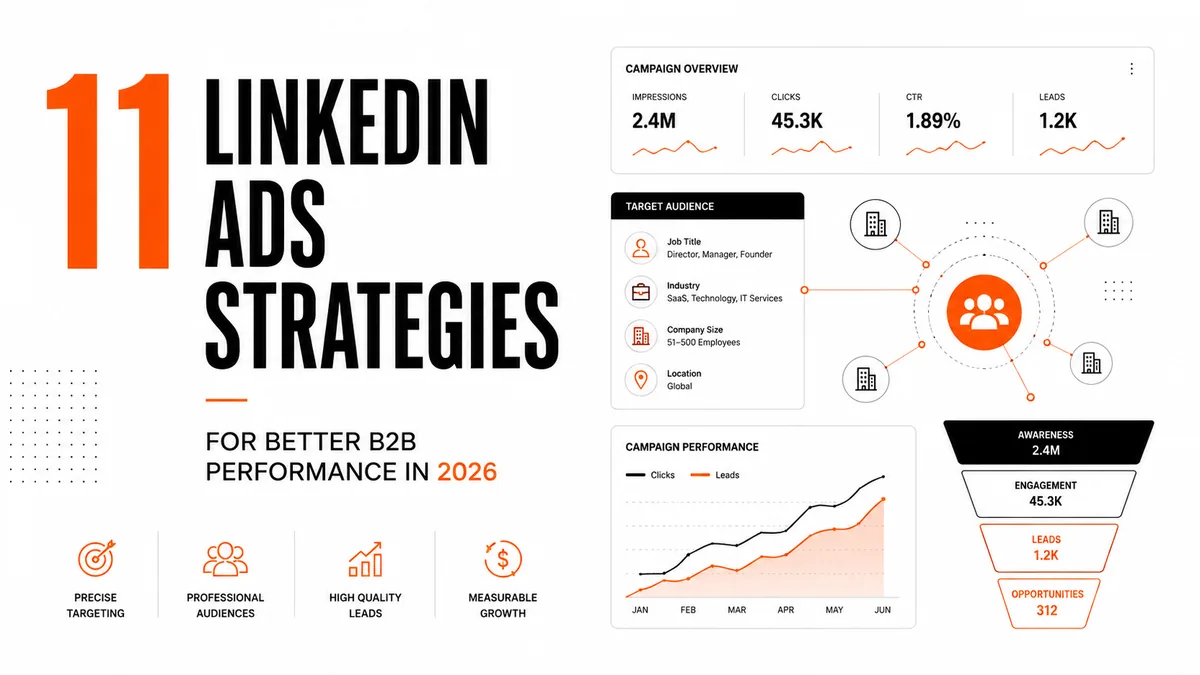
11 LinkedIn Ads Strategies to Improve B2B Lead Generation and Campaign Performance in 2026
Targeting is only the starting point. Campaign settings, bidding, placements, creative and the conversion journey decide whether B2B LinkedIn Ads produce qualified pipeline or just cheap leads.
Introduction
LinkedIn Ads can be one of the most useful advertising channels for B2B businesses. Unlike many other platforms, LinkedIn allows advertisers to target people using professional information such as job titles, seniority, company size, industry and skills. This can make it easier to reach relevant decision-makers.
But simply having access to good targeting does not guarantee good results.
Many businesses launch campaigns, follow the default recommendations inside Campaign Manager and then wonder why their costs are high or why the leads are not converting. The problem is often not just the ad. Campaign settings, audience targeting, bidding, placements, creative and the overall conversion journey can all affect performance.
As a LinkedIn Ads expert and performance marketer, I believe LinkedIn advertising should not be looked at only from the perspective of impressions, clicks or even cost per lead. For B2B businesses, SaaS companies and companies looking for better lead generation, the bigger question is: are the campaigns bringing the right people into the business?
Whether you are managing campaigns yourself, working with a LinkedIn Ads agency, a LinkedIn advertising agency, a B2B marketing agency or looking for LinkedIn marketing services, understanding how these settings and strategies work is important. You can see how this plays out on real accounts in my B2B growth stories.
In this article, I will break down 11 LinkedIn Ads strategies and best practices that can help improve B2B LinkedIn Ads, lead generation and overall advertising performance.
1. Review every LinkedIn Ads setting before you launch
One of the biggest mistakes in LinkedIn advertising is assuming that every default setting is automatically the best option.
LinkedIn Campaign Manager provides recommendations and enables certain settings by default. However, those recommendations may not always match the specific objective of your campaign. For example, some settings may help increase delivery, but your actual goal may be to maintain better targeting control or generate more qualified B2B leads.
Before launching a campaign, take the time to review every important setting. Look at:
- Audience targeting
- Audience expansion
- Ad placements
- Location targeting
- Bidding
- Optimisation settings
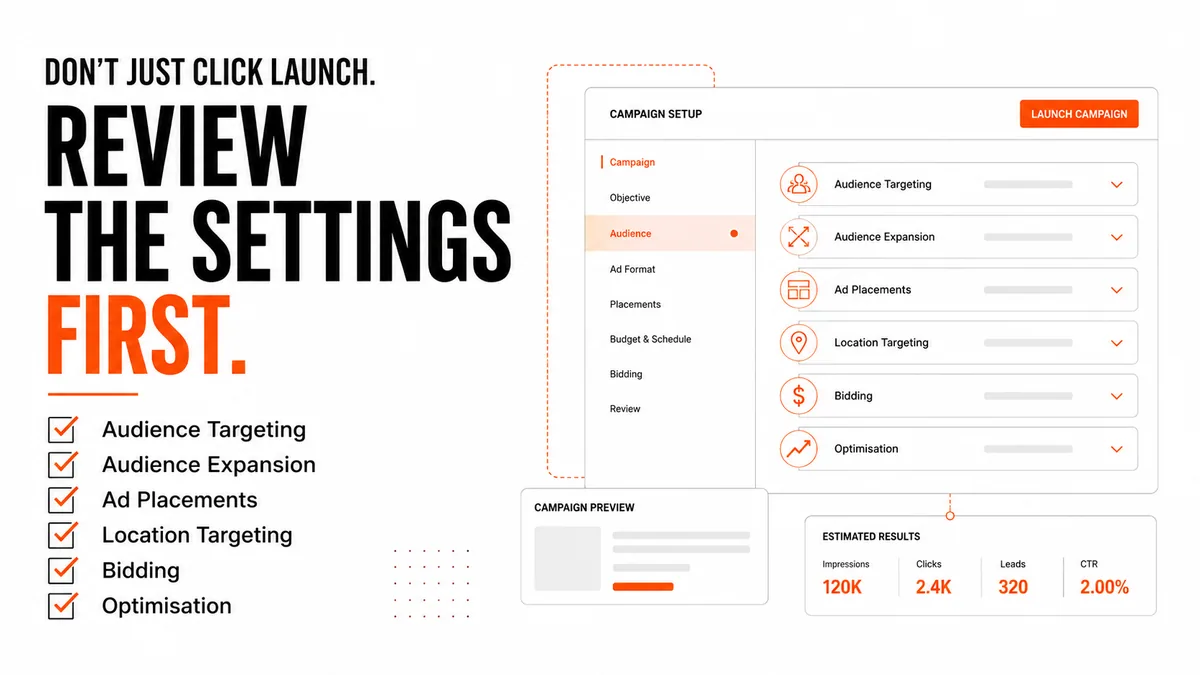
Small changes in campaign setup can affect how your ads are delivered and how efficiently your budget is spent. A good LinkedIn marketer should not simply accept every platform recommendation. The settings should support the actual business goal.
This is especially important for businesses investing in LinkedIn B2B marketing, where lead quality can matter much more than simply generating a high volume of leads.
2. Do not automatically rely on audience expansion
Audience Expansion allows LinkedIn to reach people outside the audience you manually selected. LinkedIn may use this feature to find additional people who it believes could be relevant. This may increase reach and delivery.
However, if you have carefully created an audience using job titles, seniority, industry or company characteristics, you should understand that audience expansion can reduce some of that control.
This does not mean Audience Expansion should never be used. The better approach is to test it separately. For example, you could have one campaign targeting your manually selected audience and another campaign testing a broader or expanded audience. This allows you to compare performance.
Instead of looking only at:
- Clicks
- CTR
- CPC
- Cost per lead
Also look at whether the leads are actually qualified.
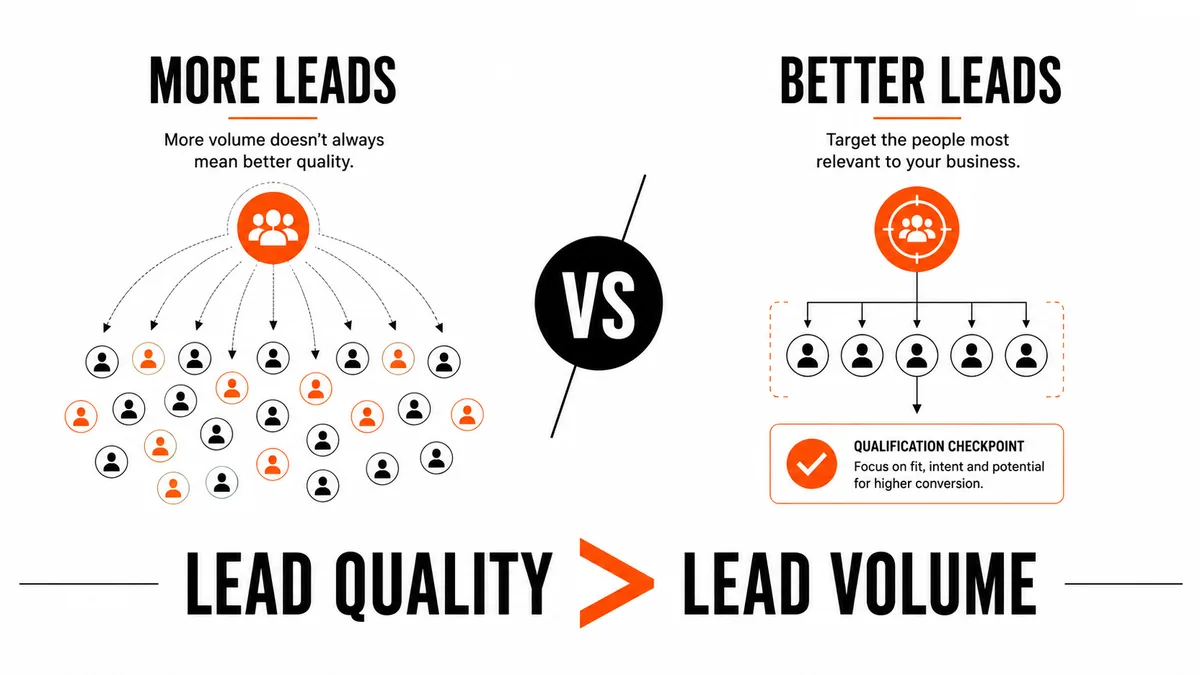
For B2B lead generation, generating more leads is not always the same as generating better leads.
A B2B lead generation agency, LinkedIn Ads agency or internal marketing team should understand the difference. The goal should not simply be more form submissions. The goal should be to generate leads that are relevant to the business. The Billoxy B2B SaaS lead generation campaign is a practical example of optimising towards relevant leads rather than raw volume.
3. Test the LinkedIn Audience Network separately
The LinkedIn Audience Network allows advertisers to extend their ads beyond LinkedIn to third-party websites and mobile apps. This can increase delivery and reach.
However, if your priority is generating qualified B2B leads, it is important to understand whether the traffic and leads from those placements are as valuable as the results coming directly from LinkedIn.
Rather than combining everything into one campaign and assuming the overall result tells the complete story, testing separately can provide a clearer comparison. You can then analyse:
- Cost per click
- Cost per lead
- Lead quality
- Qualified lead rate
The cheapest source of leads is not necessarily the best source of leads.
This is an important part of performance-based advertising. A campaign should not be judged only by the lowest CPL. The quality of the leads also matters. For businesses working with a LinkedIn advertising agency or B2B advertising agency, this is an important distinction when analysing campaign performance.
4. Use location targeting that matches your actual market
Location targeting is another important setting that can easily be overlooked. LinkedIn gives advertisers different options for defining location-based audiences.
For many B2B campaigns, the goal is to reach people who are actually part of the market you are targeting. If you are targeting a specific country or market, review the location settings carefully and select the option that best matches your campaign requirements.
The goal is not to make the audience unnecessarily complicated. The goal is to make sure the people seeing the ads are relevant to your business.
Better targeting does not always mean adding more filters. Sometimes it simply means removing unnecessary people from the audience.
For a LinkedIn Ads expert or LinkedIn marketer, understanding audience relevance is a major part of building an effective LinkedIn advertising strategy.
5. Understand your bidding before choosing Maximum Delivery
Maximum Delivery is one of the commonly used bidding approaches on LinkedIn. It can be useful in certain situations, but it may not always be the most cost-efficient approach for every campaign.
Manual CPC can provide more control over how much you are willing to pay for clicks. Instead of allowing LinkedIn to determine how aggressively it should bid, you can define your own bid.
The important point is not that every campaign should always use Manual CPC. The important point is understanding what your bidding strategy is doing. Before selecting a bidding approach, ask what you are trying to optimise for. Are you focused on:
- Traffic
- Delivery
- Leads
- Cost control
Your bidding strategy should match the actual campaign objective. This is an important part of working as a performance marketing expert. Advertising performance is not just about launching campaigns. It is about understanding how the decisions inside those campaigns affect costs and results.
6. Do not assume the recommended bid is the right bid
When you select Manual CPC, LinkedIn provides a recommended bidding range. Many advertisers assume that this is the amount they need to pay. That may not always be the case.
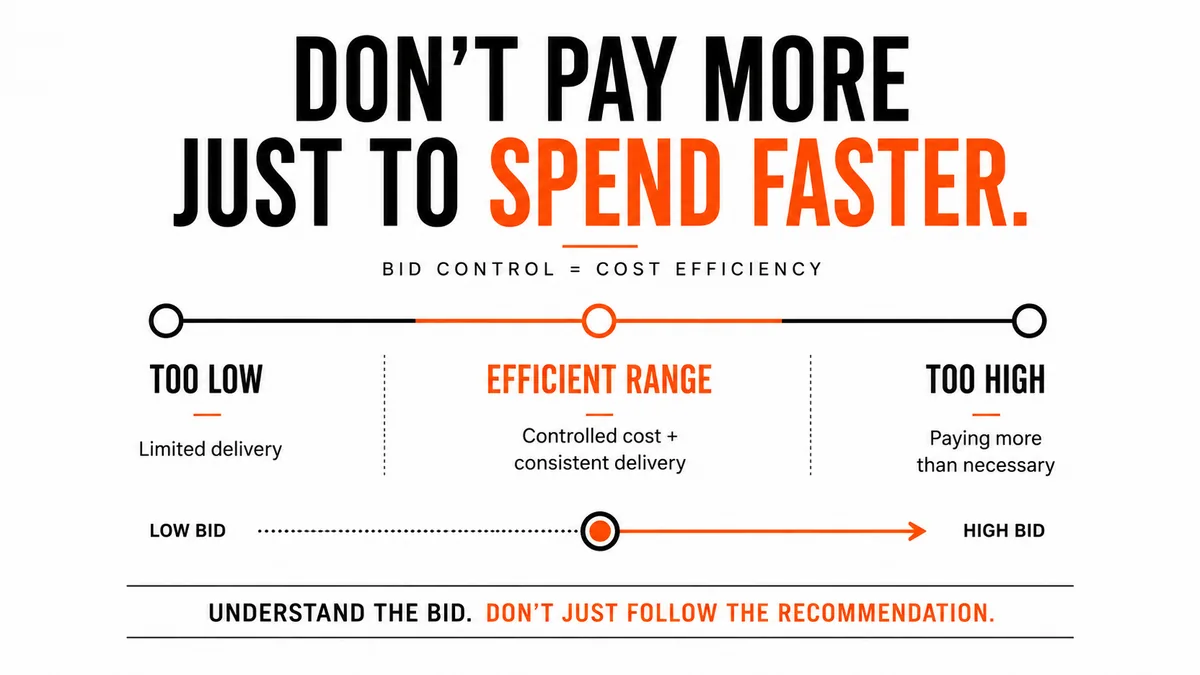
Instead of automatically starting with the recommended bid, you can begin with a more conservative bid and gradually increase it if necessary to achieve consistent delivery. If your campaign is spending properly and generating the required delivery, there may be no reason to immediately increase your bid.
The objective is not simply to spend the budget. The objective is to spend efficiently.
This is where performance-based advertising requires more than simply following the platform recommendations. You need to understand what you are paying for and whether the cost is justified by the result.
7. Allow stronger LinkedIn Ads to get more delivery
Not every default setting inside LinkedIn Campaign Manager is necessarily something that should be changed. One setting that can be useful is allowing LinkedIn to optimise towards stronger-performing ads.
Some advertisers prefer to rotate ads evenly because they want every creative to receive the same exposure. However, this can also mean continuing to spend money on ads that are performing worse.
If the objective is campaign performance, allowing LinkedIn to favour stronger ads can help the platform identify and deliver the ads that are working better. However, this should not be confused with structured creative testing. If you are specifically trying to compare different creatives, you need to understand that testing and performance optimisation are not exactly the same thing.
A good LinkedIn Ads agency or LinkedIn marketer should understand the difference between testing to learn and optimising for performance.
8. Do not ask a cold B2B audience to book a meeting immediately
One of the biggest mistakes in LinkedIn B2B marketing is asking people to take a major action immediately after they discover your brand. For example, someone sees your company for the first time. They do not know who you are. They may not understand what you offer. They have not seen any proof. And the first thing they see is: Book a Demo.
The person may perfectly match your target audience and still not be ready to speak with your sales team.
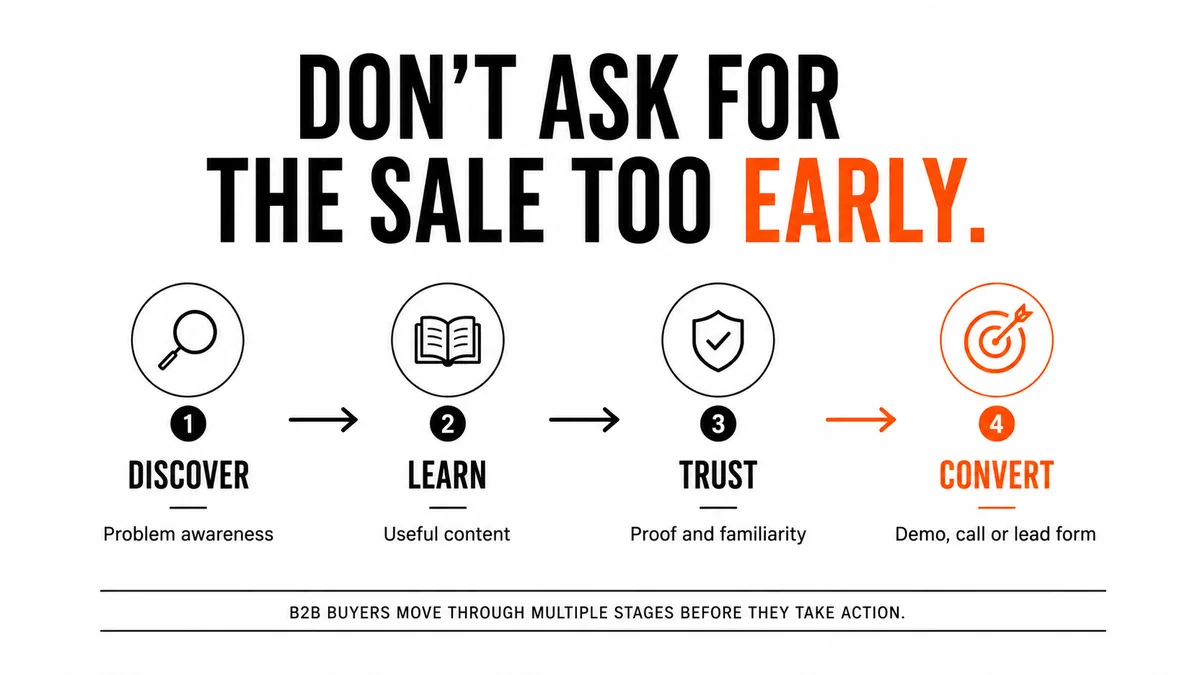
Instead, LinkedIn advertising can be used as part of a larger journey. First, help people understand a problem. Then provide useful information and build trust. You can use:
- Educational content
- Thought leadership
- Customer stories
- Helpful resources
After people have interacted with your brand, retargeting can be used to present a higher-commitment offer. This can eventually lead to demo requests, sales conversations and lead forms.
For a B2B SaaS marketing agency, SaaS marketing agency or B2B business, this can be particularly relevant because the buying process may involve more than one interaction. The Poket Pos B2B SaaS pipeline campaign is one example of a staged journey rather than a single conversion ask.
The strongest B2B lead generation strategy may not always be about immediately generating a lead. Sometimes the audience needs to build familiarity and trust first.
9. Useful videos can be more effective than expensive videos
Many businesses assume that better production automatically means better advertising performance. That is not always true.
A highly produced corporate video may look impressive but still fail to provide the audience with something useful. On the other hand, a knowledgeable person speaking directly to the camera and explaining a relevant problem can sometimes be more effective.
The focus should be on usefulness. For LinkedIn content and LinkedIn advertising, people often want to learn something relevant to their work or business. Instead of focusing only on expensive production, focus on:
- A useful message
- A relevant problem
- Clear communication
- Practical information
For LinkedIn marketing services, content and advertising should focus on whether the message is useful to the audience, not simply whether the production looks expensive. This principle also carried through the Future Learning education campaign, where useful content did the heavy lifting. Authenticity and useful information can be more important than unnecessary complexity.
10. Build smarter B2B audiences instead of one large audience
Audience size matters, but bigger is not always better. A very small audience may struggle to generate enough activity. A very large audience can make it difficult to understand exactly what is working.
For example, imagine targeting:
- Founders
- CEOs
- Marketing Managers
- Sales Directors
- Multiple industries
- Different company sizes
If the campaign performs well, you may not know exactly which part of the audience is responsible for the performance.
Instead of putting everyone into one campaign, consider segmenting audiences based on meaningful differences.
By seniority
Founder, manager or director.
By company size
Different company size segments.
By industry
Separate industries into different audience groups.
This can help you understand which audiences respond better. You are not only generating campaign results. You are also learning more about the market. That information can help improve future LinkedIn Ads, B2B advertising and marketing decisions.
For B2B marketing companies, SaaS businesses and performance marketing teams, this type of audience learning can become valuable over time.
11. Give your LinkedIn Ads campaign enough budget to learn
LinkedIn is generally considered a premium advertising platform. That means campaigns need enough budget to generate useful data. If the budget is too limited, campaigns may end before you have enough information to understand what is actually working.
You may not have enough data to confidently decide:
- Which audience performs better
- Which creative is stronger
- Whether your offer is working
- Whether your lead quality is improving
This does not mean every business needs to spend more. The goal is to spend enough to learn something meaningful.
If the budget is limited, it may make more sense to simplify the campaign structure. Instead of testing too many audiences and creatives at the same time, focus on fewer variables. This can provide clearer information and make optimisation easier.
A performance marketing expert, LinkedIn marketer or LinkedIn Ads agency should understand that limited budgets also limit how quickly meaningful conclusions can be made. The goal is not just to spend. The goal is to learn and optimise based on the available data.
Build trust before you ask for the sale
The best LinkedIn advertising strategy is not always based on asking every person to convert immediately. For many B2B businesses, the journey may look more like this:
Discover → Learn → Trust → Convert
People may first need to recognise your brand. Then understand your expertise. Then see useful information or proof. Only after that may they be ready to speak with sales.
This is why LinkedIn marketing, B2B lead generation and performance marketing should not always be viewed as isolated campaigns. The campaign is one part of the overall journey.
For a B2B marketing agency, B2B advertising agency, SaaS marketing agency or internal marketing team, the full journey should be considered. The best results may come from multiple valuable interactions rather than a single advertisement.
One final point: understand what a click actually means
CTR is a useful metric, but it should not be analysed without context. Different LinkedIn campaign objectives and ad formats may define clicks differently. This means comparing CTR across completely different campaign types can sometimes be misleading.
Instead of looking at one number and deciding which campaign is better, understand what that metric actually represents. For B2B advertising, a high CTR is not automatically more valuable than a lower CTR. The real question is: what happens after the click?
- Does the person become a lead?
- Is the lead qualified?
- Does the lead eventually move further through the sales process?
This is why performance-based advertising should look beyond surface-level metrics.
The bottom line: LinkedIn Ads are more than just lead generation
There is no single LinkedIn Ads setting that guarantees success. Better performance usually comes from combining multiple things:
- Smart targeting
- Controlled audience expansion
- Relevant placements
- Efficient bidding
- Strong creative
- Useful content
- A thoughtful B2B journey
- Proper testing
- Enough data to learn
Whether you are managing campaigns internally, working with a LinkedIn Ads expert, LinkedIn Ads agency, LinkedIn advertising agency, LinkedIn marketing agency or looking for LinkedIn marketing services, the same principle remains important.
Do not look only at the cost of generating a lead. Look at what happens after that lead enters the business.
For B2B businesses, SaaS companies and companies working with B2B lead generation agencies, the most important metrics may go beyond clicks, CTR, CPC and CPL. The full journey matters.
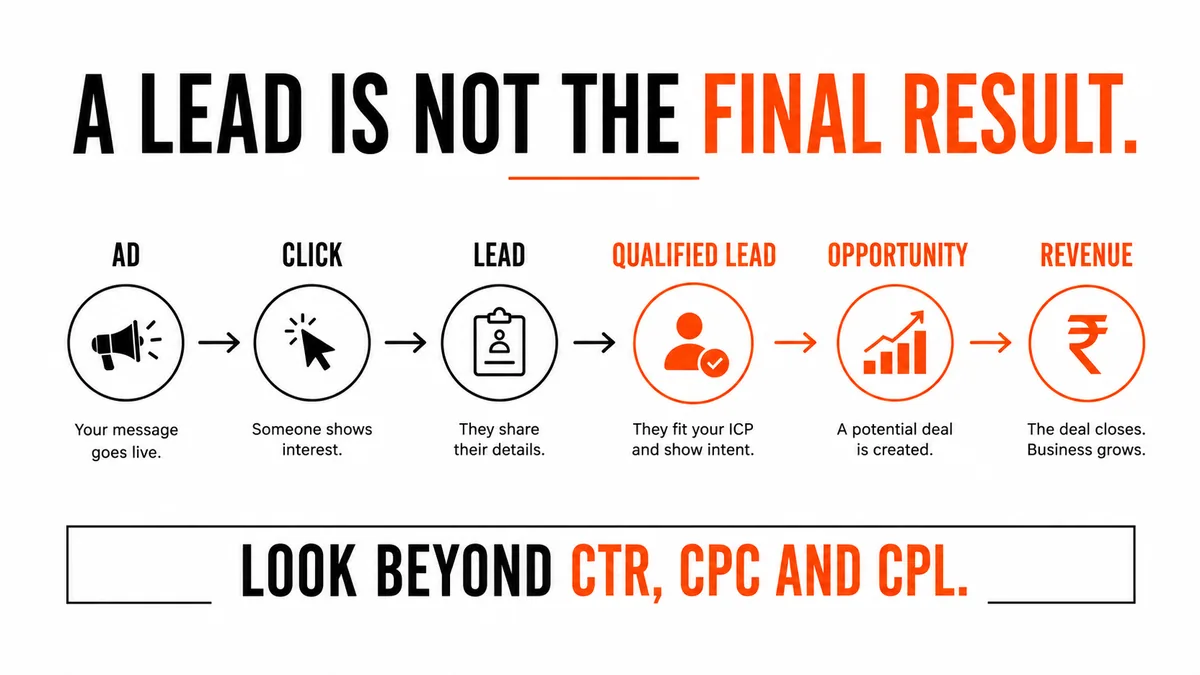
That is where LinkedIn advertising becomes part of a larger performance marketing system. A campaign may generate cheap leads and still fail to create meaningful business outcomes. At the same time, a campaign with a higher cost per lead may generate better-qualified prospects.
This is why the objective should not simply be to get more leads. The objective should be to understand which parts of the advertising and conversion process are working, which are not, and where improvements can be made.
That is the approach I believe matters most for B2B LinkedIn Ads, LinkedIn marketing, SaaS marketing and performance marketing.

Written by
Hem Meisheri
Performance Marketer
I work on B2B and D2C performance marketing, with a focus on LinkedIn Ads, Meta Ads and lead generation that is measured beyond cost per lead. More about my work.