Meta Andromeda: Why Creative Diversity Matters in Meta Ads
Producing 40 versions of the same idea is not the same as giving Meta 40 ideas. Here is how retrieval changes the way I plan creative.
By Hem Meisheri · September 2026
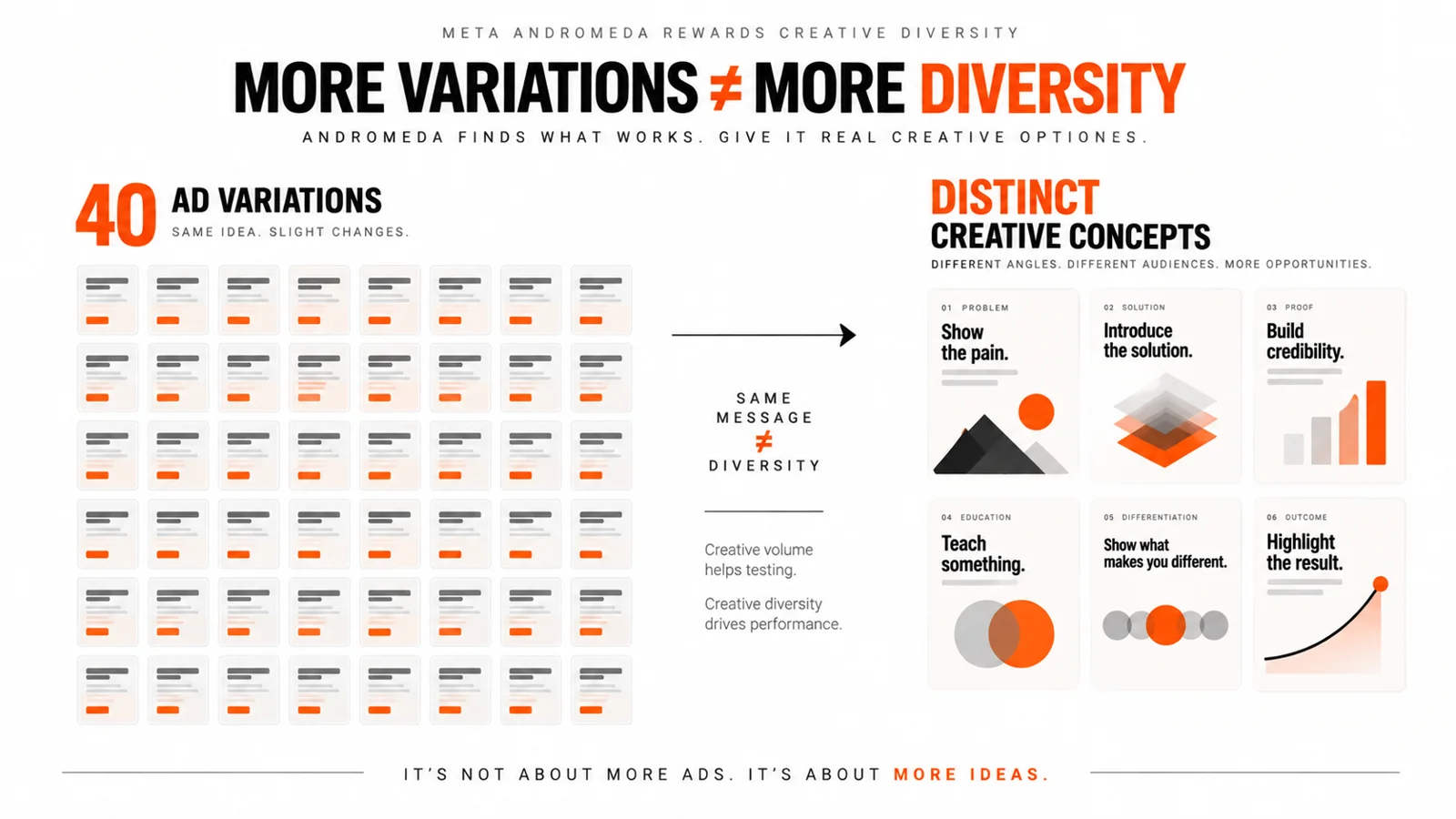
Most brands think that creating more ads means creating more opportunities. So they take one winning concept and produce 20, 30 or even 40 variations. Same video, different hook. Same image, different headline. Same creative, different CTA.
On paper it looks like a large creative testing program. But you may be creating 40 ads without creating 40 genuinely different opportunities for Meta to understand and deliver.
This is where Meta Andromeda becomes important. Andromeda is Meta's personalized ad retrieval system. Meta describes retrieval as the first stage of its multi-stage advertising recommendation system: it works through an enormous pool of ad candidates and reduces that pool to a much smaller set of relevant candidates before later ranking takes place.
That changes how performance marketers should think about creative testing. The question is no longer simply "how many ads did we launch?" A better question is "how different are the concepts we actually gave Meta to work with?"
What is Meta Andromeda?
Andromeda is part of the system Meta uses to retrieve relevant ads for a particular person. Meta says its retrieval system has to process tens of millions of ad candidates and narrow them down to a much smaller set of relevant candidates, which can then move into later stages of the recommendation and ranking system.
Think about the scale of that problem. Every time someone opens Facebook or Instagram, Meta has an enormous number of potential ads it could show. It cannot treat every possible ad equally all the way through the process. So the system first has to answer: which ads are worth considering for this person? Then the later systems determine which of those candidates should actually win the opportunity to be shown.
This is why Andromeda matters. Your ad does not simply appear in a giant auction containing every ad on Meta. There is a retrieval process before the later ranking and auction decisions. Meta has built Andromeda specifically to make that retrieval process more sophisticated and scalable, using deep neural networks, ad and user representations, and hierarchical indexing.
Creative volume is not the same as creative diversity
Imagine you launch 40 ads. You might think Meta now has 40 different creatives to choose from. Technically there may be 40 ad assets. Strategically, you might have created only three or four different ideas.
For example: "Reduce your customer acquisition cost." "Lower your CAC." "Want cheaper customer acquisition?" All three communicate essentially the same idea. Now imagine all three use the same person, the same background, the same footage, the same product, the same visual structure and the same offer. You changed the words. You did not change the concept.
That distinction matters more as Meta's systems become increasingly capable of understanding creative content. Meta says Andromeda uses advanced representations of people, interests, products and services, and organizes ads through a hierarchical index to make retrieval more efficient as the number of creatives grows.
So the goal shouldn't be to create more versions. It should be to create more meaningful concepts.
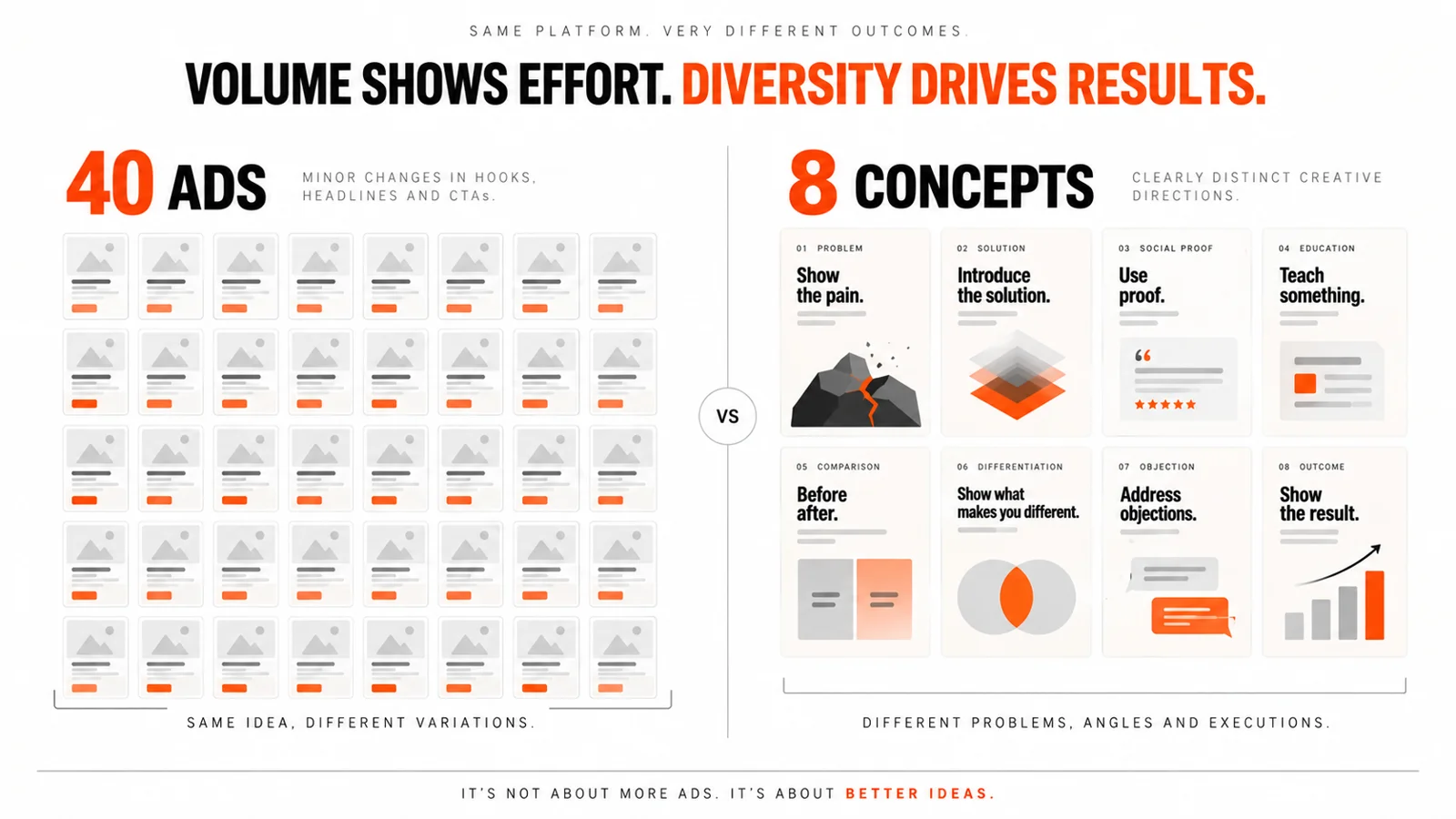
Why 40 variations can still behave like a small creative portfolio
There is an important nuance here. The idea that Meta literally assigns every similar ad an "Entity ID" and gives that entity exactly one auction ticket is widely discussed in the performance marketing community, but Meta has not publicly documented that mechanism in those advertiser-facing terms.
So I would not build a strategy around a hard rule such as "40 similar ads definitely equal one auction entry." The safer conclusion is this: if your creatives are highly repetitive, uploading more of them does not necessarily give Meta proportionally more distinct creative information or more meaningful opportunities to learn from different concepts.
Andromeda was explicitly designed to handle a rapidly increasing volume of creative while improving personalization and retrieval efficiency. Meta itself says creative volume is increasing because of Advantage+ automation and generative AI, and that Andromeda's hierarchical index is built to handle that growth. Producing 50 minor variations simply because you can is not necessarily a good testing strategy.
What actually makes a creative different?
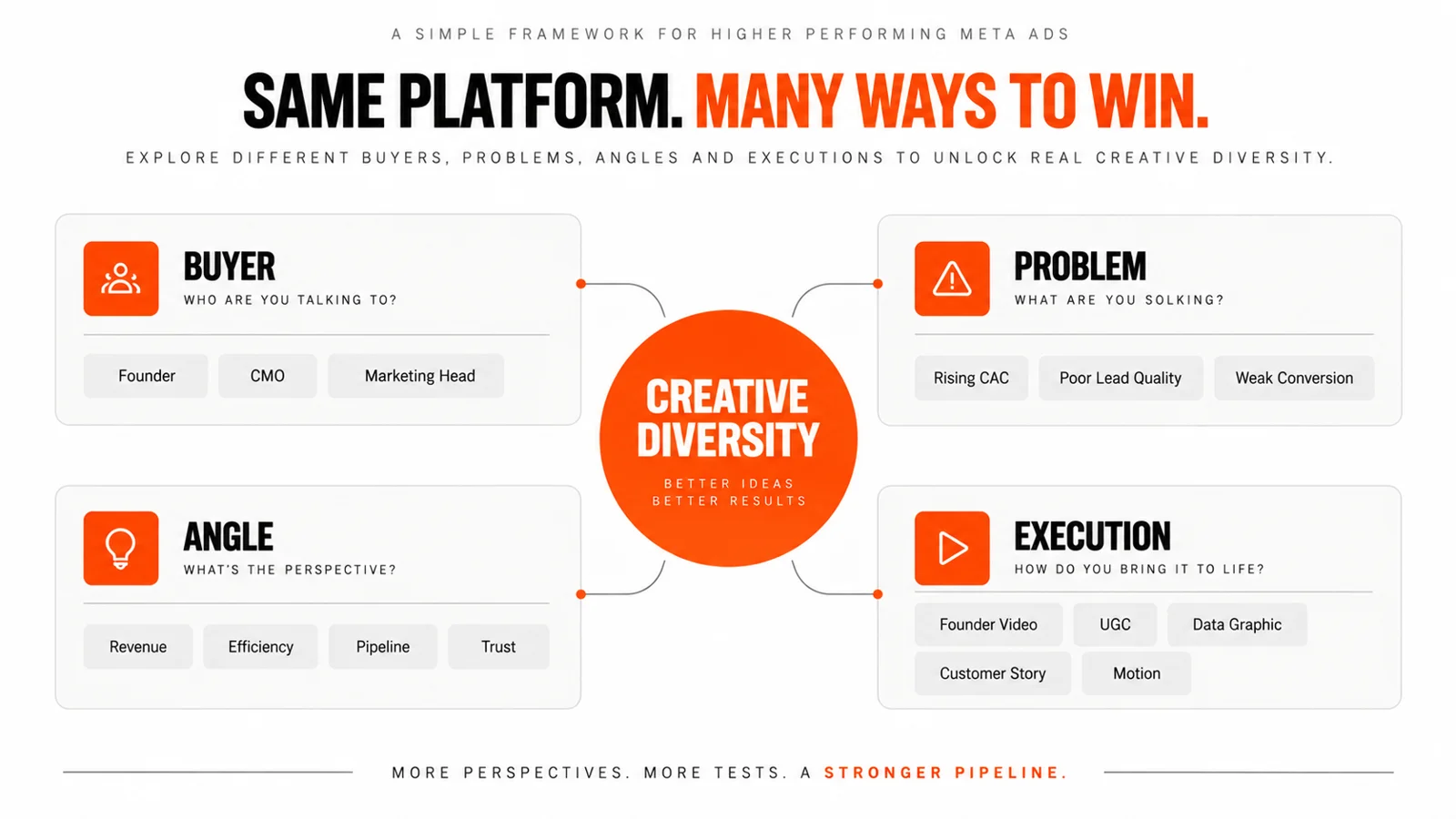
I like to think about creative diversity across four dimensions.
1. Buyer
Who are you speaking to? A founder, a marketing head, a performance marketer, procurement, a first-time buyer, an existing customer. A different buyer can have a completely different reason for purchasing.
2. Problem
What problem are you addressing? "Our Meta leads are cheap but sales can't qualify them." "Our CAC has increased despite stable conversion rates." "Our ads generate clicks but the landing page isn't converting." Same company, same product, completely different problems.
3. Promise or angle
What reason are you giving someone to care? You could position the same product around saving money, saving time, reducing risk, increasing revenue, improving efficiency, improving quality, convenience, status, proof or expertise. These are different motivations.
4. Execution
How are you communicating the idea? UGC, founder-led explanation, editorial typography and data, a product demonstration, a motion graphic, a customer story. Execution matters because the creative isn't just the words. It is the complete combination of visual, audio, copy, context and message.
Meta also continues to encourage creative built appropriately for different placements and formats, and reports performance benefits from native 9:16 Reels creative with audio and safe-zone messaging compared with still-image creative in its own testing.
The old creative testing model is becoming weaker
The old approach looked like this: one concept, ten hooks, five headlines, two thumbnails, different CTAs, 40 ads. The problem isn't that testing hooks is useless. It isn't. The problem is assuming that 40 variations automatically equals 40 creative ideas.
A better structure looks like this:
- Concept 1: poor lead quality, founder video, angle: sales teams don't need more leads, they need better leads.
- Concept 2: rising CPL, data-led static, angle: a low CPL can hide a broken B2B funnel.
- Concept 3: poor conversion rate, screen recording, angle: your campaign may not be the problem, your landing page might be.
- Concept 4: lack of trust, customer story, angle: why buyers choose one provider over another.
Now you're testing different ideas, not just different sentences. If you want the mechanics of running those tests cleanly, my creative testing framework covers how to isolate variables.
The two types of creative diversity
Angle diversity
Change why someone should care. For a D2C brand that could mean price, quality, convenience, social proof and product performance. For B2B it could mean reducing acquisition cost, improving lead quality, increasing sales efficiency, reducing wasted ad spend and improving pipeline visibility. The product doesn't change. The reason for buying does.
Execution diversity
Take one strong angle and communicate it differently. For the angle "poor B2B lead quality" you could create a founder talking-head video, a customer interview, a data infographic, a screen recording of CRM data, a static comparison, an animated funnel and a case-study creative. The underlying message stays consistent, but the creative experience is substantially different. That is a far more useful testing structure than 20 versions of the same video.
The formula I would use
Instead of asking "how many ads should we make?" ask "how many genuinely different concepts are we testing?" A practical framework:
Creative diversity = Angle × Buyer × Context × Format
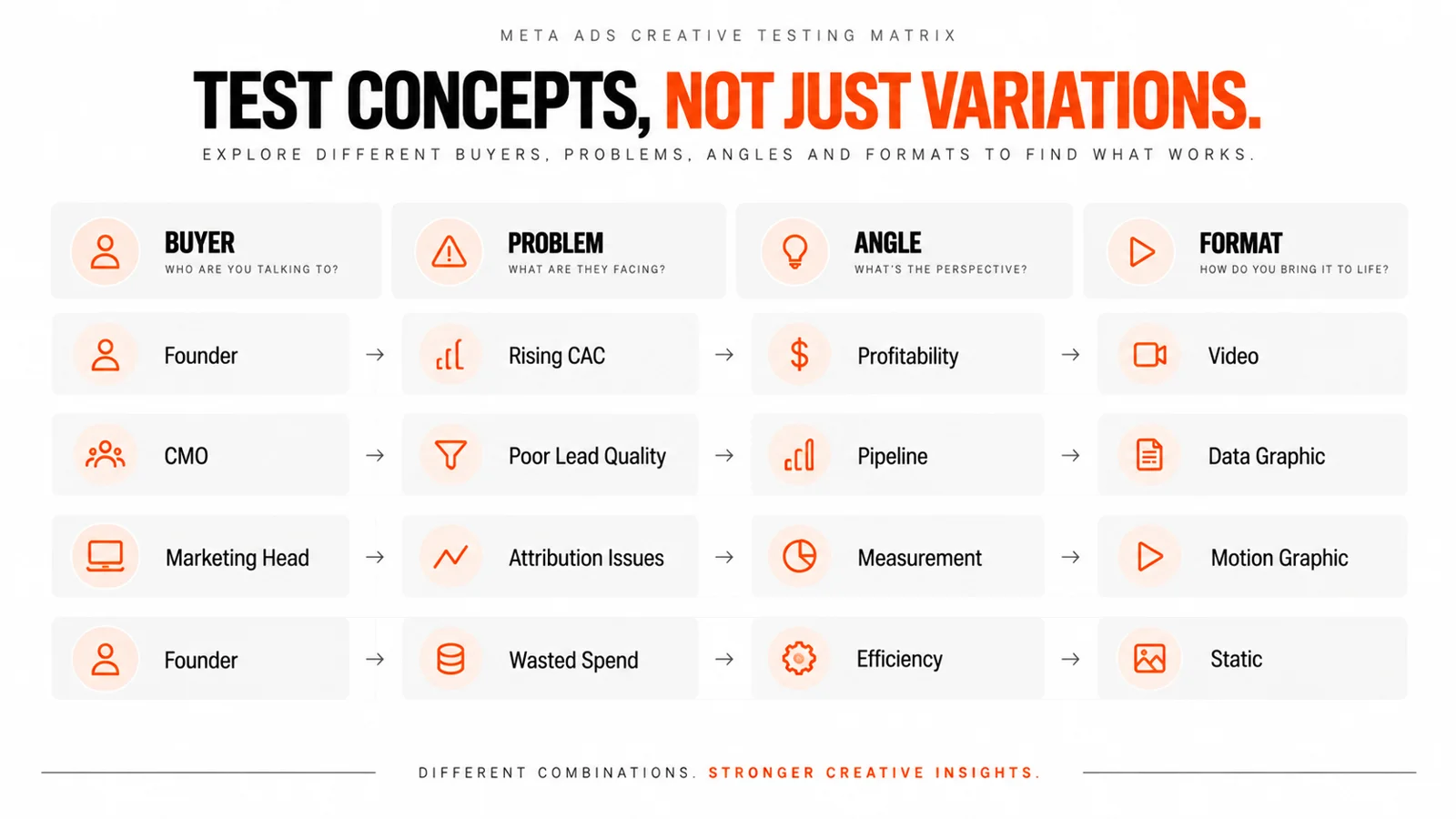
You don't need to change all four every time. But if every ad has the same buyer, problem, promise, visual and format, you're producing variations rather than genuinely different concepts. A useful launch might therefore be eight concepts rather than 40 reskins.
| # | Buyer | Problem | Format | Angle |
|---|---|---|---|---|
| 1 | Founder | Rising CAC | Video | Profitability |
| 2 | CMO | Poor lead quality | Data graphic | Pipeline |
| 3 | Performance marketer | Weak conversion | Screen recording | Optimization |
| 4 | Founder | Wasted spend | Static | Efficiency |
| 5 | CMO | Slow sales cycle | Customer story | Revenue |
| 6 | Marketing head | Attribution issues | Motion graphic | Measurement |
| 7 | Founder | Scaling difficulty | Video | Growth |
| 8 | CMO | Unqualified leads | Carousel | Sales efficiency |
That's a creative testing system, not simply a production spreadsheet.
What this means for B2B Meta Ads
B2B buyers are not one homogeneous audience. A founder may care about "will this generate revenue?" A marketing director may care about "will this improve qualified pipeline?" A sales leader may care about "will my team stop wasting time on bad leads?"
The same service can therefore have multiple legitimate creative angles. Instead of making 30 ads that say "generate more B2B leads," build different creative branches around lead quality, pipeline, sales efficiency, CAC, attribution, revenue, conversion rate and scaling. You give the system genuinely different semantic inputs while learning which business problem produces the strongest response. That thinking sits at the centre of my B2B paid media strategy work, and it pairs closely with LinkedIn Ads strategies for B2B lead generation when you are running both channels.
What this means for D2C
The same principle applies. Selling a skincare product, you could build concepts around ingredient science, before and after, customer testimonial, convenience, a specific skin concern, premium positioning, price and value, and the founder story. You aren't simply changing the headline. You're changing the reason the customer might want the product. That's much more useful creative information, and it is how I approach creative on D2C ecommerce accounts.
Does this mean you should stop testing hooks?
No. Hooks still matter. But hooks should exist inside a broader creative concept, not become the entire definition of creative testing.
Take a concept such as "your B2B CPL is lying to you." Test several hooks. Then take the same insight and turn it into a founder video, a data-led graphic, a customer story, a screen recording and a carousel. Now you're testing both the message and the execution.
Andromeda does not mean targeting and bidding no longer matter
This is an important correction to the popular Andromeda narrative. Meta's own description makes clear that retrieval is one part of a broader multi-stage advertising system. After retrieval, more sophisticated ranking models predict user and advertiser value to determine the final set of ads.
So the practical takeaway isn't "ignore everything except creative." It's that creative is increasingly important because it is one of the major inputs Meta can understand about the ad and its relevance to different people. That is a very different claim. Diagnosis still matters too, which is why Meta Ads optimization should never be reduced to switching off whatever has the worst ROAS this week.
What should you actually do in your next Meta Ads launch?
- Step 1, define the business problem: what are you actually trying to improve? For example, qualified B2B leads.
- Step 2, define your major buyer motivations: better lead quality, lower CAC, more pipeline, better sales efficiency.
- Step 3, build distinct concepts: six to ten genuinely different concepts around those motivations.
- Step 4, vary execution: don't shoot every concept in the same room with the same person and the same format. Use talking head, UGC, screen recording, static, carousel, motion graphic and customer proof where appropriate.
- Step 5, test the concepts: don't immediately create another 20 variations because one ad has a better CTR. First ask whether you discovered a better concept.
- Step 6, iterate the winners: once a concept proves itself, test hooks, headlines, CTAs, opening frames, editing and offers. That's where smaller variations make sense.
Before you scale any winner, it's worth checking that the traffic itself is behaving. How Meta Ads traffic quality works across clicks, landing page views and purchases will tell you whether the concept is genuinely working or the funnel is leaking after the click.
The real shift in Meta Ads creative strategy
The biggest mistake would be reading about Andromeda and concluding "I need more ads." The better conclusion is "I need better separation between my ads."
Meta built Andromeda to handle an enormous and growing number of creative candidates. Its hierarchical retrieval system exists precisely because the number of ads entering the ecosystem is exploding. That means advertisers shouldn't compete purely on creative volume. They should compete on creative information: different problems, different motivations, different buyers, different contexts, different executions. Then use performance data to discover which combinations actually produce business results.
Because 40 ads that all say the same thing aren't necessarily 40 ideas. They're often just 40 ways of saying the same thing.
FAQs
What is Meta Andromeda? It is Meta's personalized ad retrieval system, the stage that narrows tens of millions of ad candidates down to a much smaller relevant set before ranking and auction stages run.
Does Andromeda mean I should upload more ads? Not by itself. More assets only help if they carry genuinely different creative information. Repetitive variations add production work without adding much for the system to learn from.
How many concepts should I launch? As a working starting point, six to ten distinct concepts is usually more useful than 40 variations of one idea.
Is the "one Entity ID equals one auction ticket" rule official? No. It is an industry interpretation. Meta documents the retrieval stage and the creative-volume problem, not that specific advertiser-facing mechanism.
The takeaway
The next time someone tells you "we launched 40 creatives," ask "how many different concepts?" That's the number I'd care about. Not how many files were uploaded, how many hooks were written, or how many background colours were changed.
The brands that adapt well to Meta's increasingly automated advertising system won't necessarily be the brands producing the most ads. They'll be the brands giving the system better and more distinct creative signals. That is the real lesson from Andromeda.
Want a second opinion on whether your creative plan is genuinely diverse or just 40 reskins? Send me your current ads on WhatsApp.
Message me on WhatsApp