Meta Ads Optimization: Don't Kill a Low-ROAS Ad Too Quickly
The ad with the worst ROAS is not always the ad hurting you. Before you switch it off, understand the job it is doing in the customer journey.
By Hem Meisheri · August 2026
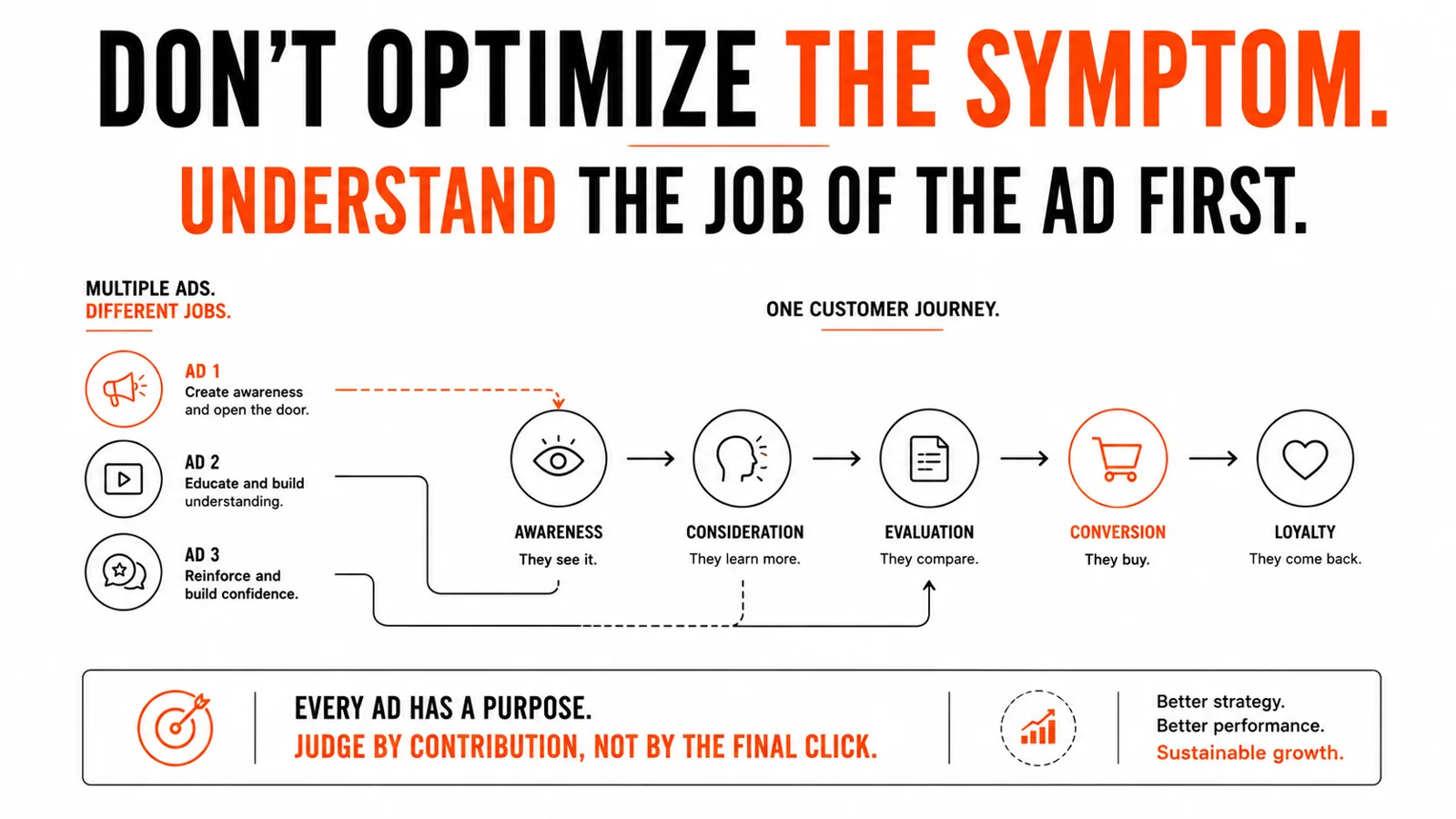
Meta Ads optimization is not always about turning things off
One of the easiest things to do in Meta Ads Manager is to find an ad with poor ROAS and turn it off. It feels logical. The ad spent money. The return looks bad. So you kill it.
But sometimes that ad is not the problem. It might be helping another ad convert. It might be introducing the customer to your brand for the first time. It might be answering a question the customer needs answered before they buy. Or it might simply be one step in a longer customer journey.
This is why Meta Ads optimization needs to go beyond looking at the last purchase and asking which ad received credit for it. You need to understand what the ads are doing together.
The problem with judging every ad by ROAS
ROAS is useful. But ROAS does not tell you everything. Imagine you have three ads.
- Ad A: ₹50,000 spent, ₹1,00,000 revenue, 2x ROAS
- Ad B: ₹30,000 spent, ₹45,000 revenue, 1.5x ROAS
- Ad C: ₹20,000 spent, ₹10,000 revenue, 0.5x ROAS
Looking at those numbers alone, Ad C looks terrible. You might immediately turn it off. But what if Ad C is the ad introducing a large number of customers to the brand? Those people then see Ad A. Then they see Ad B. Then they purchase.
Ad A may receive the conversion credit. Ad C may have helped create the conversion in the first place. This is where last-touch attribution becomes misleading. The ad that gets the purchase is not necessarily the only ad that mattered.
Think about the customer journey, not just the individual ad
A customer rarely sees one ad, clicks it and immediately buys. The journey usually looks more like this: first ad, second ad, third ad, website, retargeting, purchase.
The first ad might introduce the brand. The second might explain the product. The third might provide social proof. The customer then comes back and purchases. If you judge the first ad only by the purchases directly attributed to it, you may conclude it is not working. Its job was completely different. It was the first touch.
So the important question in Meta Ads performance is not "how much ROAS did this ad generate?" It is "what role is this ad playing in the customer journey?"
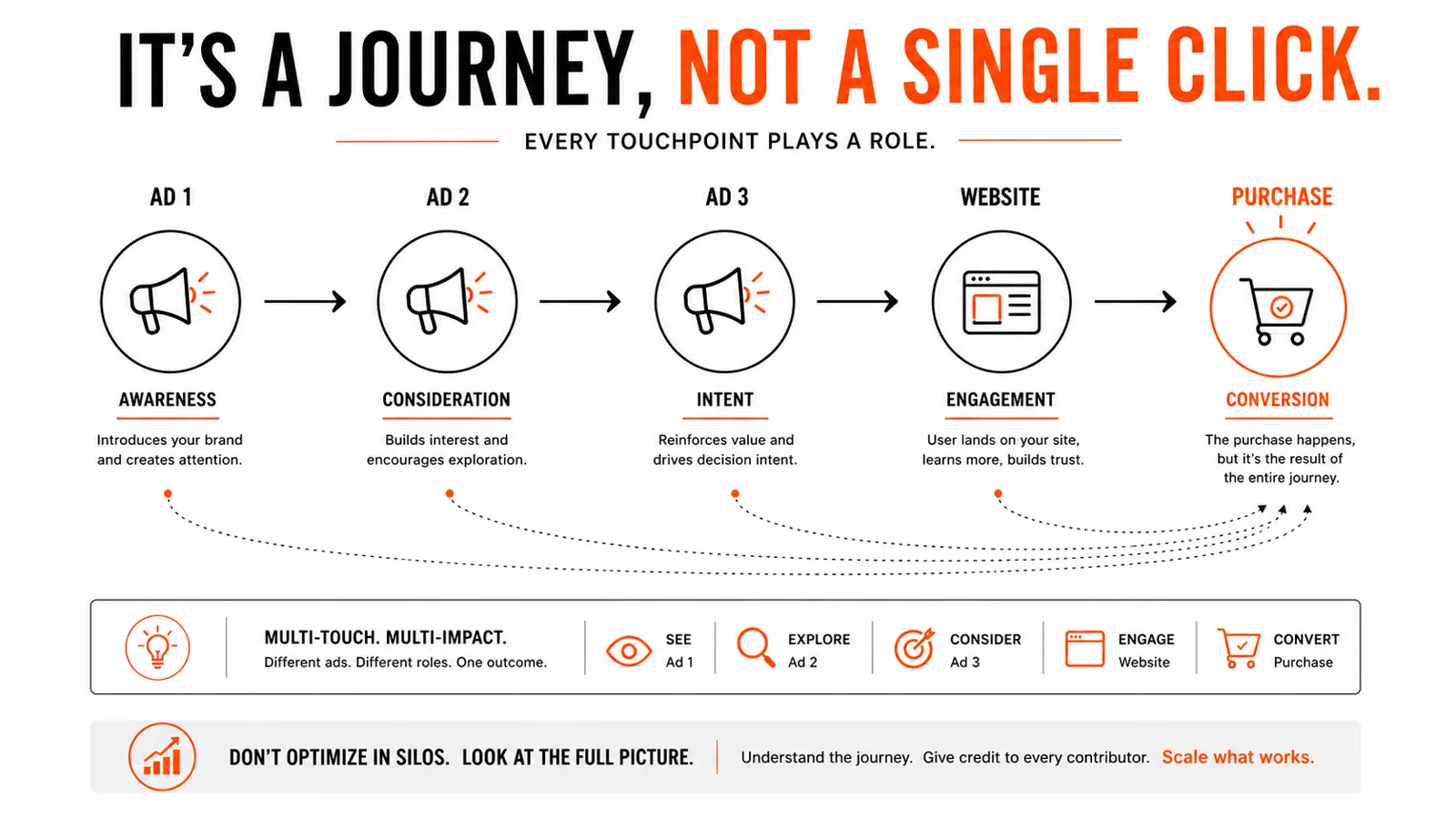
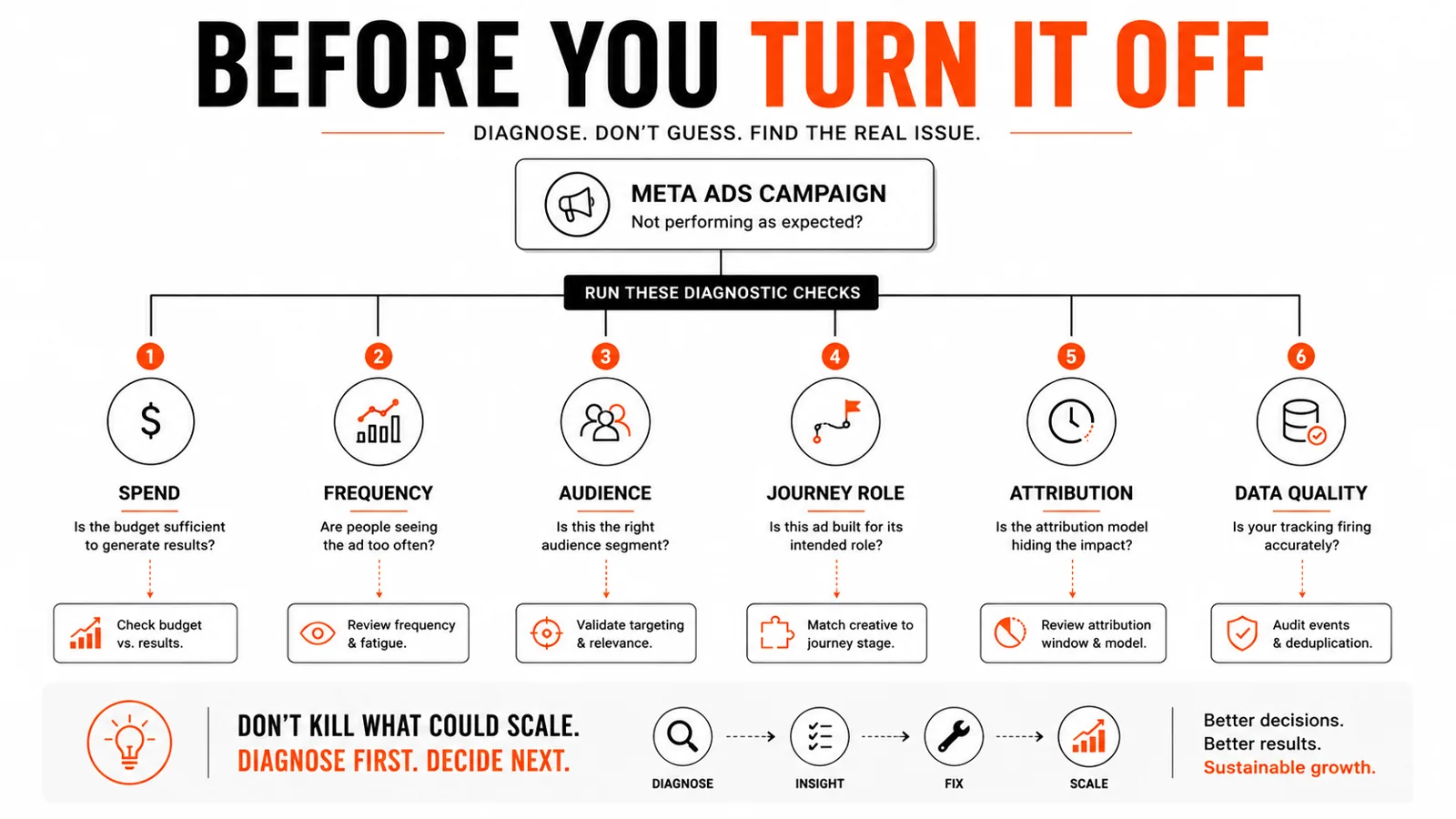
Before you turn off an ad, look at what it is actually doing
1. How much spend is it receiving?
Spend distribution tells you something. If delivery keeps allocating meaningful budget to an asset, the system is finding some value in it. That does not automatically make the ad good, but you should understand why it is getting that delivery before removing it.
2. What is its frequency?
Frequency shows how often people are seeing the message. An ad with an upper-funnel role naturally behaves differently from a direct-response ad, and comparing them on the same yardstick hides that.
3. What audiences are seeing it?
Look at customer segments. A creative can work very well with one type of buyer and poorly across the account as a whole. That is a targeting read, not a creative verdict.
4. Where is it appearing in the journey?
Is it introducing people, helping consideration, or being shown to people who already know the brand? Those are very different jobs, and each deserves a different success metric. If the drop-off is happening after the click rather than inside the ad, the diagnosis lives in the traffic quality equation, not in the ROAS column.
Your account should answer customer questions
This is one of the most useful ways to think about Meta Ads campaign optimization. Look at the questions your customers keep asking in support tickets, comments, reviews, sales calls, WhatsApp conversations, objections and product questions.
If the same question keeps appearing, that is a content gap. And that gap can become an ad.
- "What happens if the product does not work for me?" You need creative that addresses the guarantee, returns or risk.
- "How is this different from your competitor?" You need comparison creative.
- "Will this actually work for my situation?" You need proof, demonstrations or customer stories.
Instead of creating another generic "Buy Now" ad, answer the question preventing the purchase. If those same questions are also unanswered on the page after the click, fix that first with the 7-second landing page test.
Treat your ad account like a landing page
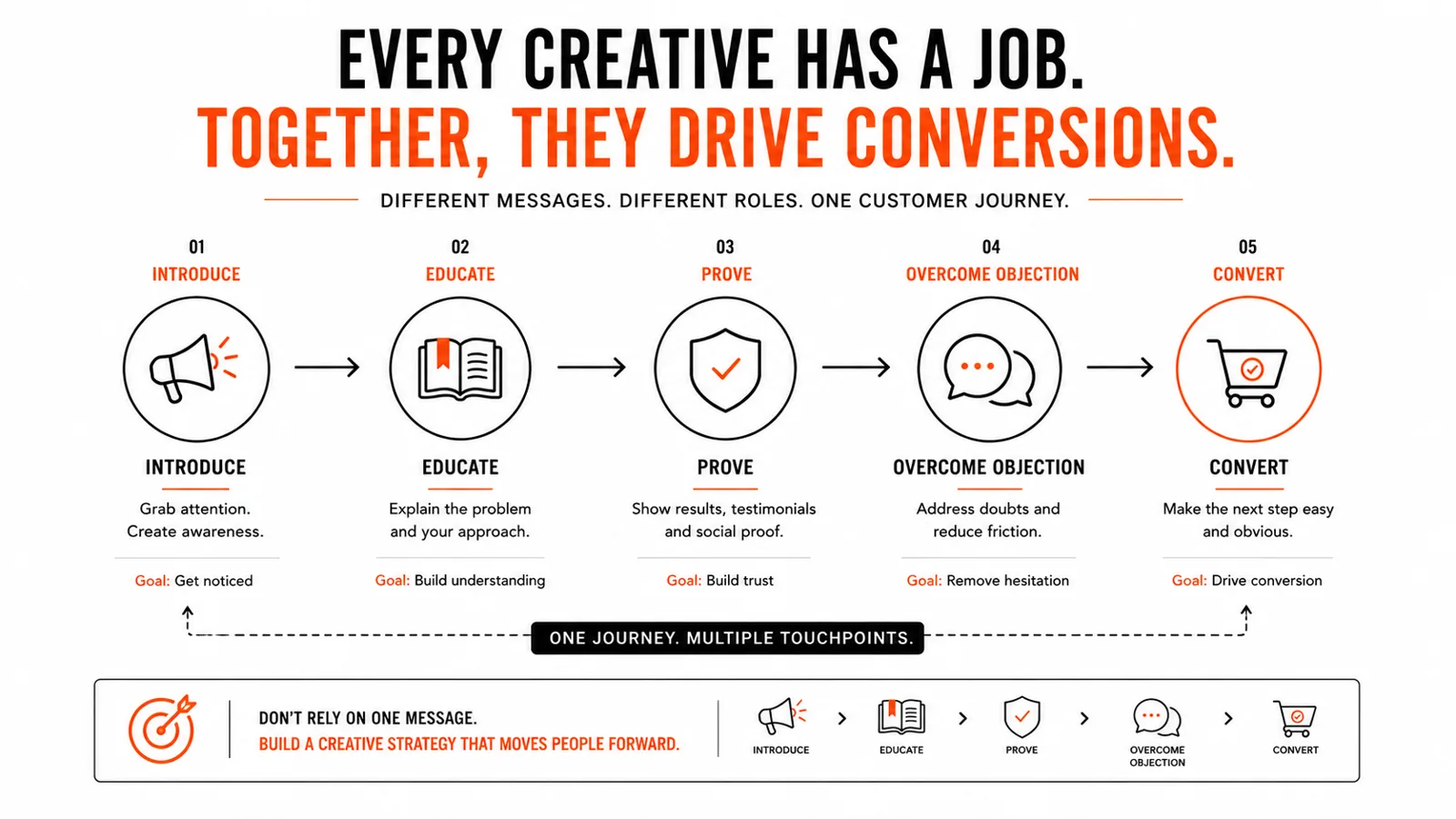
A good landing page answers the questions a customer has before buying. Your ad account should do the same thing. One creative explains the product. Another establishes credibility. Another shows results. Another handles objections. Another explains the technical detail. Another provides a guarantee. Together, they create a journey.
So instead of asking "which ad is my winner?", ask "what information is missing from my customer's journey?" That is a much better question for Meta Ads optimization, and it is the question that makes creative testing compound instead of churn.
Different customers need different reasons to buy
Not every customer needs the same message. A technical buyer wants specifications and performance data. A customer looking for validation wants reviews and proof. A customer worried about risk wants guarantees and returns. The product is the same. The reason for buying is not.
This matters more in B2B and considered purchases, where the journey runs across weeks and several stakeholders, and it shows up differently in D2C ecommerce, where the same buyer cycles through several touchpoints in days. Having multiple messages is not about making twenty versions of one ad. It is about covering the different questions that exist across the journey.
So when should you actually turn an ad off?
You should absolutely turn off poor performers. The point is not to make that decision on one metric alone. Before switching it off, ask:
- Is it consuming meaningful budget without contributing enough value?
- Is it reaching the wrong audience?
- Is the creative simply weak?
- Is it playing an early-stage role?
- Is another ad receiving the conversion credit after this ad introduced the customer?
- Is there enough data to make the decision?
- What happens to the rest of the account if I remove it?
That last question is the one that gets missed most often.
What this means for scaling Meta Ads
As accounts grow you add audiences, creatives, placements, messages, touchpoints, retargeting and customer segments. The journey becomes harder to read if you only look at the final conversion. Meta Ads scaling then becomes less about finding one winning ad and putting all the budget behind it, and more about a system where different creatives play different roles. Some create awareness. Some create consideration. Some overcome objections. Some convert.
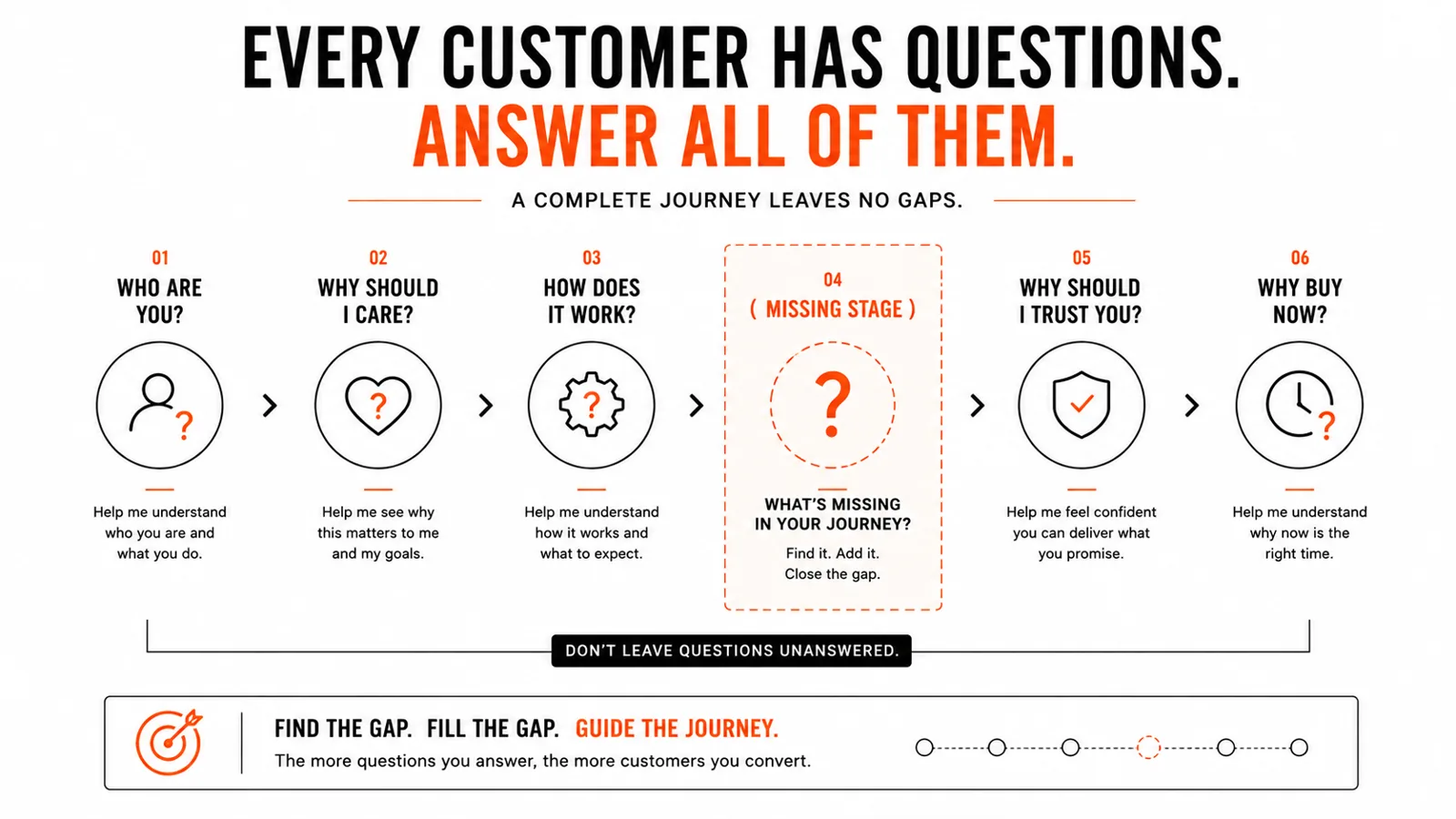
Look for the holes in the journey
Map the journey, then ask what the customer needs to know before buying:
- First touch: who are you?
- Problem awareness: why should I care?
- Solution: how does this work?
- Proof: does it actually work?
- Objection: what could stop me?
- Risk reduction: why should I trust you?
- Conversion: why should I buy now?
If you have no creative covering one of those questions, you have a gap. That gap may matter more than the ad with the lowest ROAS. On the Bartisans and Billoxy accounts, filling journey gaps moved the numbers more than pausing weak ads ever did.
Don't optimize the symptom
If an ad has low ROAS, the answer is not automatically to turn it off. First understand why. Maybe the ad is weak. Maybe the audience is wrong. Maybe the offer is not working. Maybe the landing page is not converting. Maybe the ad is creating the first touch and another ad is getting the credit. Maybe the campaign has not collected enough useful data yet.
The job of a performance marketer is not to make the dashboard look clean. It is to understand what is actually producing the business outcome. That is also why rising CAC is rarely fixed inside the ads manager alone.
The way I look at Meta Ads performance
Who is seeing the ad. Why are they interested. What message are they receiving. Where does the journey continue. What happens before conversion. Which creative or touchpoint contributes to the purchase. What does that customer actually generate over time.
That is far more useful than asking which ad has the highest ROAS. The highest ROAS ad is not necessarily carrying the account, and the lowest ROAS ad is not necessarily useless. Sometimes the ad you are about to turn off is doing something you have not measured properly yet.
Final thought
The goal is not to keep every ad running forever. The goal is to understand the job each ad is doing before deciding whether it deserves to stay. Look at the customer journey. Look at your audience segments. Look at spend distribution. Look at frequency. Look at the questions customers keep asking. Then identify what is missing, build creative to fill that gap, and only then decide what needs to be removed.
Good Meta Ads campaign optimization is not about making more changes. It is about making better decisions.
Want a second opinion before you switch off an ad that might be carrying the account? Send me the account structure on WhatsApp.
Message me on WhatsApp