The Meta Ads equation that tells you where your traffic quality is breaking
Unique Outbound Clicks, Landing Page Views and Purchases read together show you where the traffic breaks, long before ROAS tells you something is wrong.
By Hem Meisheri · Performance Marketer for D2C & B2B Brands · August 2026
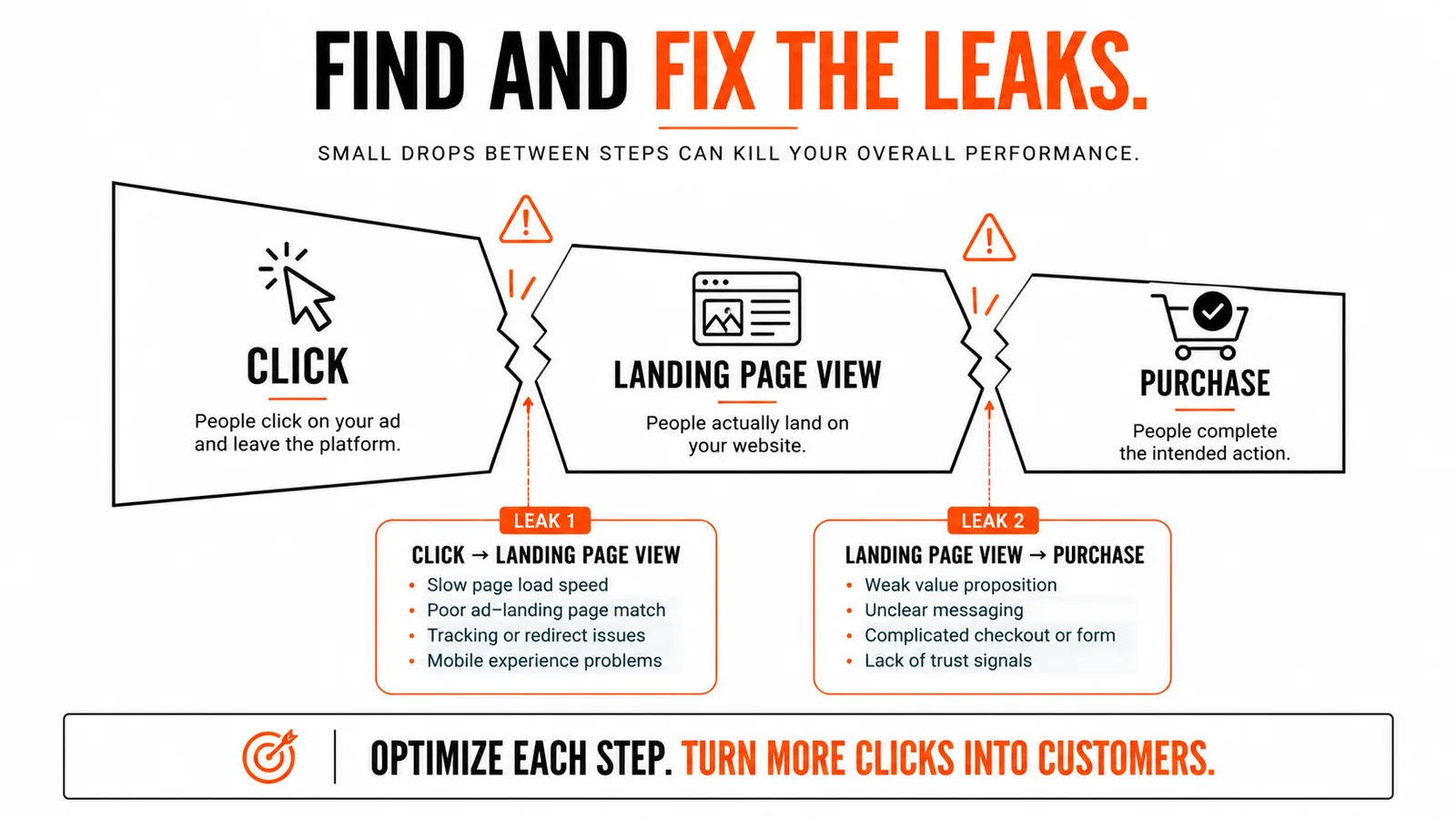
Most Meta advertisers look at the same numbers when a campaign starts going wrong. ROAS. CPA. CPC. CTR. And when ROAS falls, the first reaction is usually predictable: change the creative.
Sometimes that is the right answer. But sometimes the creative isn't the problem at all. The problem is happening somewhere between the moment someone clicks your ad and the moment they become a customer.
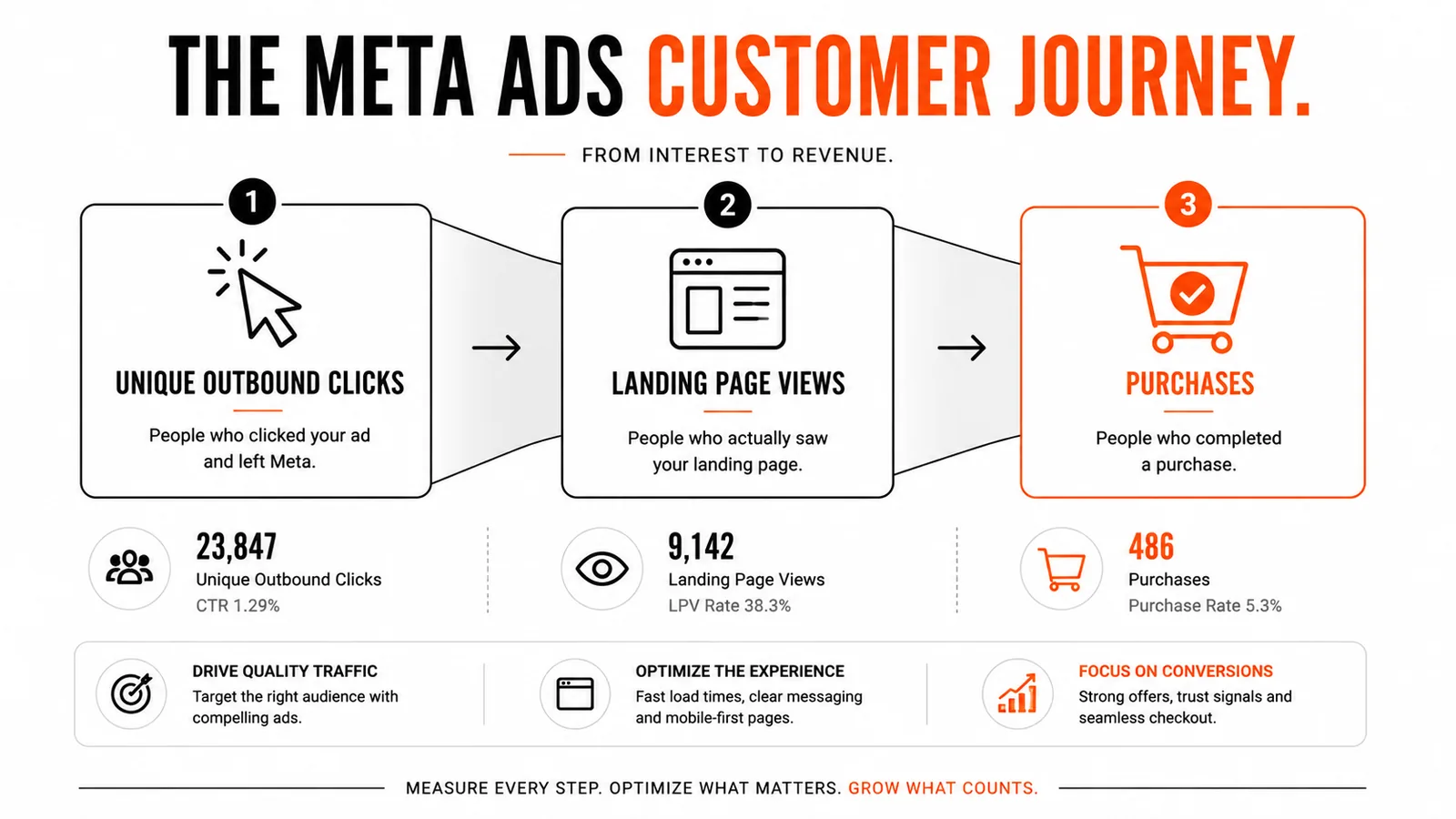
That is why I like looking at three numbers together:
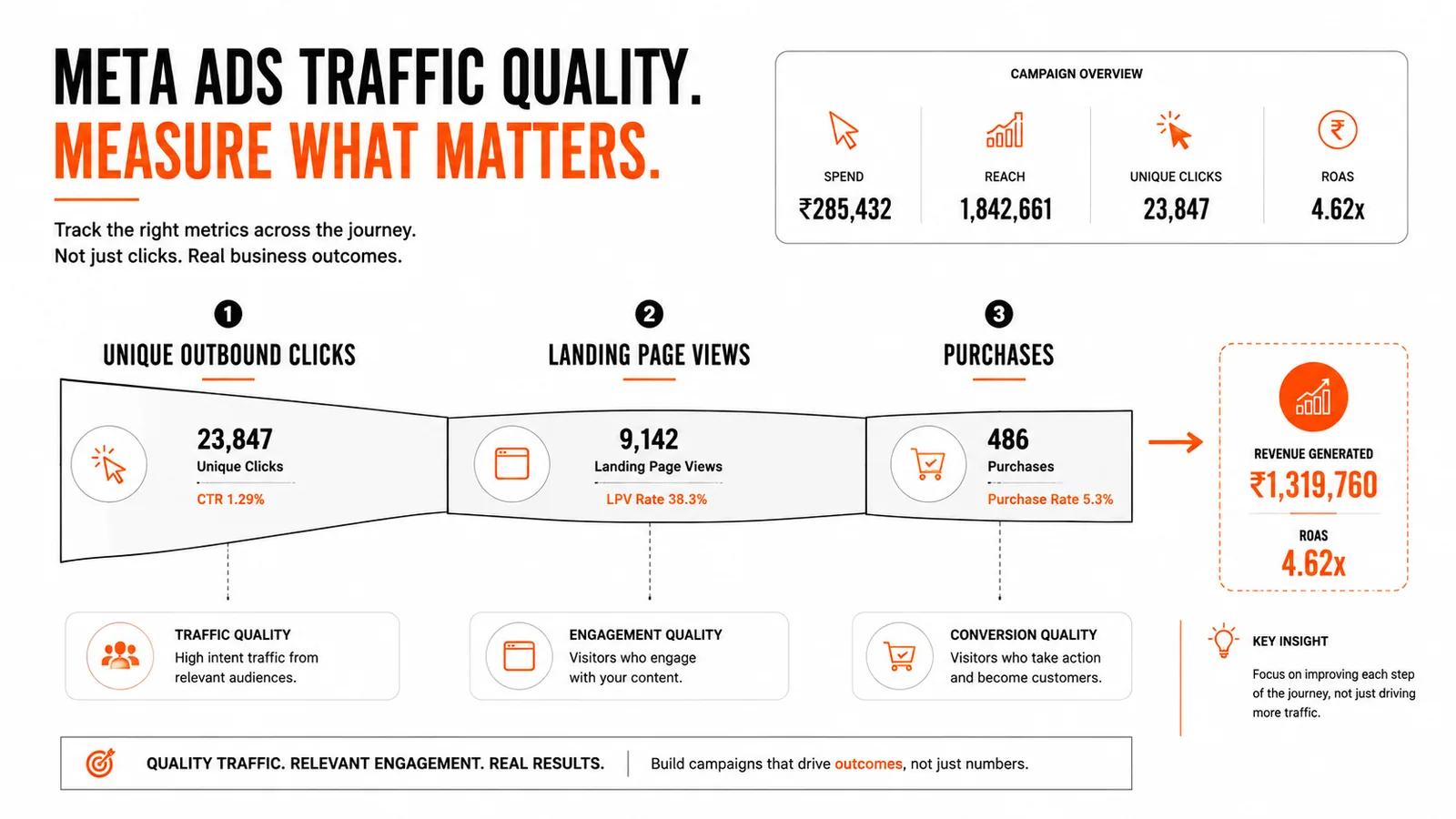
Unique Outbound Clicks → Landing Page Views → Purchases
These numbers give you a simple way to understand what is happening to your traffic before the final ROAS number tells you that something has already gone wrong.
As a Meta Ads expert, I don't want to know only whether an ad generated clicks. I want to know whether those clicks were real, whether those people actually reached the website, and whether the people who reached the website were capable of becoming customers.
The three numbers you need
1. Unique Outbound Clicks
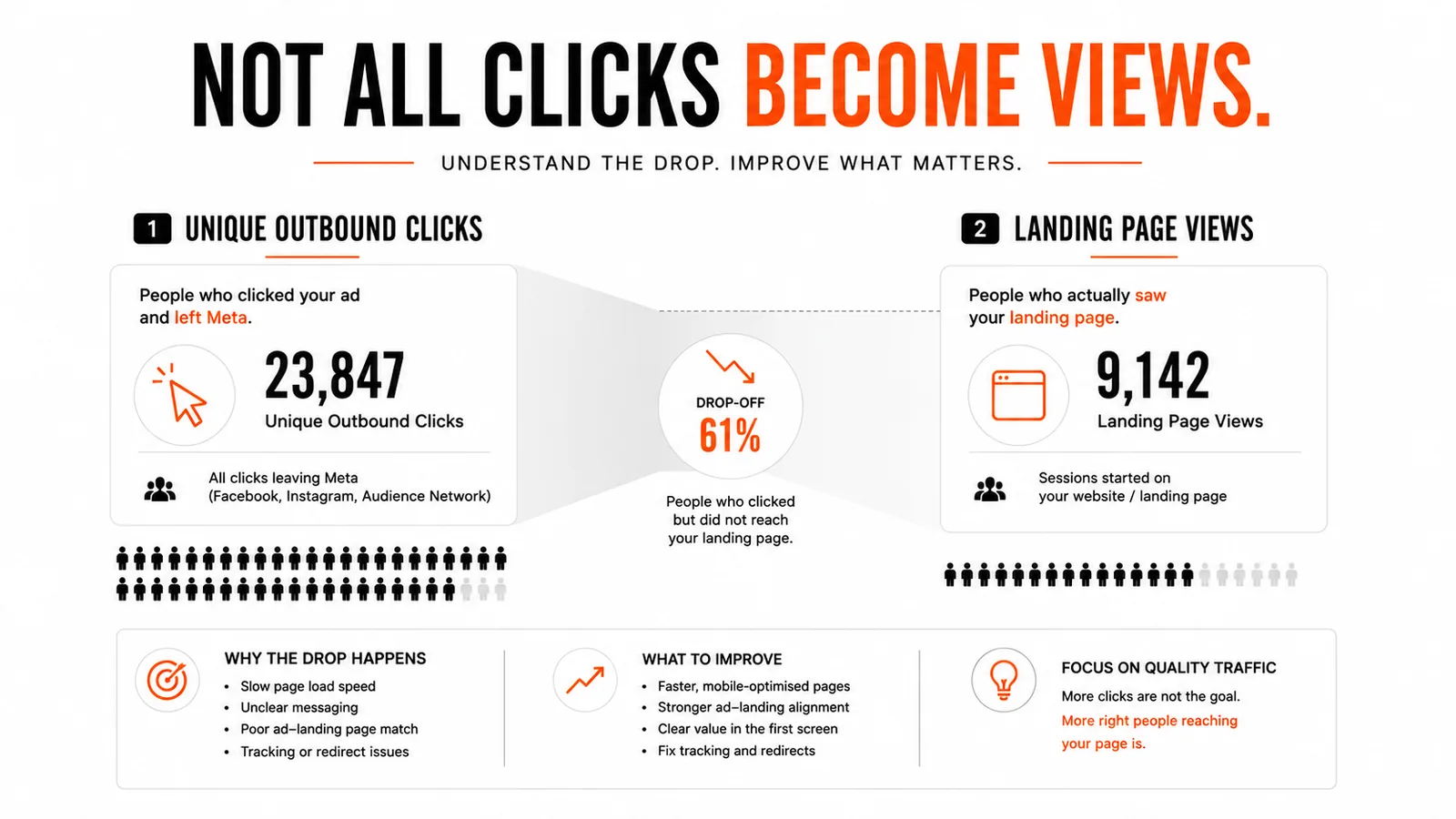
This is the number of people who clicked a link that takes them away from Meta and toward your website. It represents the initial intent to go somewhere. Someone saw your ad. Something about it made them click. But that doesn't mean they actually reached your website.
And that's the first mistake advertisers make. A click is not automatically a website visit.
2. Landing Page Views
Landing Page Views tell you something more useful. The person clicked, the page loaded and the relevant tracking event fired. In other words, they actually made it to the landing page.
So now you can compare Unique Outbound Clicks against Landing Page Views. This gives you your first diagnostic relationship.
If you have 10,000 Unique Outbound Clicks but only 7,000 Landing Page Views, you have a gap. That gap is worth investigating. It doesn't automatically tell you the cause. It could involve traffic quality, placements, page loading, tracking or the journey between the click and the page. But it tells you something important: not every click became a real landing-page visit.
The first ratio: click quality
The first relationship is Unique Outbound Clicks ÷ Landing Page Views. Think of it as your click quality signal.
If clicks and landing-page views stay relatively close, your traffic is making it through the first part of the journey. If the gap starts getting wider, you need to investigate.
Scenario A: 10,000 clicks and 9,000 landing page views. Then later: 10,000 clicks and 6,500 landing page views. Your click volume hasn't changed. But something has changed in the quality of what happens after the click.
That is much more useful information than looking at CTR and saying "the ad is still getting clicks, so everything must be fine." It isn't necessarily fine. The people clicking may not be making it through the journey.
The second relationship: clicks, landing pages, purchases
Now take the complete journey. 10,000 Unique Outbound Clicks → 8,000 Landing Page Views → 400 Purchases.
Now you can ask two different questions.
- Are people clicking and actually reaching the website?
- Of the people who reach the website, are they buying?
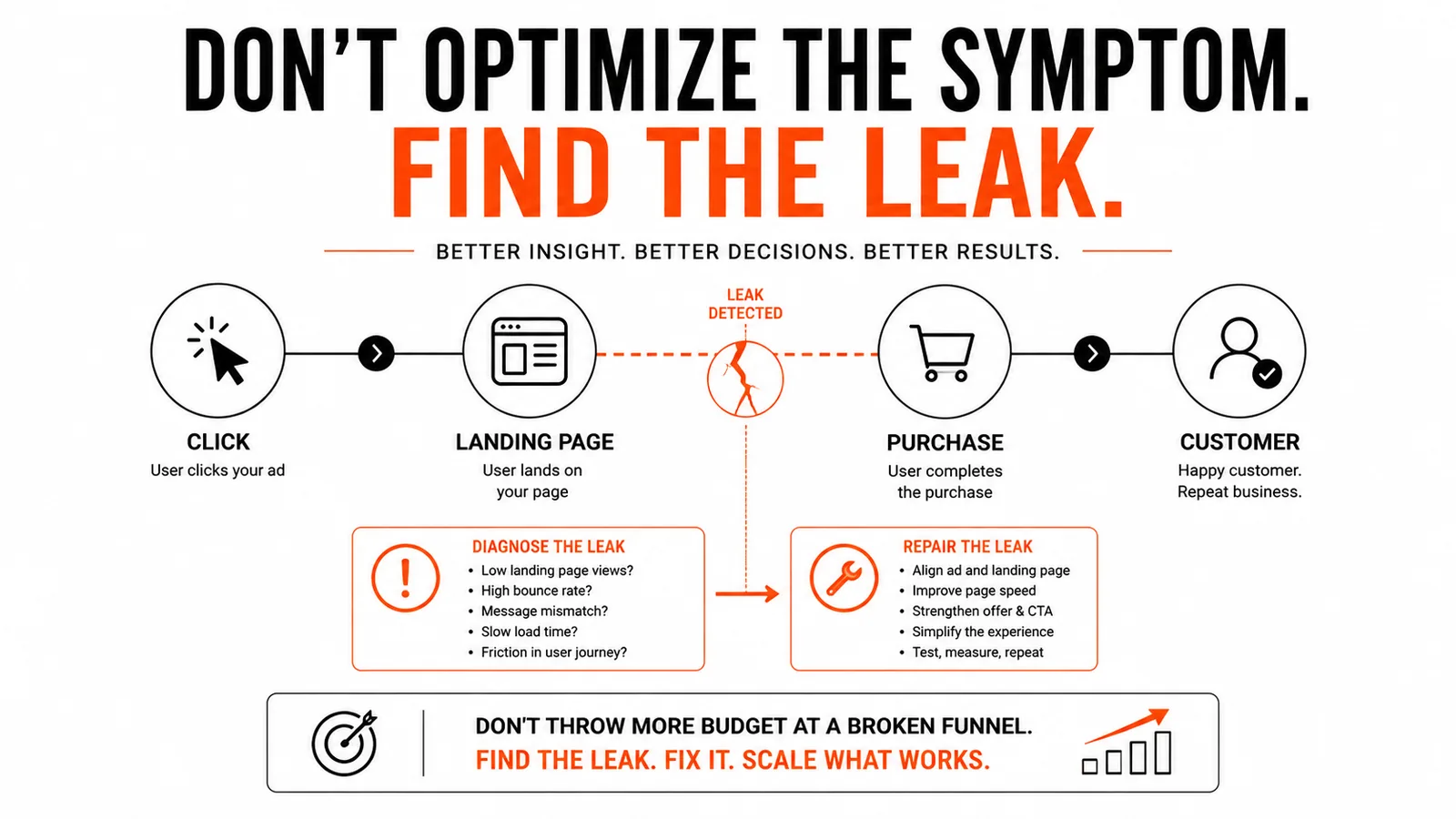
Those are two completely different problems. And that's why looking only at ROAS can be misleading. ROAS tells you the outcome. This framework helps you start figuring out where the deterioration happened.
When click quality gets worse
Imagine your click quality relationship starts getting worse. You have plenty of clicks. But increasingly fewer people are becoming landing-page views.
Don't immediately redesign the website. Don't immediately replace every creative. And don't automatically assume your audience is bad. Start by looking at placements.
Meta doesn't distribute traffic equally across every placement. A campaign can produce an attractive CPC while quietly receiving more delivery from a placement that generates cheap but lower-quality clicks. That is why a performance marketing expert should not evaluate traffic purely on how cheap it is. Cheap traffic isn't automatically good traffic. The question is what happens after you buy that traffic.
The whole acquisition system matters here, not just the ad account, which is why my performance marketing services cover media, measurement and the post-click journey together.
When conversion gets worse
Now imagine something different. Your clicks are still becoming landing-page views at roughly the same rate. So the first part of the journey looks healthy. But purchases are falling. Now the problem is further down the funnel.
This is where you start investigating the quality of the people who are actually arriving, and this is where D2C performance marketing becomes especially important. A D2C campaign isn't successful because people clicked an ad. It is successful when the economics of acquiring those customers make sense.
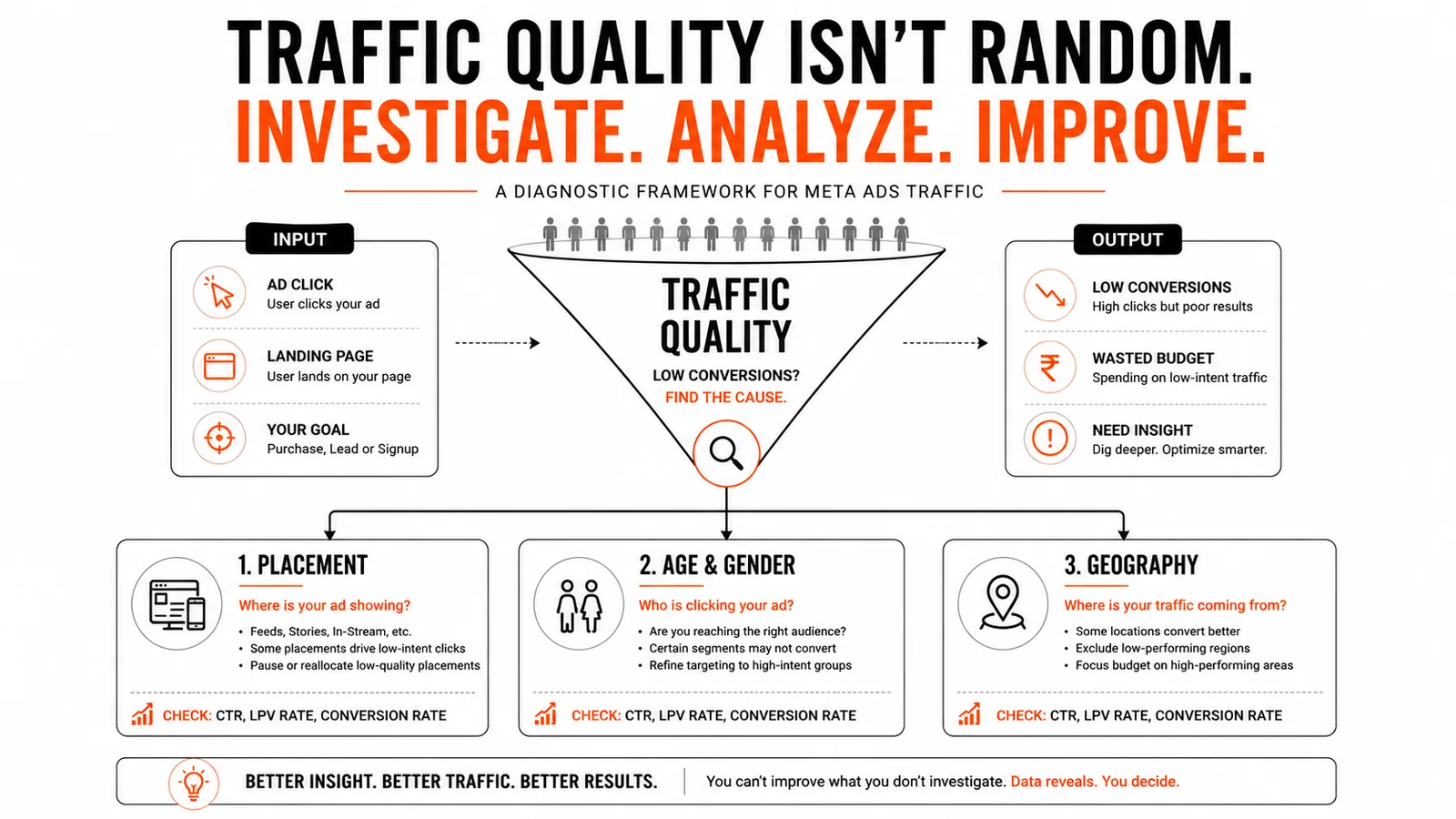
So if landing-page views remain stable but purchases decline, look at the audience distribution. Start with placement, then age and gender, then geography.
The goal isn't to decide that a particular age group or location is automatically bad. The goal is to find where the change is concentrated. The same logic applies to lead quality in B2B performance marketing, where cheap leads and qualified pipeline are rarely the same thing.
Look beyond the blended campaign number
Many advertisers look at the campaign as one large number. CTR 1.5%, CPC ₹20, ROAS 2.1x, and then they make a decision. But blended numbers can hide what is actually happening.
Suppose your campaign has five placements. Four are performing normally. One is generating a huge amount of cheap traffic that doesn't progress through the funnel. The blended numbers can make the problem difficult to see.
That's why the diagnosis should move from blended campaign, to placement, to age and gender, to geography. You're trying to locate where the quality changed.
The same placement-first diagnosis logic applies on other channels too. I use a similar sequence in these LinkedIn and Meta campaign diagnostics for B2B lead generation.
What if the conversion relationship gets worse?
Let's say clicks to landing page views looks relatively stable, but landing page views to purchases starts getting worse. Now you know the problem isn't necessarily that people aren't reaching the website. They're reaching it. The question becomes why they aren't buying.
- The audience may have changed.
- The offer may be less attractive.
- The landing page may not match the promise made by the ad.
- The product may have an issue.
- The checkout experience may be creating friction.
- The traffic may simply contain more people willing to browse but not purchase.
The ratio doesn't tell you which explanation is correct. It tells you where to start looking. If the message match is your suspicion, run the 7-second landing page test before you touch the media plan.
Good performance based marketing isn't about finding one metric that magically explains everything. It's about using the numbers to narrow the problem down.
What if both relationships get worse?
This is the situation where I'd become more concerned. If clicks to landing page views gets worse and landing page views to purchases also gets worse, you may have a broader traffic-quality problem.
- Delivery changes
- Audience expansion
- Placement changes
- Demographic shifts
- Geographic shifts
- Technical issues
- Tracking problems
The important thing is not to jump straight to one explanation. Break the data down, find where the deterioration is concentrated, then test the fix. When quality slides on both relationships at once, the cost of acquiring a customer follows, which is exactly how CAC changes when acquisition quality deteriorates.
Why you shouldn't immediately blame creative
Creative is an easy target. ROAS falls, so we say the creative is tired. CTR falls, so we say we need new hooks. CAC rises, so we say let's make more ads.
Creative absolutely matters. But it isn't the only part of the acquisition system. Your campaign is a chain: ad, click, landing page, conversion, customer.
If the problem is happening between click and landing-page view, creating a new ad may not solve it. If the problem is happening after people reach the website, changing the creative may not solve it either. You need to identify the broken part first. That is one of the biggest differences between simply running ads and doing serious freelance performance marketing.
A simple way to diagnose the problem
Step 1: Check Unique Outbound Clicks
Are people still clicking? If clicks have dropped significantly, investigate the ad, offer, audience and delivery.
Step 2: Compare clicks with Landing Page Views
Are people actually reaching the page? If the gap is getting larger, investigate the click-to-site journey and placements.
Step 3: Compare Landing Page Views with Purchases
Are the people arriving actually buying? If this relationship gets worse while click quality remains stable, investigate the audience and the post-click experience.
Step 4: Break down the change
Look at placement, then age and gender, then geography. Don't just look at the campaign average.
Step 5: Test one explanation
Once you have a likely cause, make the relevant change, then measure whether the relationship improves. Don't change everything simultaneously. Otherwise you won't know what actually fixed the problem.
Why this can be more useful than ROAS alone
ROAS is an outcome metric. It's extremely important. But it doesn't explain the cause. Imagine you wake up and see ROAS dropped from 3.5x to 2.2x. That's useful information. But what do you do next?
If you only look at ROAS, you have a huge number of possible explanations. If you look at clicks, landing page views and purchases, you can start narrowing them down. Maybe clicks are healthy. Maybe landing-page views are healthy. Maybe purchases have fallen. Now your investigation becomes much more focused.
You're no longer asking "why is my Meta campaign bad?" You're asking "why are people reaching the website but not converting?" That's a much better question.
The real value of this framework
The point isn't that these three numbers replace every other Meta Ads metric. They don't. You still need CPM, CTR, CPC, CPA, ROAS, frequency, conversion rate, spend and revenue.
But these three numbers help you understand the journey between the ad and the purchase. That's valuable because performance problems rarely announce exactly where they started. Your ROAS tells you the business outcome has deteriorated. Your click-to-landing-page relationship helps you investigate the traffic. Your landing-page-to-purchase relationship helps you investigate what happens after the visitor arrives. And your placement, demographic and geographic breakdowns help you find where the change is concentrated.
Don't optimise the symptom, find the leak
A good Meta Ads expert shouldn't just look at the dashboard and react to whatever number is red. The job is to understand what the numbers are actually saying. A click isn't a customer. A landing-page view isn't a customer. A cheap CPC isn't a successful campaign. And even a good ROAS doesn't necessarily mean every part of the funnel is healthy.
Unique Outbound Clicks → Landing Page Views → Purchases. Then ask: where did the quality change?
If the problem appears between the click and the landing page, investigate traffic and placements. If it appears between the landing page and purchase, investigate the audience and conversion journey. If both deteriorate, investigate the broader delivery and audience mix. And only then decide what needs to change.
That is how I approach performance marketing: not by chasing whichever metric looks bad today, but by finding the part of the system that actually broke. You can see how that plays out on real accounts in these performance marketing case studies.
Because the goal isn't to buy more clicks. The goal is to buy better traffic that turns into customers.
- Meta Ads creative diversity: what Andromeda changes about creative testing
- Meta Ads optimization: don't kill a low-ROAS ad too quickly
- How CAC changes when acquisition quality deteriorates
- The 7-second landing page test
- 11 LinkedIn Ads strategies for B2B lead generation
- Performance marketing case studies with the full numbers
If your ROAS is falling and you can't tell whether the problem is the traffic or the site, WhatsApp me. I'll read the click to landing page to purchase relationship in your account.
Message me on WhatsApp