Creative as Targeting: How B2B Meta Ads Can Filter Prospects Before the Click
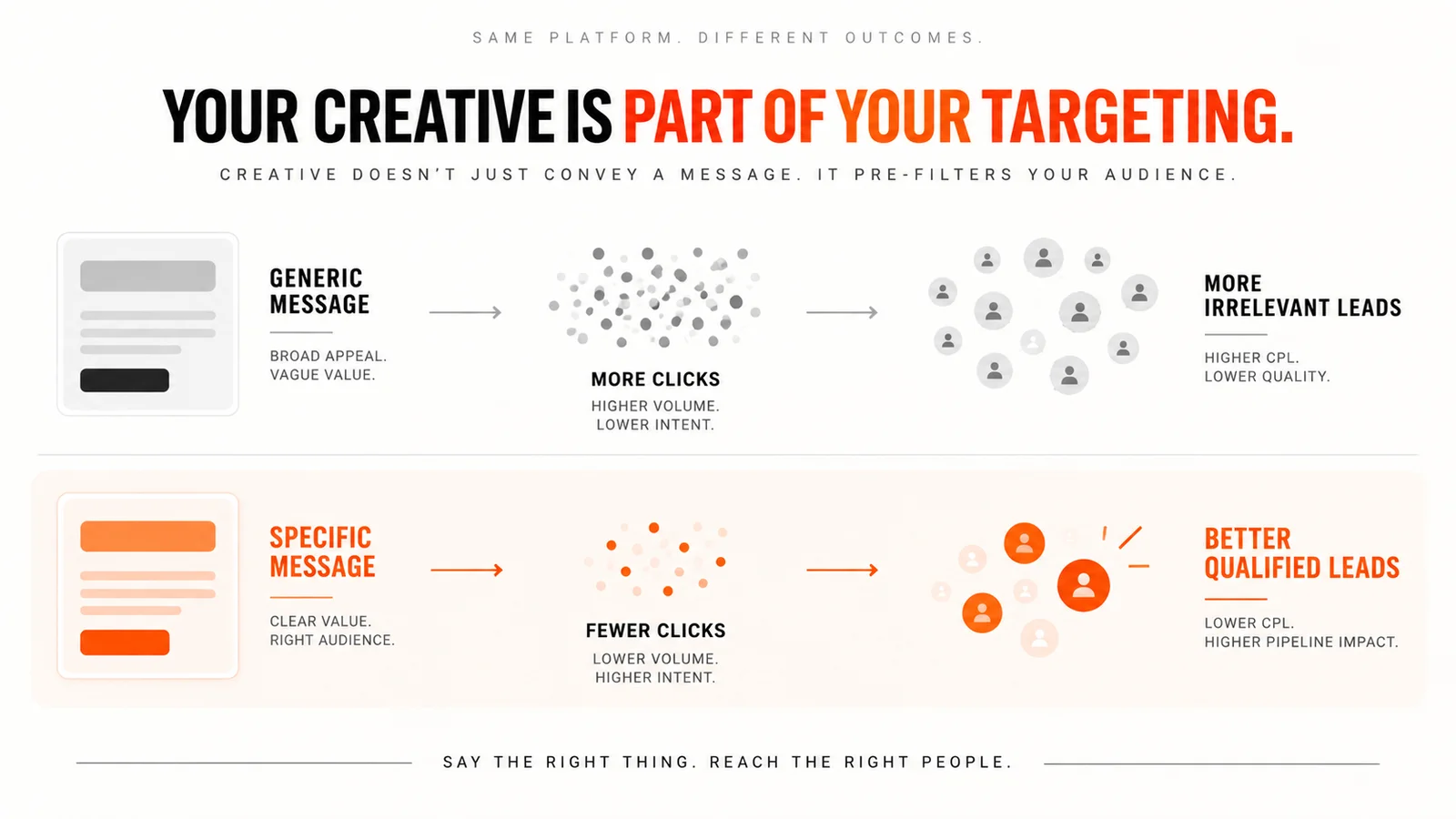
Your ad copy is not just there to persuade. It decides who pays attention, who clicks and who scrolls past. That makes creative a targeting layer.
By Hem Meisheri · September 2026
Most advertisers think about targeting as something that happens inside Meta Ads Manager.
Choose an audience. Choose a location. Choose a job title. Choose an interest. Then let Meta find the people most likely to convert.
But there is another form of targeting that is often overlooked: your creative. The words you put in the ad can decide who pays attention, who clicks and who ignores you. That means your creative doesn't only need to convince someone to take action. It can also help decide who should take action in the first place.
This becomes particularly important with B2B Meta Ads. Because if your campaign is designed to generate leads, getting more people to submit a form isn't necessarily the goal. You want the right people to submit it. And sometimes the best way to improve that starts before the form. It starts with the message.
Your Creative Can Tell the Wrong Prospect to Leave
Imagine you're running Meta Ads for a B2B performance marketing service. Your actual ICP might be: a D2C or B2B company, already spending significantly on paid media, with an internal marketing team, a specific acquisition problem, enough budget to act on recommendations, and looking for a performance partner rather than basic campaign setup.
Now imagine your ad says: "Want to grow your business with Meta Ads?"
Almost anyone can relate to that. A founder. A student. A freelancer. A small business owner. Someone who has never run paid ads. Someone spending ₹10,000 a month. Someone spending ₹10 lakh a month. The message doesn't tell the wrong person to leave. So they don't.
Now change the message to: "Spending ₹5L+ a month on Meta Ads but still can't see where the growth is leaking?"
The audience has immediately changed. Someone spending ₹20,000 a month may scroll past. Someone who doesn't run Meta Ads may scroll past. But someone spending ₹5 lakh a month and struggling with CAC might stop.
You didn't necessarily change the targeting. You changed the qualification. That's the power of creative as targeting.
B2B Meta Ads Don't Always Need More People
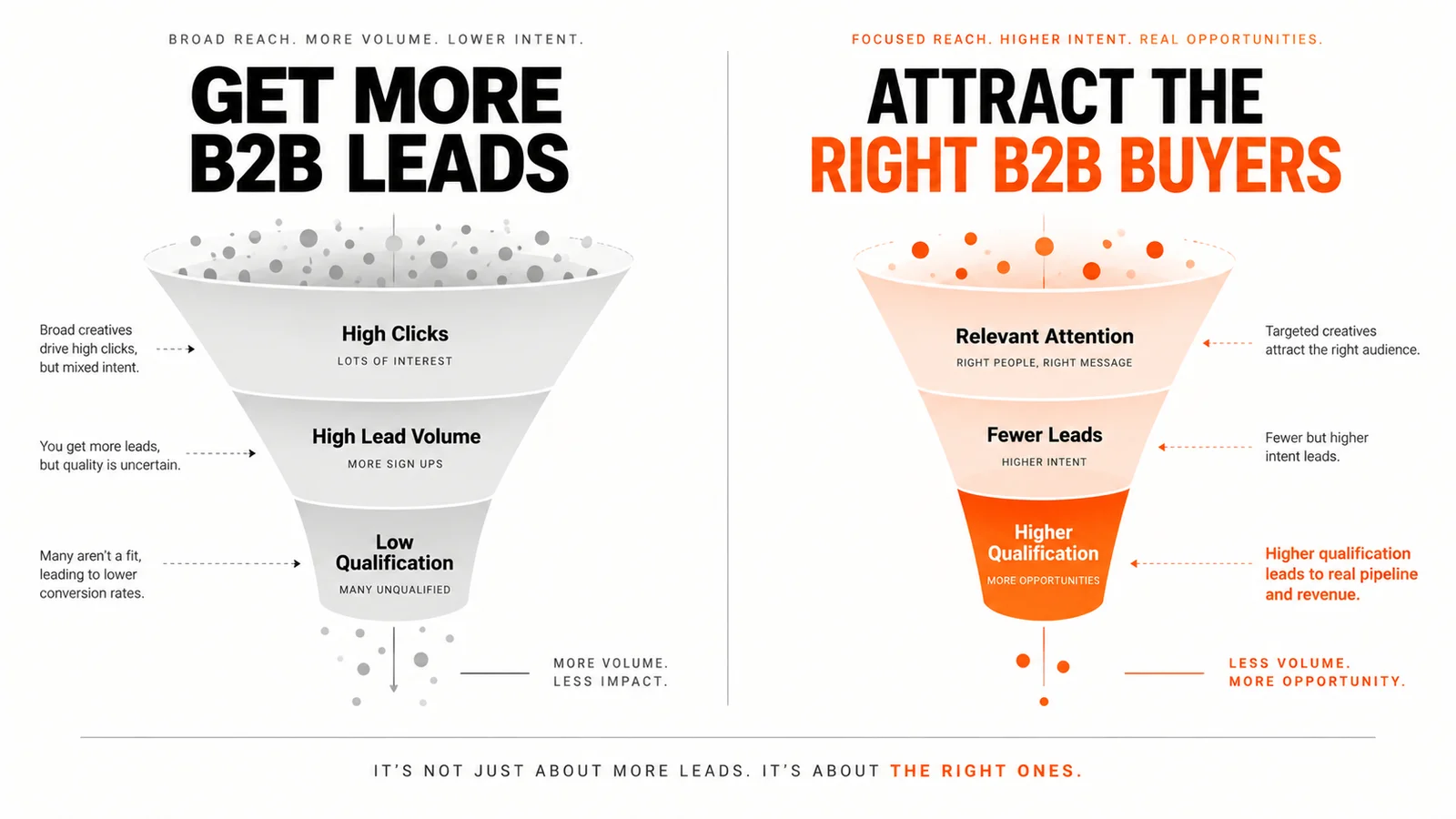
One of the easiest ways to look at a lead-generation campaign is: more leads equals a better campaign. But that's not necessarily true.
If you generate 500 leads and 450 are irrelevant, you've created more work. Sales has to call them, email them, qualify them, follow up, mark them as irrelevant, update the CRM and move on. The campaign may look successful in Meta Ads Manager. The sales team may feel completely differently.
This is why B2B lead quality matters, and why the first article in this series covered how to improve B2B lead quality with intentional friction. Creative can influence that quality before the person even reaches the form.
Start With Your ICP
Before creating a B2B ad, you should know who you actually want. Not just "business owners." That's too broad. Define the characteristics that genuinely matter:
- Company: what type of company is this?
- Size: how large does the company need to be?
- Role: who needs to see this?
- Budget: is there a minimum advertising or operating budget?
- Problem: what problem are they already experiencing?
- Intent: what would make them actively look for a solution?
Once you know those things, your creative can start doing some of the filtering.
Don't Make the Ad Attractive to Everyone
This sounds counterintuitive. Most advertisers want their ads to appeal to as many people as possible. But in B2B, broad appeal isn't necessarily useful.
If you work with a specific type of company, your creative should make that clear. For example, instead of "Get more leads from Meta Ads," try: "Generating hundreds of Meta leads but your sales team says most aren't qualified?"
Now the person has to recognize the problem. Someone who has never experienced it may ignore the ad. Someone experiencing exactly that problem may stop. That is useful. You're not trying to maximize curiosity. You're trying to maximize relevant curiosity.
Use Specific Problems Instead of Generic Benefits
Generic marketing language sounds like: grow faster, scale your business, get more leads, increase your revenue. Almost every business can say these things. They don't tell the right prospect that the message is for them.
Instead, start with a problem. For example:
- "Your Meta CPL dropped 30%. Your pipeline didn't."
- "Your sales team isn't asking for more leads. They're asking for better ones."
- "500 Meta leads. 12 sales conversations. Where did the rest go?"
These statements create recognition. The right prospect thinks: "That's exactly what's happening." That's when the creative starts doing its job.
Problem-Led Creative Can Improve Lead Quality
Think about the relationship. Generic message → more people relate → more clicks → more form submissions → more irrelevant leads.
Now compare it with: specific problem → fewer people relate → more relevant clicks → more qualified submissions → less wasted sales time.
The second campaign may generate a higher CPL. That doesn't automatically mean it's worse. If the qualification rate improves significantly, your cost per SQL could actually become lower.
This is exactly why the first two articles in this cluster matter. In the first, we looked at adding friction to improve lead quality. In the second, we looked at feeding CRM outcomes back into Meta. Now we're moving one step earlier: can the creative itself improve the signal before the person submits the form? Yes.
Your Ad Can Pre-Qualify the Prospect
Think of the ad as the first qualification question. You don't have to literally ask "Are you a good fit?" You can communicate the criteria through the message.
For example: "For B2B companies spending ₹3L+ per month on paid acquisition." That statement tells the right person "this is for me," and the wrong person "probably not for me." That's a good outcome. You don't need every person who sees your ad to click. You need the right people to click.
Use Numbers When They Actually Qualify the Audience
Numbers can be useful when they're based on your actual ICP. For example: ₹5L+ monthly ad spend, 50+ employees, 10+ salespeople, ₹1Cr+ annual revenue. These can immediately create a qualification layer.
But don't invent thresholds just because they look impressive. If your sales team genuinely needs a company to have a certain level of budget, size or complexity, make that visible. The number should represent a real qualification criterion. Otherwise, you're just adding noise.
Creative Can Also Filter by Problem
You don't always need a company-size qualifier. Sometimes the problem itself is the filter.
For example: "Your Meta CPL looks great. Your sales pipeline doesn't." This attracts businesses that already measure CPL and are experiencing a disconnect between marketing and sales.
Another: "Getting leads from Meta but your sales team keeps calling them junk?" This is much more likely to attract someone with a lead-quality problem than someone simply looking for cheap leads. Your audience is being filtered by pain.
Different Creative Can Attract Different Buyers
You don't need every creative to say the same thing. Suppose you're targeting B2B companies. One creative could focus on lead quality. Another on CAC. Another on pipeline. Another on creative testing. Another on attribution. Another on sales and marketing alignment.
Each one can attract a slightly different type of prospect. That's useful because you're learning which problem is creating the strongest commercial intent. The creative isn't just an ad. It becomes a signal about the customer's problem.
Don't Confuse CTR With Good Creative
A high CTR can look impressive. But a click isn't the outcome. Imagine:
| Metric | Creative A | Creative B |
|---|---|---|
| CTR | 2.5% | 1.2% |
| CPL | ₹700 | ₹1,400 |
| SQL rate | 5% | 30% |
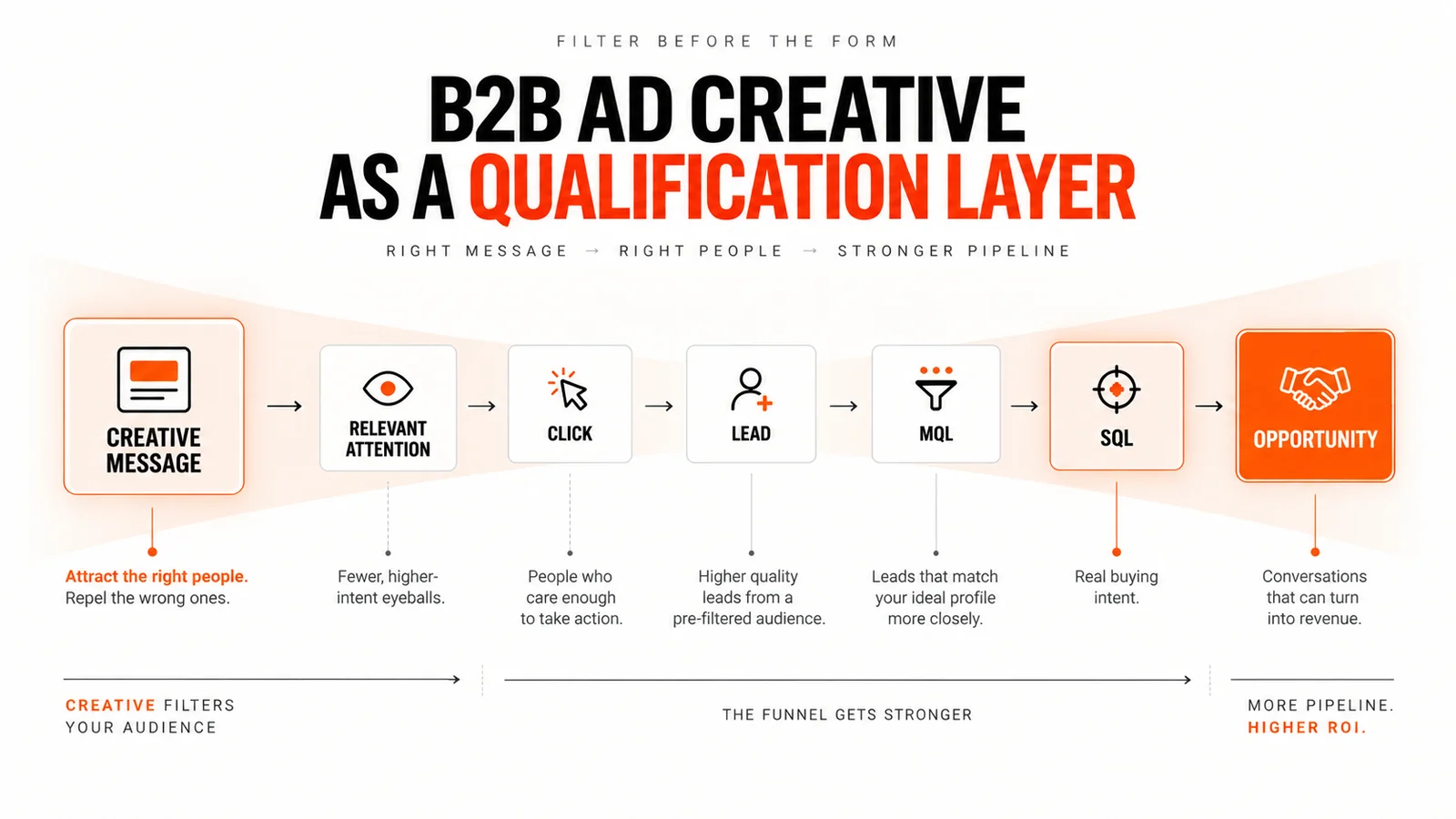
Creative A looks better if you're looking only at CTR and CPL. But Creative B may be producing far more valuable sales opportunities. This is why your creative evaluation should move down the funnel: CTR → landing page or form conversion → lead quality → MQL → SQL → opportunity → revenue.
The best creative isn't necessarily the one that generates the most clicks, and the same principle applies to diagnosing where Meta Ads traffic quality breaks down. It's the one that helps generate the right business outcome.
Creative Can Help Meta Understand Value
This becomes even more interesting when combined with the CRM feedback loop from the previous article.
Suppose you have two types of leads. Creative A generates lots of leads, but most are poor-fit. Creative B generates fewer leads, but a much larger percentage become SQLs. If your CRM signals are connected properly, Meta can eventually receive information that helps distinguish those outcomes.
Now the creative itself becomes part of a larger system: Message → Person → Lead → CRM → SQL → Opportunity → Revenue. This is where B2B performance marketing becomes much more than ad setup. You're designing the entire feedback loop. The ELGi Equipment case study shows what that looks like when pipeline, not lead volume, is the goal.
What About Broad Targeting?
This is where creative becomes even more important. As Meta takes more control over audience discovery and delivery, advertisers increasingly have to think about the signals they're giving the system. You can't assume that manually defining every audience characteristic will solve everything.
The creative itself can become an important source of information. If your ad repeatedly speaks directly to B2B SaaS founders, or companies spending ₹5L+ on paid acquisition, or marketing teams struggling with lead quality, you're giving the market a much clearer reason to self-select.
That doesn't mean Meta will only show the ad to those people. It means you're making the value proposition and qualification criteria much clearer.
Use Creative to Filter, Not Just Persuade
This is probably the biggest change I'd make to how you think about B2B creative. Don't ask only: "Will this make someone click?" Ask: "Who will this make click?" Those are very different questions.
A generic headline might get more clicks. A specific headline might get fewer clicks but attract better prospects. That trade-off can be completely worthwhile. Because the objective isn't maximum attention. It's useful attention.
A Simple B2B Creative Framework
Before launching a new B2B Meta Ads creative, write down five things.
- Who is this for? Example: B2B companies already spending on paid acquisition.
- What problem are they experiencing? Example: lead volume is increasing but sales-qualified opportunities aren't.
- What makes the problem expensive? Example: sales spends time chasing poor-fit leads.
- What is the insight? Example: optimizing for CPL can teach Meta to find cheaper form submissions rather than better buyers.
- Who should respond? Example: companies that already have enough lead volume but need better pipeline quality.
Now turn that into your creative. You don't need to hide the qualification. Make it visible.
Example: From Generic to Specific
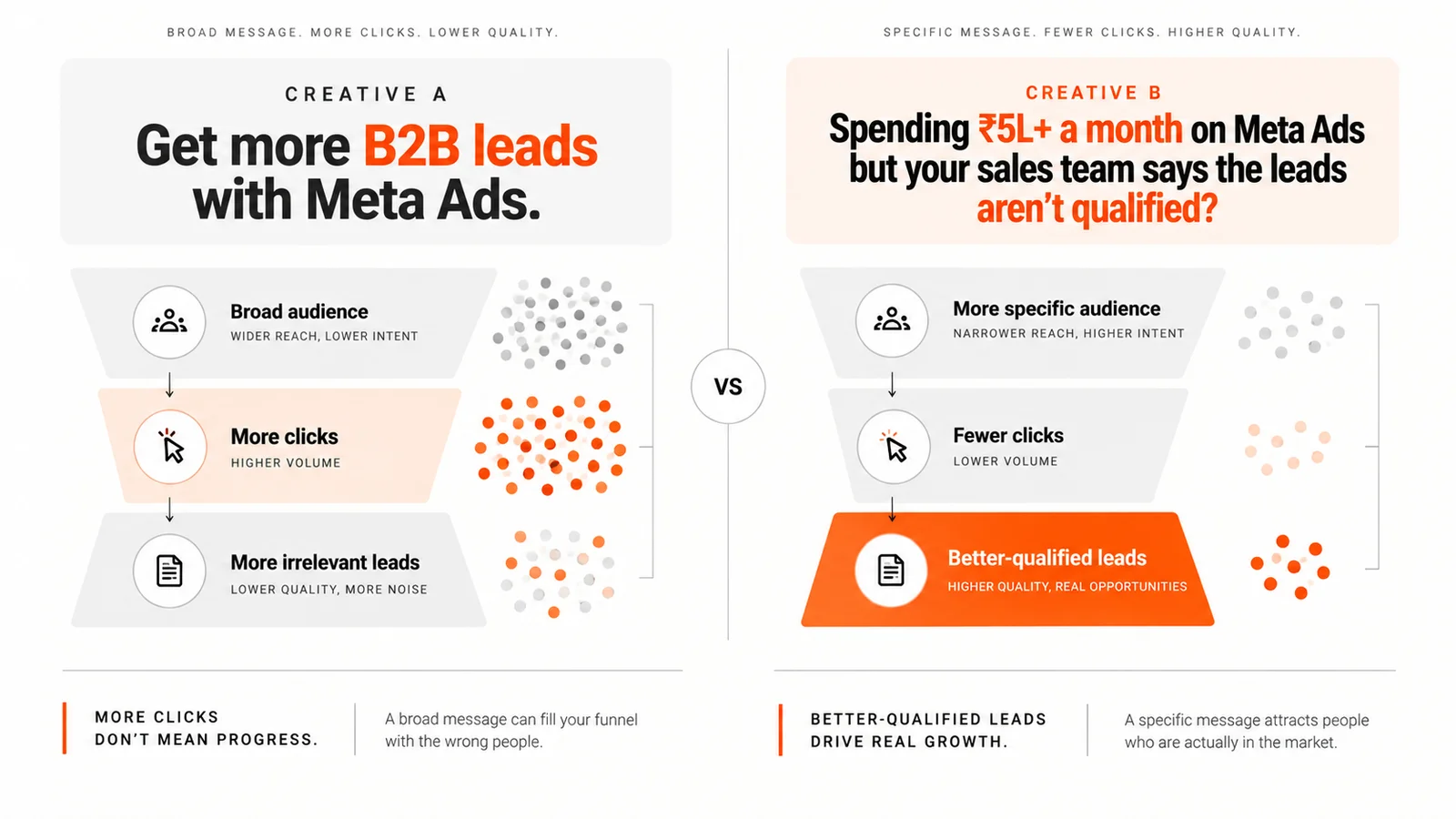
Generic: "Get more B2B leads with Meta Ads." Nothing is technically wrong with it. But it's broad.
Better: "Getting B2B leads from Meta but sales says they're junk?" Now we're talking to someone with a specific problem.
More qualified: "Spending ₹3L+ on Meta but your sales team can't qualify the leads?" Now we're talking to a narrower audience.
Even more specific: "For B2B teams spending ₹3L+ on Meta: if CPL is falling but SQLs aren't, your optimization signal may be wrong."
This isn't necessarily going to produce the highest CTR. But the people who recognize the problem are much more likely to understand why the ad exists. That's the point.
Your Creative Should Match the Funnel
Not every prospect is at the same stage. Someone seeing you for the first time may need problem awareness. Someone who knows the problem may need education. Someone comparing solutions may need proof. Someone ready to act may need an offer and a next step.
Your creative should reflect that. A cold audience may not need a hard sales pitch. A warm audience may not need another educational explanation. This is why creative strategy and audience strategy can't be completely separated. They work together.
How to Test This Properly
Don't create ten completely different ads and call it a test. Start with one clear hypothesis. For example: specific qualification language will reduce lead volume but improve SQL rate.
Then create Version A with a generic problem message, and Version B with the same core message plus a specific ICP qualifier. Keep the important variables controlled. Then compare CTR, CPC, CPL, MQL rate, SQL rate, cost per SQL and opportunity rate.
The test is successful if the business outcome improves, not simply because the new ad has a better CTR. A disciplined creative testing framework keeps those variables isolated so the result actually means something.
The Goal Is Not to Make the Audience Smaller
There is an important distinction here. Creative qualification isn't about deliberately making your audience tiny. It's about making the message more relevant to the people you actually want.
If your ICP is genuinely broad, your messaging can remain broad. If your ICP is narrow, your messaging should reflect that. The right level of specificity comes from the business, not from an arbitrary SEO or advertising formula.
The Connection Between Creative, CRM and Meta
Now put the three articles together:
- Article 1, improve lead quality before sales receives the lead: better forms, qualification questions, intentional friction, clearer criteria.
- Article 2, tell Meta what happens after the lead: CRM stages, MQL, SQL, opportunities, Conversions API, revenue feedback.
- Article 3, improve the quality of the people entering the funnel: problem-led creative, ICP-specific messaging, qualification language, clear positioning, creative testing.
Together: Creative → Qualified attention → Lead → MQL → SQL → Opportunity → Customer → Revenue → Feedback to Meta. That's the system.
FAQs About B2B Meta Ads Creative
Should B2B Meta Ads creative mention the target audience directly? If the audience has a meaningful qualification criterion, yes. Industry, company size, role or spending level can make sense when they genuinely reflect your ICP.
Will more specific creative reduce my CTR? It can. That's not automatically a problem. If clicks decrease but SQL quality improves, the campaign may actually become more efficient.
Should I optimize B2B creative for CPL? No. CPL can help you diagnose acquisition efficiency, but evaluate the creative against lead quality, SQL rate, opportunity creation and eventually revenue.
Should every creative have a qualification statement? No. Some creatives should educate, some demonstrate proof, some address objections and some qualify. The important thing is that your overall creative system covers the questions your buyers have.
Can creative replace audience targeting? No. Creative is another signal and qualification layer. It doesn't replace a sound audience strategy, offer, measurement setup or sales process.
Stop Asking "Which Ad Gets More Clicks?"
The better question is: which ad attracts the right people? And then: which of those people become qualified leads? And then: which qualified leads become opportunities? And eventually: which opportunities become revenue?
That's the difference between looking at creative as an asset and looking at creative as part of a performance system. Your ad doesn't have to convince everyone. It needs to make the right person recognize themselves in the problem.
The clearer you are about who the offer is for, what problem you're solving and what qualifies someone to take the next step, the more useful your advertising signal becomes. And when that signal is connected to your CRM and downstream outcomes, you're no longer optimizing creative only for clicks. You're building a system that learns which messages attract the people your business actually wants.
That's where B2B Meta Ads become much more interesting. Not more clicks. Not more leads. But better people entering the funnel, better signals going back to Meta, and better business outcomes coming out the other end. If you'd rather have someone build that system with you, that's exactly what my B2B performance marketing work covers.
Want a second opinion on whether your B2B creative is attracting the right buyers? Send me your current ads on WhatsApp.
Message me on WhatsApp