Lead Quality vs. Volume: When to Introduce Friction in Your B2B Meta Ads
A low CPL can wreck a B2B pipeline. Intentional friction protects B2B Meta Ads lead quality by filtering weak intent before sales spends a single call block on it.
By Hem Meisheri · September 2026
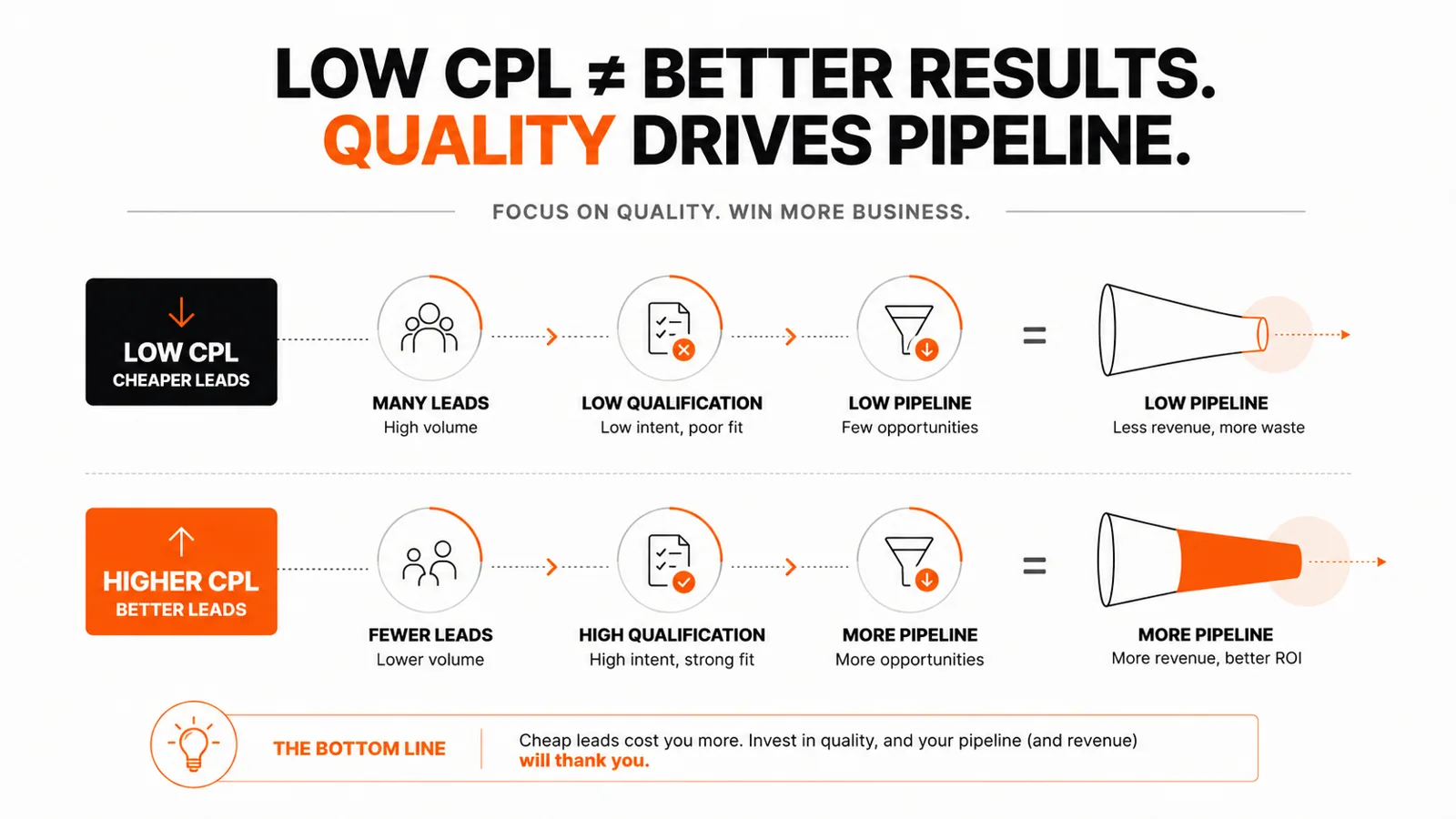
Meta's native lead objective rewards the people most likely to tap submit with the least effort. That often means casual scrollers, accidental mobile submissions, personal email addresses, and contacts who deny filling out the form when sales calls.
Sales then spends its day sorting form fills instead of speaking with buyers. The campaign looks efficient in Ads Manager while opportunity creation stays flat.
Intentional friction changes the signal. Review screens, corporate email requirements, and questions that require a real answer make a prospect pause before submitting. That pause filters weak intent and gives Meta a better pattern to pursue.
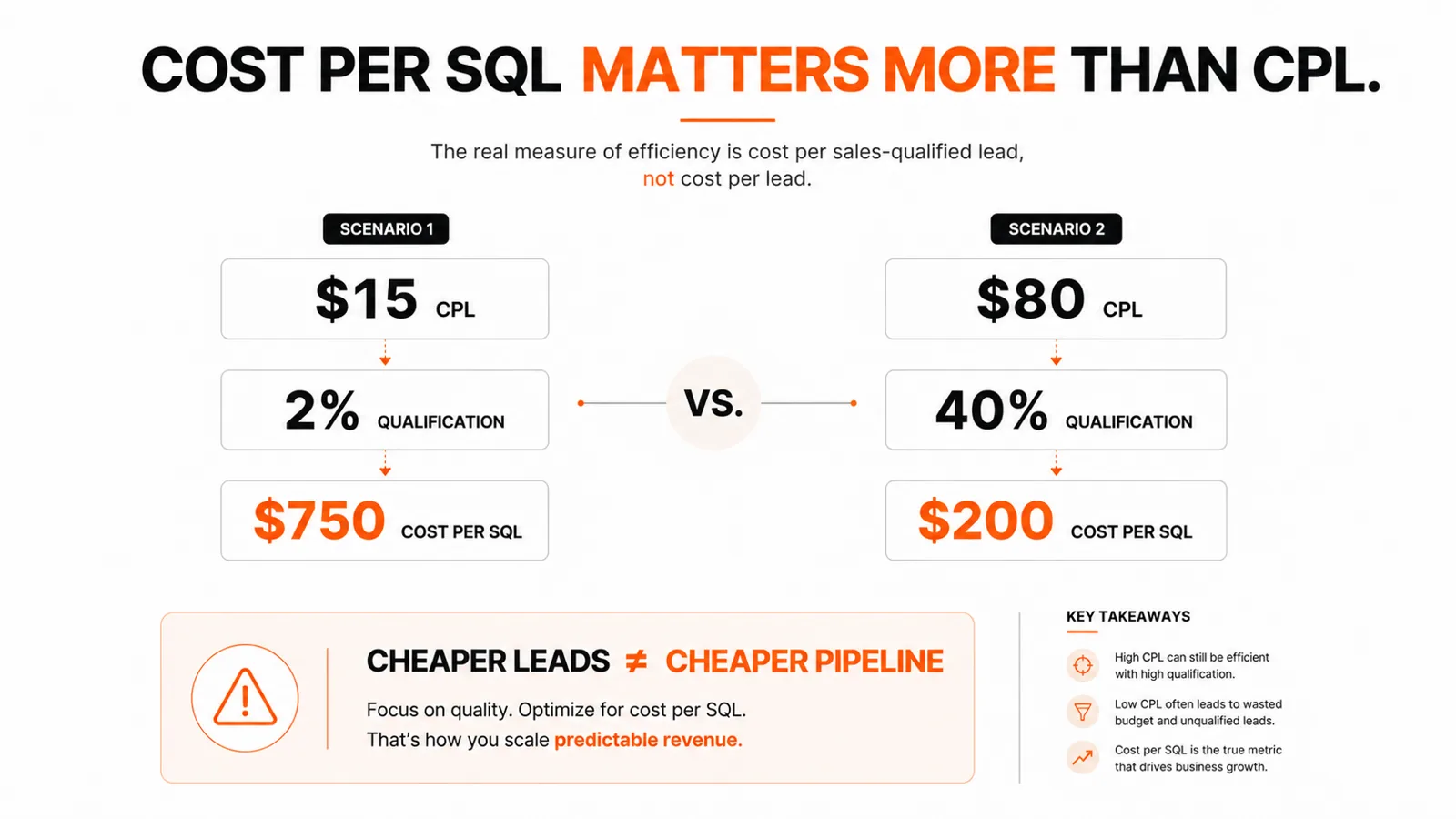
The metric worth protecting is cost per sales-qualified lead. A more expensive form fill can produce far more pipeline when it reaches a real buyer.
The Real Math of B2B Friction: Cost per Lead vs. Cost per SQL
Cost per SQL is the decision metric.
A $15 CPL with a 2% qualification rate costs $750 per qualified lead. An $80 CPL with a 40% qualification rate costs $200 per qualified lead, even though the dashboard makes the $15 campaign look cheaper.
Meta can still be an efficient place to buy attention. Average CPC is $0.62 on Meta versus $5.39 on LinkedIn, while B2B SaaS CPM averages $4 on Meta versus $25 to $60 on LinkedIn. Cheap reach gives you room to ask better questions before sales gets involved. That cost gap does not make one channel better than the other, and LinkedIn Ads for B2B lead generation still earns its place when you need precise firmographic targeting.
Canem Errant reported a B2B SaaS account that moved from 45 MQLs at €89 CPL and a 12% SQL rate to 112 MQLs at €52 CPL and a 34% SQL rate over 12 weeks. The account increased lead volume while tripling its sales-qualified lead rate.
A B2B sales manager feels this gap quickly. Give her 100 cheap leads with weak fit, and her team spends call blocks chasing dead numbers. Give her fewer contacts who match role, company, and budget criteria, and those same call blocks can create opportunities.
This walkthrough shows how lead forms can raise lead quality before a sales handoff.
Track CPL as a supporting number, then calculate cost per SQL from the CRM. That calculation tells you whether added friction is paying for itself.
When Should You Add Friction? 5 Warning Signs
Add friction when sales can show that form volume has stopped turning into conversations.
- More than 70% are unreachable: Sales reports that most inbound contacts cannot be reached or say they never submitted the form.
- Personal addresses dominate: Gmail and Yahoo addresses outweigh verified corporate domains in the form-fill mix.
- Submissions arrive in under five seconds: Native mobile autofill is doing the work, leaving little sign that the person read the offer or qualification criteria.
- MQL volume rises while opportunities stall: The top of the funnel grows, but pipeline opportunity creation stays flat or falls.
- Fast follow-up produces almost no connections: A reply inside 60 minutes produces near-zero connection rates. Dadek Digital reports that leads are nearly seven times more likely to qualify when contacted within 60 minutes than when the response waits an hour longer.
These signs point to a capture problem, not a sales-speed problem. Start by checking the CRM lead match rate, then flag the share of Meta leads marked non-ICP or unreachable. Keep that share below 15%.
If the same symptoms show up after the click rather than inside the form, the read belongs with Meta Ads traffic quality instead.
If the warning signs are present, adding a review step and a small set of qualification fields is a direct way to protect sales capacity.
4 Smart Friction Levers for Meta Instant Forms
Use the smallest barrier that removes weak submissions while preserving real buyer intent.
- Higher Intent form type: Turn on the form type that adds a review screen. Prospects must swipe and confirm their pre-filled details, which removes accidental taps and rushed submissions.
- Custom qualifying questions: Add one to three fields that Meta cannot prefill, such as company size, role, or paid-ad spend tier. Meta allows up to 15 questions across four formats, but a short form keeps the focus on the facts sales needs.
- Conditional logic routing: Route answers that miss your criteria to a polite end screen. Send qualified respondents to instant booking, so a good lead can choose a meeting while intent is fresh.
- Advantage+ Lead Verification: Require corporate email validation and SMS authentication where appropriate. Meta introduced these checks to cut lead waste by roughly 10%.
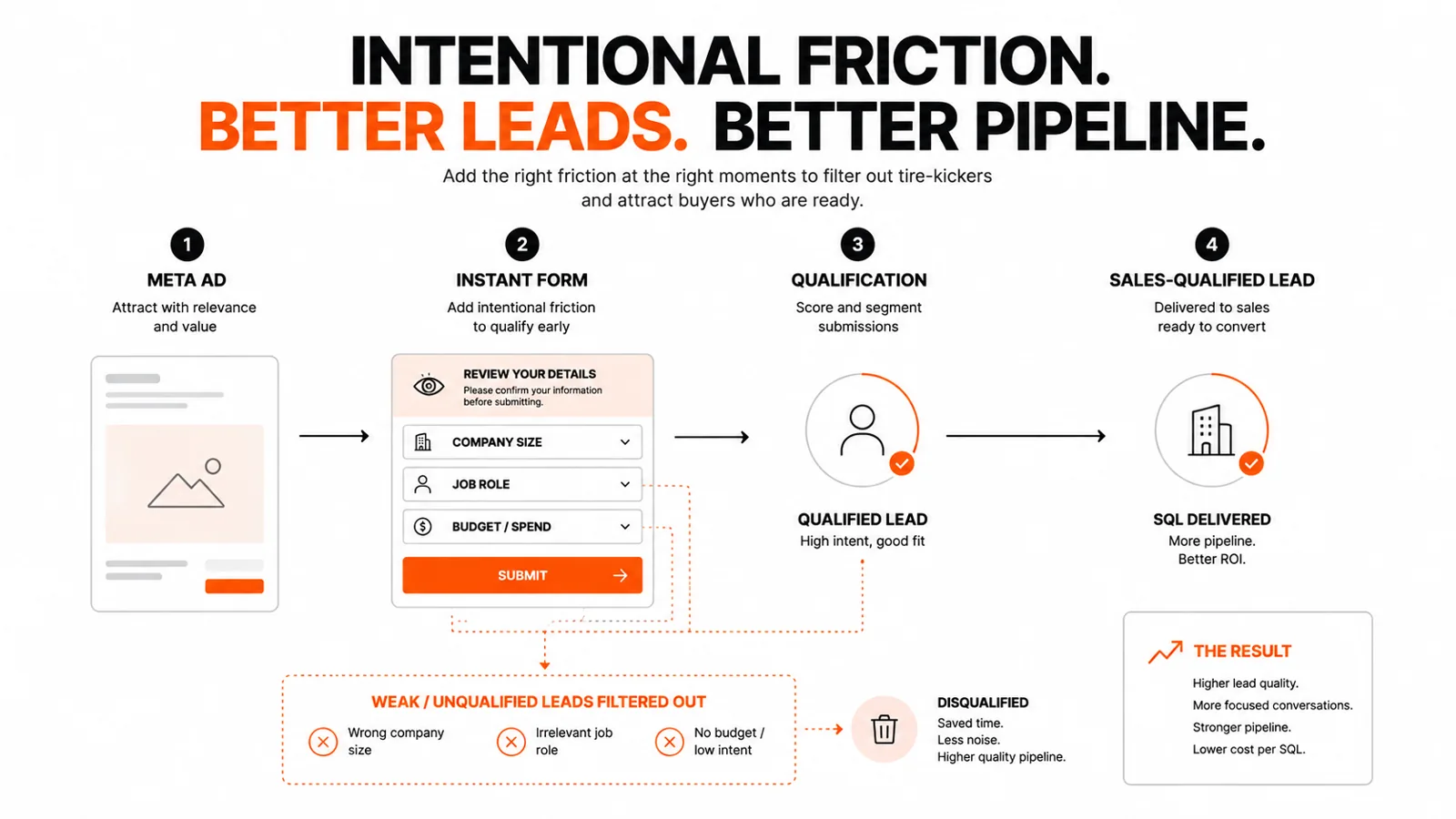
Set the questions from your documented ICP, not from curiosity. If company size, role, and budget determine whether sales accepts a lead, ask for those fields. Avoid adding questions that no one will use in the CRM.
Start with the higher-intent form type and two custom questions. Review SQL rate after the change, then add verification or conditional routing when personal emails and unreachable contacts remain common.
Filtering Before the Click: Using Problem-Led Creative as Friction
Your ad creative should state who the offer is for before anyone opens the form.
Generic copy such as "Want to grow your revenue?" attracts broad curiosity. A line such as "If your company manages 50+ reps and spends over €3,000/month on paid ads" gives the right prospect a reason to continue and gives everyone else a reason to move on.
Use the opening of the ad to name the operational problem your buyer already feels. Then make the qualifier visible in the creative and copy. A structured creative testing framework makes this repeatable instead of a one-off rewrite.
- Name the company threshold that matters to your sales team.
- State the relevant spend threshold or operating condition.
- Describe the problem in the buyer's daily language.
- Make the diagnostic call the next step for people who meet the criteria.
A two- to four-minute video sales letter adds useful friction before form entry. Use the first minute to name the operational problem, the second to explain the structural framework, and the third to ask for a diagnostic call.
Watch depth then becomes a behavioral signal. Someone who reaches 75% or 95% of the video has spent more time with the problem than someone who taps a pre-filled form immediately. Build lead capture around that higher-intent audience, then keep the form questions aligned with the same criteria.
Instant Forms vs. Landing Pages: Selecting the Right Capture Mechanism
Choose the capture path based on the sales motion and the amount of proof a buyer needs before a conversation.
Across more than 3,000 campaigns, Facebook Instant Forms averaged a 12.54% conversion rate versus 10.47% for external landing pages. Raw instant-form submissions were also 30% to 50% cheaper, which makes them useful when you need volume and can qualify it properly.
| Channel | Friction | Best for | Signals |
|---|---|---|---|
| High-volume instant form | Low | Broad early-stage lead capture | Form submit |
| Higher-intent instant form | Medium | B2B offers with clear ICP criteria | Review, answers, verification |
| Website landing page | High | Longer sales cycles needing fuller context | Page behavior, multi-step responses |
| Hybrid architecture | Medium | Video-led qualification before capture | Watch depth, form answers |
High-volume instant forms fit campaigns where a sales team can handle more early-stage inquiries. Higher-intent forms fit when sales needs role, company, or spend information before accepting a lead.
Landing pages fit longer sales cycles where buyers need more explanation before sharing details. A hybrid path uses problem-led video or ad creative to filter attention, then sends engaged viewers into a higher-intent instant form.
Pick the path that sends the clearest sales signal, then judge it by cost per SQL rather than raw submission cost.
Closing the Loop: Training Meta on CRM Conversions via CAPI
Send CRM milestones back to Meta so delivery can learn which leads become revenue opportunities.
Conversions API reduces browser-level tracking loss. Involve Digital reports an average 19% improvement in cost per result for advertisers using Conversions API alongside the pixel.
Without downstream CRM events, Advantage+ Leads can drift toward people who complete forms cheaply. The same setup can run nearly twice as high in cost per MQL when it lacks the CRM feedback needed to distinguish a buyer from a casual responder. This is also why diagnosing Meta Ads performance rarely ends with a settings change.
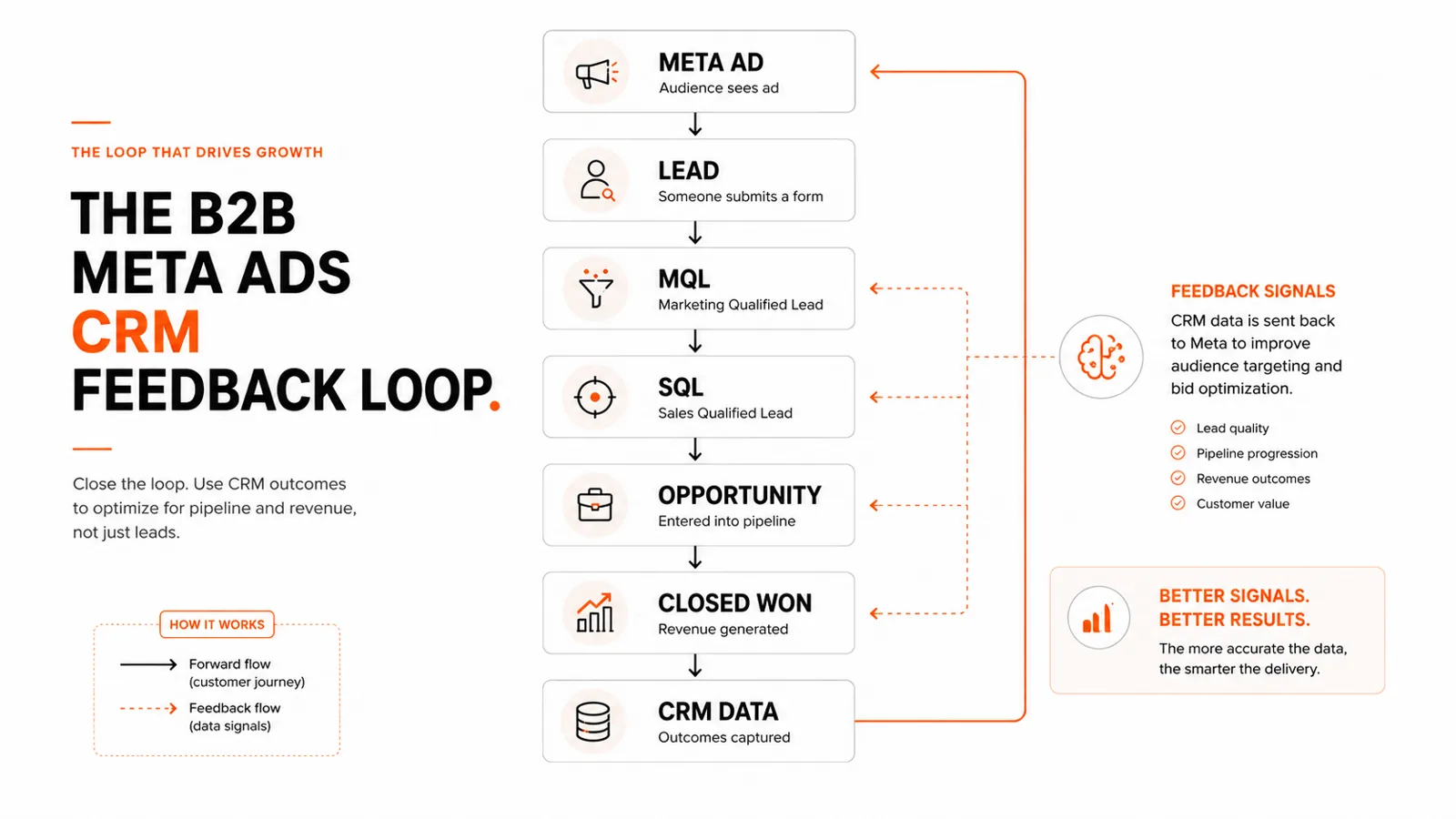
Build the feedback loop in this order:
- Map CRM stages: Send MQL, SQL, Opportunity Created, and Closed Won events back to Meta.
- Set the attribution window: Use a 7- to 28-day window so the system can connect a lead with later CRM movement.
- Check event volume: Aim for at least 50 conversion events in a seven-day window. If closed-won volume is lower, use an intermediate event such as a booked demo.
- Verify event quality: In Events Manager, confirm that server events fire, deduplication works, and Event Match Quality is above 6.0.
The form supplies the first quality filter. CRM events tell Meta whether that filter produced sales-worthy leads, which is the feedback loop that keeps delivery pointed at pipeline. The next step is choosing which of those events to optimize for: feed downstream CRM outcomes back into Meta.
Frequently Asked Questions About B2B Meta Lead Quality
Will adding qualifying questions spike my CPL too high?
CPL can rise after you add qualification questions, and that is acceptable when cost per SQL falls. Measure the qualification rate and sales acceptance rate alongside CPL before judging the change.
How do I avoid the learning phase when lead volume falls below 50 events per week?
Use an intermediate CRM milestone, such as booked demo, when SQL or closed-won events do not reach 50 per week. Send that event through Conversions API within a 7- to 28-day attribution window.
Should B2B advertisers use Advantage+ audience targeting or manual interest stacks?
Use Advantage+ Audience only with CRM lifecycle events feeding back through Conversions API. Those events give Meta a buyer-quality signal; without them, delivery can drift toward cheap form completions.
How does requiring a business email affect mobile completion rates?
A corporate email requirement adds a completion barrier, so fewer people will finish the form. It also removes many personal-email submissions before sales spends time on them, which is the useful trade when corporate domain fit is part of your ICP.
Stop Buying Form Fills: Build an Intent Engine
Start with the CRM. Audit current cost per SQL, add the form friction tied to your ICP, and send MQL, SQL, opportunity, and closed-won milestones back through Conversions API.
Make one active form higher intent today, then review the next week's SQL rate and unreachable-lead share. That gives you a revenue-based signal for the next change, and it is the fastest way to lift B2B Meta Ads lead quality without buying more cheap leads.
Want a second opinion on whether your Meta lead forms are protecting pipeline or just producing cheap form fills? Send me the setup on WhatsApp.
Message me on WhatsApp