Moving Beyond CPL: How to Feed B2B Pipeline Signals Back to Meta
A cheap lead is not necessarily a good lead, and a qualified lead is not necessarily a sales opportunity. The next step in B2B Meta Ads is connecting advertising data to your CRM.
By Hem Meisheri · September 2026
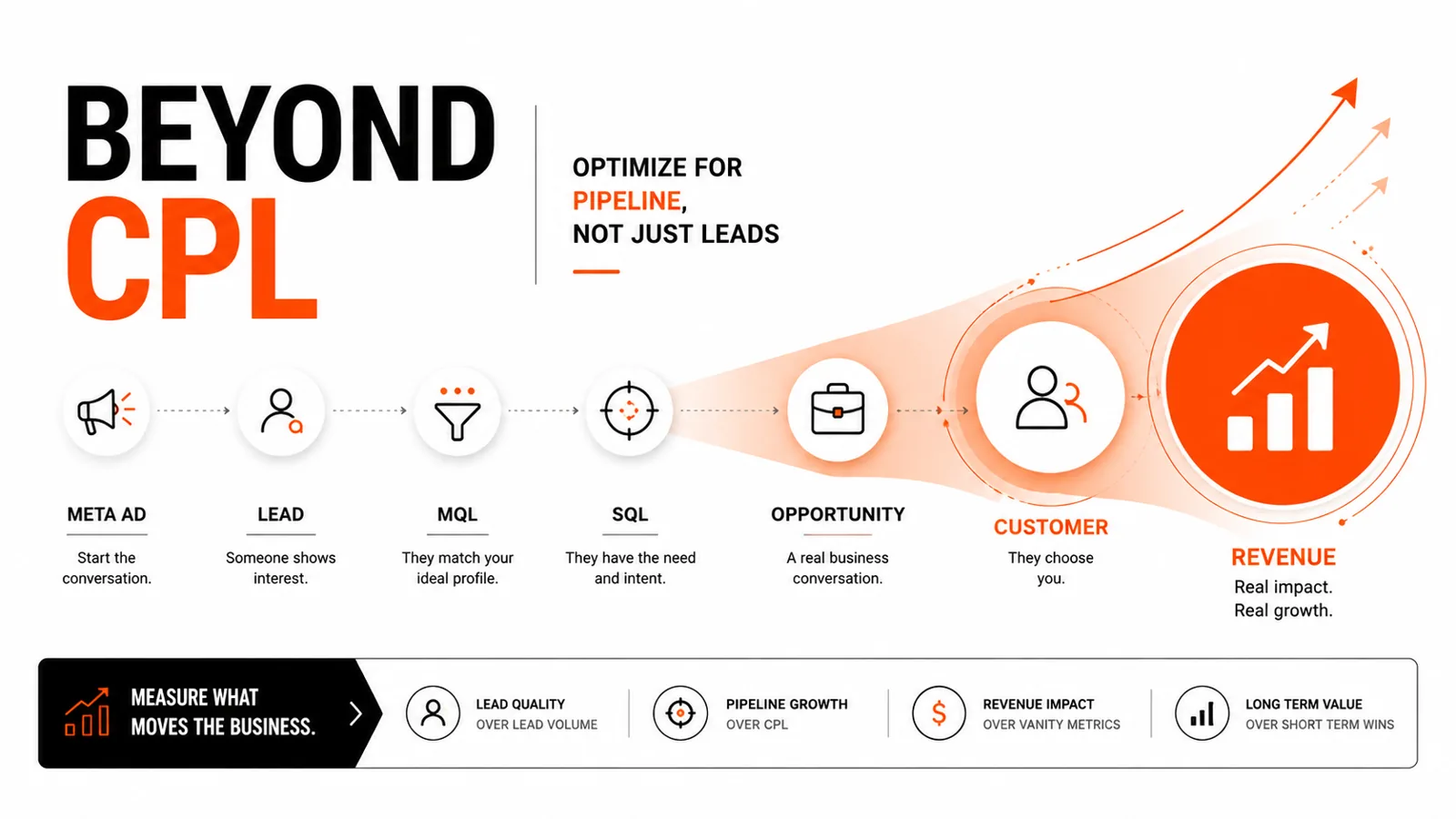
A cheap lead is not necessarily a good lead. And a qualified lead is not necessarily a sales opportunity.
This is one of the biggest problems with measuring B2B Meta Ads only through metrics such as CPL, leads or even MQLs. A person can click an ad, submit a form and become an MQL without ever becoming a customer. If Meta only receives that first conversion signal, it has very little information about what happened next.
Did the lead match your ICP? Did sales accept it? Did they book a meeting? Did they become an opportunity? Did they eventually become a customer? Those are very different outcomes.
For B2B companies, the real performance of Meta Ads often becomes visible much further down the funnel. That is why the next step after improving lead quality is to connect your advertising data with your CRM and start thinking beyond CPL. It is also the point where B2B performance marketing stops being a lead-count exercise.
CPL Tells You What You Paid For a Lead. It Doesn't Tell You What the Lead Was Worth.
Suppose you run two B2B Meta Ads campaigns. Campaign A generates 200 leads at ₹500 per lead. Campaign B generates 80 leads at ₹1,200 per lead.
Looking only at CPL, Campaign A appears to be the obvious winner. But then the CRM tells you something different.
- Campaign A: 200 leads → 30 MQLs → 8 SQLs → 2 opportunities
- Campaign B: 80 leads → 35 MQLs → 18 SQLs → 7 opportunities
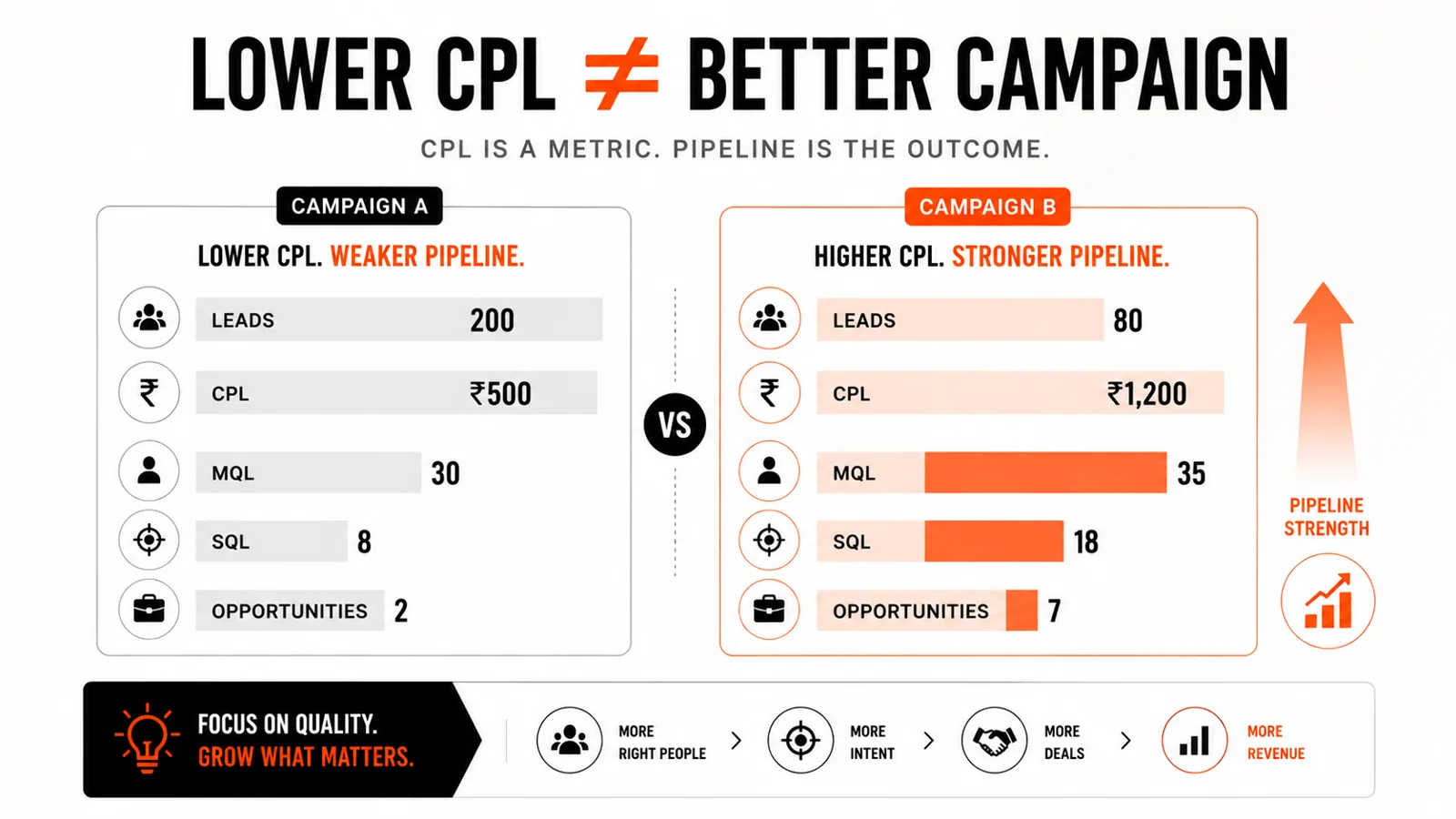
Campaign B is generating fewer leads and paying more for each one. But it is producing substantially more sales-qualified opportunities. That changes the decision completely.
The question is no longer "which campaign has the lowest CPL?" It becomes "which campaign is producing the most valuable pipeline for the money we spend?"
That is the shift from lead generation to pipeline optimization, and it is one of the most important changes a B2B performance marketer can make.
The Problem With Optimizing Meta Ads Only for Leads
When you tell Meta that a lead is the conversion you care about, the platform has a straightforward job. Find more people who are likely to generate that conversion.
But a form submission is only the beginning of a B2B sales process. A person who submits a form because they were curious is not equivalent to a decision-maker from a company that fits your ICP. Yet if both actions are treated as the same conversion, the system receives the same basic signal.
Your CRM might look like this: Lead → MQL → SQL → Meeting → Opportunity → Customer. But your advertising account may effectively be looking at: Lead → Conversion.
That missing information matters. The further the advertising signal is disconnected from the actual business outcome, the harder it becomes to judge whether your B2B Meta Ads are genuinely working. This is why a strong B2B Meta Ads setup should not stop at generating leads. It should create a feedback loop.
The B2B Performance Marketing Feedback Loop
Think about the customer journey as a series of signals: Ad → Lead → MQL → SQL → Meeting → Opportunity → Customer → Revenue.
Every step tells you something different. The lead tells you that someone responded. The MQL tells you that the lead meets your basic qualification criteria. The SQL tells you that sales considers the lead worth pursuing. The opportunity tells you that there is a genuine commercial possibility. The customer tells you that the entire process eventually produced revenue.
For B2B performance marketing, the goal is to move the optimization signal closer to the outcome that actually matters. That does not necessarily mean optimizing directly for closed-won revenue from day one. If you only close a small number of deals every month, there may simply not be enough data for that to be a useful optimization event.
Instead, you need to identify the deepest reliable signal that happens frequently enough to provide useful feedback: a booked demo, an SQL, or an opportunity created. The right event depends on the sales volume and length of your sales cycle.
Start With Your CRM, Not Meta Ads Manager
Before changing campaigns, look at what happens after the lead enters your CRM. Take your recent Meta leads and create a simple breakdown.
| Stage | Number |
|---|---|
| Meta Leads | 500 |
| MQL | 140 |
| SQL | 55 |
| Meetings | 32 |
| Opportunities | 14 |
| Customers | 4 |
Now ask a much more useful question: where are the biggest losses happening?
Maybe Meta is producing enough leads, but only 28% are becoming MQLs. That suggests a lead-quality problem. Maybe 70% of MQLs become SQLs, but very few book meetings. That could point toward sales qualification, offer positioning or follow-up. Maybe meetings are strong but opportunities are weak. Now the problem could be the sales conversation, pricing, product fit or qualification criteria.
The advertising campaign should not automatically receive the blame for every drop in the funnel. When the drop happens before the lead, the read belongs with Meta Ads traffic quality instead. The advertising platform tells you what happened before the lead. The CRM tells you what happened after it. You need both.
MQL Is Better Than Lead. SQL Is Better Than MQL.
This sounds obvious, but many accounts never make this distinction operationally. A lead is simply someone who responded. An MQL is someone who meets your basic marketing qualification criteria. An SQL is someone sales considers worth actively pursuing.
For example, imagine your ICP requires 50+ employees, a decision-maker or senior marketing role, existing paid media activity, a minimum monthly advertising budget and a relevant business model. A lead who submits the form but does not meet these conditions should not carry the same value as someone who does.
Before sending better downstream signals, you first need to improve the quality of the leads entering your CRM using qualification questions, higher-intent forms and clearer creative.
But you can go further. You can then use CRM outcomes to understand whether the people you are acquiring actually become qualified opportunities. That creates two layers of optimization. Layer 1: improve the quality of the lead. Layer 2: improve the quality of the outcome after the lead. That is much stronger than simply trying to reduce CPL.
How Conversions API Fits Into B2B Meta Ads
Conversions API is useful because it can help businesses send website or server-side conversion events to Meta rather than relying only on browser-based signals.
For a B2B advertiser, the important concept is not simply "install Conversions API." The important question is "what business events are we sending back?"
If Meta only receives a basic lead event, the system has limited information about what happens after that lead. But if your measurement setup can reliably connect CRM milestones to advertising activity, you can begin building a much richer signal: Lead submitted → MQL → SQL → Opportunity → Customer.
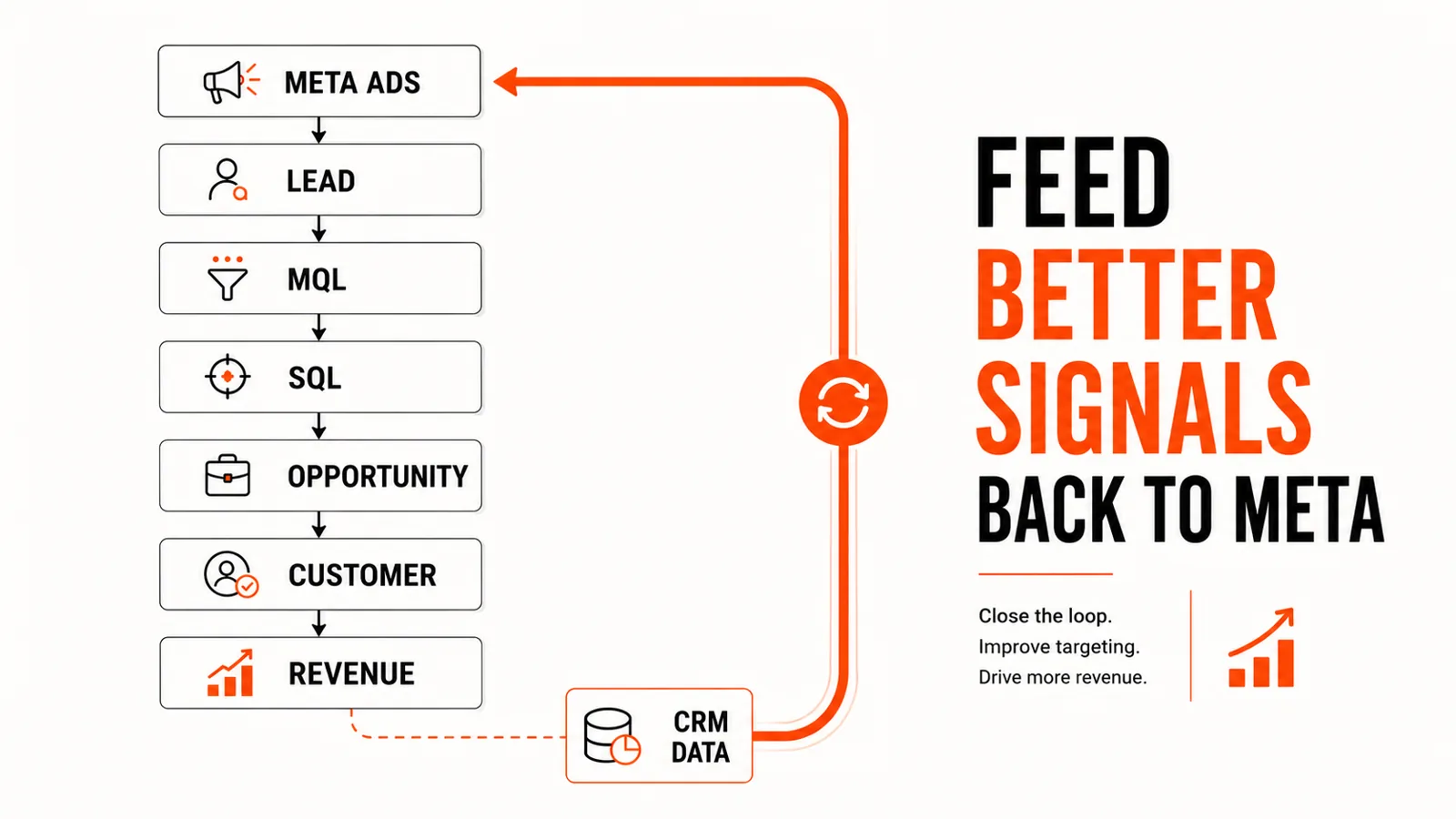
The exact implementation depends on your CRM, tracking setup and Meta configuration, so this should be treated as a measurement project rather than simply adding another tracking script. The principle is simple: do not just tell Meta that someone converted, give it better information about what a valuable conversion looks like.
Don't Send Every CRM Event Just Because You Can
More data does not automatically mean better optimization. A CRM can contain dozens of events: lead created, lead contacted, call attempted, email sent, MQL, SQL, meeting booked, meeting attended, proposal sent, opportunity, negotiation, closed won, closed lost.
You do not necessarily want to treat all of these as equally important signals. Some events are too early. Some are too noisy. Some happen too rarely. Some are heavily influenced by your sales team's behaviour rather than the quality of the original lead.
The goal is to identify the events that have a meaningful relationship with revenue. If almost every SQL eventually becomes a genuine opportunity, SQL may be a useful optimization signal. If only a tiny number of leads become closed customers every month, optimizing directly for closed-won may not provide enough volume. There is no universal best B2B conversion event.
A Simple Way to Find Your Best Optimization Signal
Take the last three to six months of CRM data, then calculate the progression between each stage. For example: 1,000 leads → 250 MQLs → 100 SQLs → 50 meetings → 20 opportunities → 5 customers.
Now calculate the value of each stage. If your average customer is worth ₹5 lakh in revenue, you can work backwards to understand the approximate economic value of progressing through the funnel.
This does not mean you should blindly assign those calculated values inside Meta. It means you now have a business framework for deciding which signals deserve more attention. You can ask which stage is both valuable and frequent enough to use for optimization. That is a much better question than "what gives us the cheapest CPL?" The same working-backwards logic sits behind B2B pipeline math.
The Biggest Mistake: Optimizing for the Wrong Event
Imagine your sales team tells you these leads are terrible. You look at Meta Ads Manager. CPL is down 30%. You celebrate. That is the problem.
The campaign may have become better at generating the exact action you told it to generate. But if that action has little relationship with revenue, the campaign can become more efficient at producing something your business does not want.
This is why performance marketing cannot be separated from business outcomes. A platform metric can be completely accurate and still be commercially misleading. The platform can tell you it generated 500 leads. Your CRM might tell you only 12 were worth pursuing. Both statements can be true. The job of a performance marketer is to connect them.
What Should You Actually Measure?
For a B2B Meta Ads campaign, I separate metrics into three levels.
Level 1: Advertising efficiency
CPM, CTR, CPC, CPL and landing page conversion rate. These tell you how efficiently you are buying and capturing attention.
Level 2: Lead quality
MQL rate, SQL rate, ICP fit, corporate email rate, contact rate and meeting-booked rate. These tell you whether the leads are useful.
Level 3: Business outcome
Opportunity rate, cost per opportunity, pipeline generated, customer acquisition cost, revenue, contribution margin and payback period. These tell you whether the advertising is actually creating economic value.
This is where the distinction between performance marketing and simply running ads becomes important. You do not want to optimize one layer while destroying another.
What If Meta Produces Fewer Leads After You Improve the Signal?
That is exactly what you want to test, but do not assume it will happen. If you change your optimization signal from Lead to a deeper CRM event, performance can change. You may see a higher CPL, lower lead volume, different audience delivery, a higher cost per SQL, or eventually better pipeline efficiency.
The outcome needs to be measured. This is not a reason to avoid deeper signals. It is a reason to test them properly. A good performance marketer does not assume that a deeper event will automatically improve performance. They test whether it does.
B2B Meta Ads Need a Revenue Feedback Loop
The complete system should look something like this: creative → qualified attention → landing page or form → lead → CRM qualification → SQL → opportunity → customer → revenue → feedback to Meta.
Qualified attention starts with the creative, which is why a repeatable creative testing framework matters as much as the tracking setup.
That last step is the part many advertisers miss. They run advertising. Then sales operates separately. Then finance operates separately. Then everyone looks at different numbers. Marketing says it generated 500 leads. Sales says most of them were useless. Finance asks where the revenue is.
The problem is not necessarily the campaign. The problem is that the organisation does not have one connected measurement system. The ELGi Equipment case study shows what happens when pipeline, not lead count, becomes the reported outcome.
The Goal Isn't Better CPL. It's Better Economics.
CPL is still useful. You should not throw it away. It tells you whether the top of the funnel is becoming more or less expensive. But CPL should be a diagnostic metric, not the final business decision.
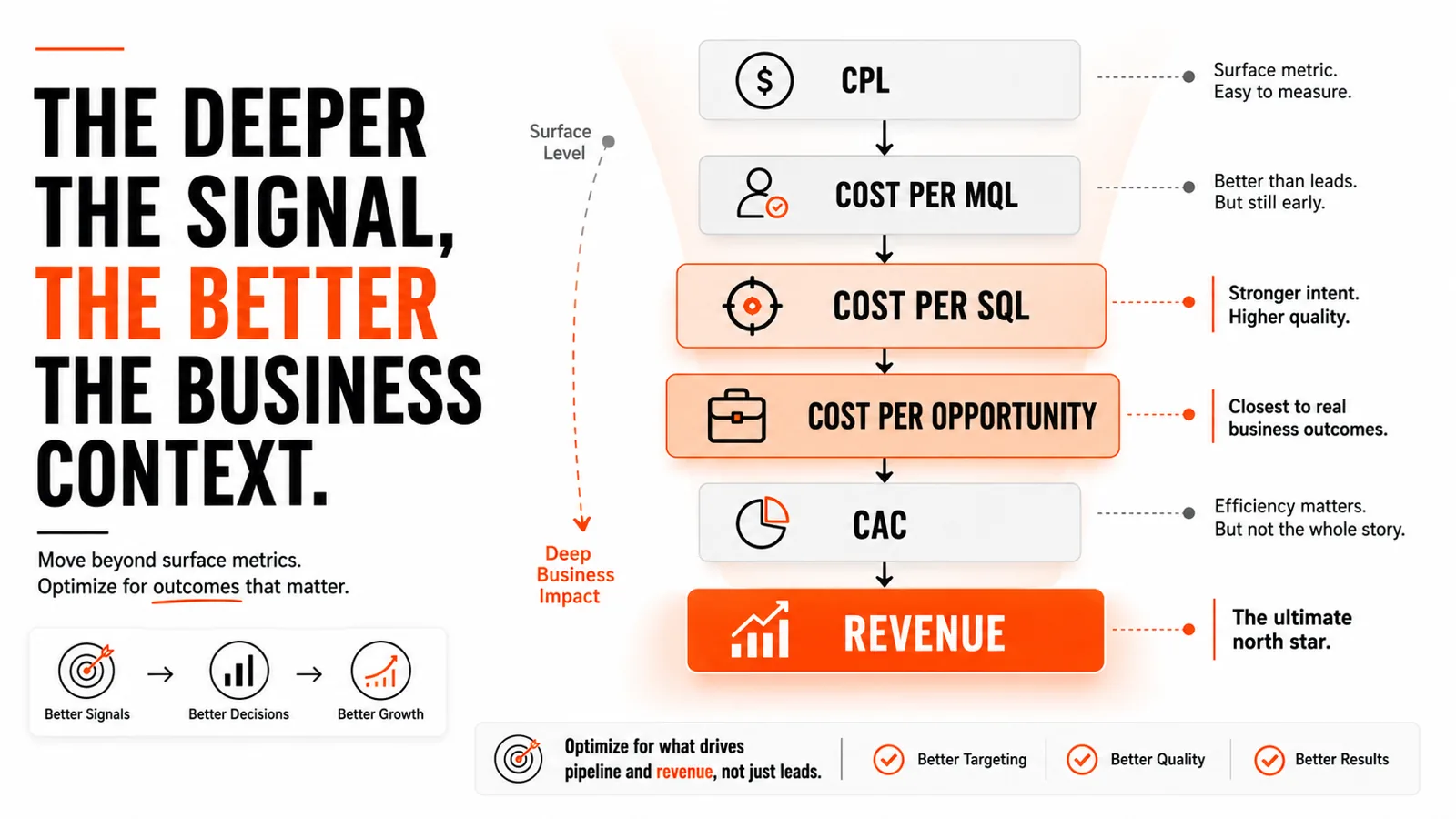
The further you can reliably measure down this chain, the better you can understand what your B2B Meta Ads are actually producing. A campaign with a ₹2,000 CPL is not automatically bad. A campaign with a ₹500 CPL is not automatically good. The real question is what happens after the lead.
How to Build This Without Overcomplicating Your Account
You do not need to rebuild your entire advertising system overnight. Start with three steps.
- Map your CRM stages: Clearly define Lead → MQL → SQL → Opportunity → Customer, and make sure sales and marketing agree on what each stage means.
- Find the strongest reliable signal: Look at your historical data. Which stage has a strong relationship with revenue while still producing enough volume to be useful? That becomes your candidate optimization signal.
- Connect the signal back to Meta: Work with your tracking and CRM setup to send the appropriate downstream events back to Meta, then monitor whether the change improves business-level metrics, not just Ads Manager metrics.
Do not change five things at once. If you change the form, creative, audience, landing page and optimization event simultaneously, you will not know what caused the result. Test the signal. Measure it. Then make the next change.
Frequently Asked Questions About B2B Meta Ads and CRM Signals
Should I stop measuring CPL?
No. CPL is still useful for diagnosing acquisition efficiency. It just should not be the only metric you use to judge B2B Meta Ads.
Should I optimize directly for closed-won customers?
Not necessarily. If you have enough consistent purchase or revenue events, it may be worth testing. If you only close a handful of deals each month, a deeper event may be too sparse to provide a useful optimization signal. The correct event depends on your data volume and sales cycle.
Is Conversions API enough to fix poor lead quality?
No. Conversions API is a measurement and signal-delivery component. It cannot fix a weak offer, poor creative, bad targeting, weak qualification or a broken sales process. Better data helps Meta make better decisions. It does not replace good marketing.
Should every B2B company use the same CRM event?
No. A SaaS company, recruitment company, professional-services firm and high-ticket B2B manufacturer can have completely different sales cycles. Your optimization event should reflect your own customer journey.
Stop Optimizing the Beginning of the Funnel
The easiest number to celebrate in B2B advertising is the number at the top. Leads. Clicks. CPL. But the money is made much further down.
A lead becomes valuable when it matches your ICP. An MQL becomes more valuable when sales accepts it. An SQL becomes valuable when a real commercial conversation starts. An opportunity becomes valuable when there is genuine buying intent. And ultimately, the business cares about customers and revenue.
That is why the next stage of B2B Meta Ads is not simply finding cheaper leads. It is building a better feedback loop between advertising, CRM and revenue. Your job is not to make Meta generate more conversions. Your job is to make sure Meta understands which conversions are actually worth generating.
Once you can connect Ad → Lead → SQL → Opportunity → Customer → Revenue, you stop managing Meta Ads as a lead-generation channel. You start managing it as a performance system.
Want a second opinion on which CRM event your Meta campaigns should optimize for? Send me your funnel numbers on WhatsApp.
Message me on WhatsApp