Best Meta Ads Expert for D2C Brands: How to Choose the Right Performance Marketer
A buyer's guide for D2C founders. How to tell the difference between someone who can operate Ads Manager and someone who can own acquisition performance.
By Hem Meisheri · September 2026
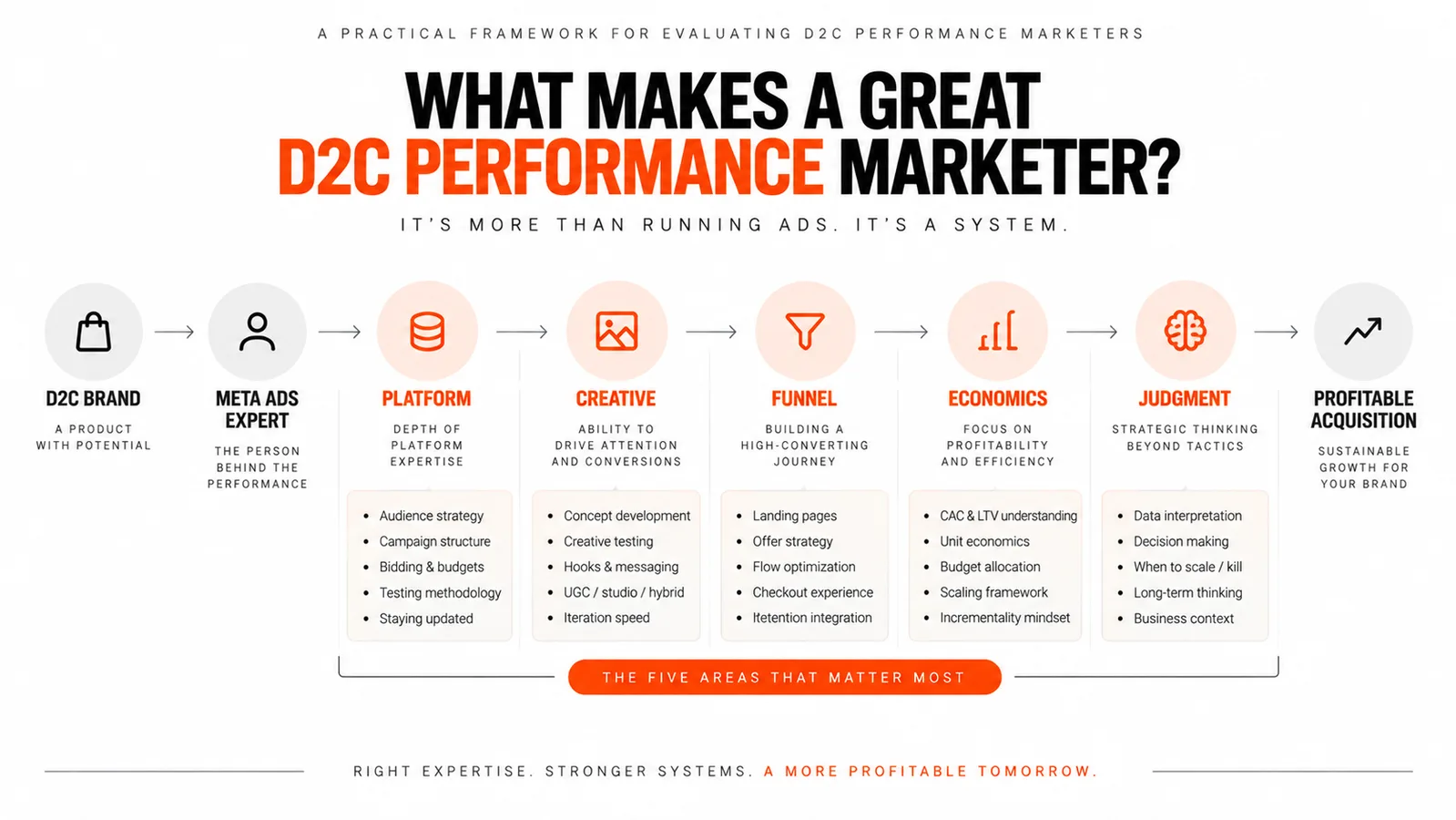
Search for the best Meta Ads expert for D2C brands and you will find a long list of people who can all show you a screenshot with a large number on it. Screenshots are easy. What is hard is knowing whether the person in front of you can grow your brand profitably once your specific margins, products, creative capacity and checkout are part of the equation.
This guide is written for the person making that decision: a D2C founder, ecommerce operator, head of growth or marketing manager who is about to hand over a meaningful monthly budget. It is not a pitch. It is a framework for evaluating a Meta Ads expert, freelancer, consultant or agency, and for knowing when you should not hire one yet.
The core argument is simple. The strongest D2C performance marketer is rarely the one reporting the highest ROAS. It is the one who understands the full chain: creative, media buying, tracking, landing page, product page, checkout, CAC, AOV, contribution margin, retention and repeat purchase. Anyone can move budget between ad sets. Very few people can tell you which part of that chain is actually costing you money.
What Does a Meta Ads Expert Actually Do for a D2C Brand?
The job title hides a wide range of responsibility. In a serious D2C engagement, Meta Ads work usually covers:
- Account strategy: what the account is trying to achieve at prospecting, consideration and retargeting stages
- Campaign structure and setup, budget allocation and bidding approach
- Creative strategy: angles, hooks, formats, offers and the briefs that produce them
- Creative testing: what gets tested, in what order, and how a result is judged
- Audience and delivery analysis: placements, frequency, auction overlap, learning phase behaviour
- Product catalogue and feed setup for dynamic and shopping formats
- Tracking: Pixel events, Conversions API, deduplication, event quality and attribution settings
- Post-click analysis: landing page, product page, cart and checkout behaviour
- Economics: CAC, new customer CAC, AOV, ROAS, MER, contribution margin
- Retention context: repeat purchase rate, LTV and payback period
- Reporting and scaling decisions, including when to pull budget back
Notice how much of that sits outside Ads Manager. Running ads and owning acquisition performance are different responsibilities. You can hire either. You should know which one you are buying.
The Difference Between a Meta Ads Expert, Freelancer, Consultant and Agency
These words are used interchangeably in the market. They describe different working models with different trade-offs.
| Model | Strengths | Risks | Often suits |
|---|---|---|---|
| Meta Ads freelancer | Direct access, lower overhead, fast decisions | Capacity limits, single point of dependency, variable seniority | Brands with some internal marketing and clear creative supply |
| Meta Ads specialist | Deep platform execution, strong technical setup | May stop at the platform boundary and not touch the funnel | Teams that already own creative, CRO and analytics |
| Performance marketer | Owns outcomes across channels and the post-click funnel | Costs more, needs data access and decision authority to be useful | Brands that want acquisition owned end to end |
| Consultant | Strategic depth, audits, direction, upskilling your team | Execution usually stays in house, so results depend on your team | Brands with an internal team that needs direction, not hands |
| Agency | Team breadth across media, creative and CRO, redundancy, process | Higher overhead, junior day to day execution, less direct access | Brands needing volume of output and multiple skill sets at once |
There is no universally correct answer. An agency is not automatically bloated and a freelancer is not automatically nimble. The question is which gaps you actually need filled, and whether the senior person you are impressed by during the pitch will be the person working on the account.
What Makes Someone a Good D2C Performance Marketer?
Nine capabilities matter more than years of experience or a list of platforms.
- Platform knowledge: structure, bidding, delivery behaviour, catalogue setup, diagnostics
- Business economics: margin, CAC, AOV, payback, and what your P&L can support
- Creative strategy: generating distinct hypotheses, not variations of one idea
- Conversion optimization: reading the landing page, product page and checkout honestly
- Tracking and attribution: Pixel, Conversions API, event quality and what the data cannot tell you
- Testing methodology: what constitutes a real test and when a result is readable
- Diagnosis: locating the constraint before changing anything
- Communication: explaining decisions in language a founder can act on
- Commercial judgment: knowing when to push and when to stop
Platform knowledge alone is not enough. A person can be excellent inside Ads Manager and still scale a brand into unprofitable growth, because nothing in Ads Manager tells them the contribution margin on the SKU they are pushing.
The D2C Performance Marketer Test
Here is a framework you can use in a single conversation. Five layers, in increasing order of difficulty.
Layer 1: Platform
Can they operate and diagnose Meta? Structure campaigns, read delivery, handle the learning phase, set up the catalogue, spot auction overlap and account for attribution windows.
Layer 2: Creative
Can they generate meaningful creative hypotheses and test them properly? Not "let us try a new thumbnail," but a stated belief about a buyer, a problem and an angle, with a defined way of knowing whether the belief was right.
Layer 3: Funnel
Can they diagnose what happens after the click? Landing page relevance, product page clarity, cart abandonment, payment friction, mobile experience and page speed.
Layer 4: Economics
Can they work with CAC, AOV, contribution margin, MER and payback period, and tell you at what CAC growth stops being worth it for your specific margins?
Layer 5: Judgment
Can they tell you when not to scale? When to hold spend flat, when the constraint is inventory or offer rather than media, and when Meta is simply not the right channel for the product.
Someone who passes only Layer 1 is a media buyer, and that can be exactly what you need if your team covers the rest. Someone who works across all five layers is much closer to a performance marketer who can own the outcome. Most hiring disappointment comes from buying Layer 1 while expecting Layer 5.
The 10 Things to Check Before Hiring a Meta Ads Expert
- Can they explain CAC beyond ROAS? Ask how they separate blended CAC from new customer CAC.
- Do they understand contribution margin? If margin never comes up, profitability is not being managed.
- Can they explain their creative testing process? Look for structure, not volume.
- Do they diagnose the funnel beyond Ads Manager? Ask what they check on the site before touching campaigns.
- Do they understand tracking and attribution? Pixel plus Conversions API, deduplication, event quality, modelled conversions.
- Can they distinguish correlation from causation? Ask how they would know a change caused a result.
- Can they explain what happens after the click? Landing page, product page, checkout, payment.
- Can they show relevant case studies with context? Category, spend level, margin structure, starting point.
- Can they explain what did not work? Anyone with real accounts has failed tests and can describe them.
- Can they tell you when Meta Ads are not the right answer? This is the most revealing question of the ten.
A consultant who forces Meta to fit every business is selling a service, not solving a problem. Some products sell better through search intent, marketplaces, retail or community. A good adviser will say so even though it reduces the size of their engagement.
Don't Hire Someone Based on ROAS Screenshots Alone
ROAS is a platform-reported outcome. It divides attributed revenue by ad spend inside a chosen attribution window. That is useful, but it does not tell you gross margin, returns, cash on delivery losses, shipping cost, discount depth, payment gateway fees, repeat purchase behaviour, incrementality or blended acquisition cost.
A hypothetical example, using illustrative numbers rather than benchmarks. Brand A reports 4.5x ROAS. Attributed revenue is 450,000 on 100,000 of spend. But discounts and COGS leave a 30 percent product margin, returns run high on the hero SKU, and shipping plus payment fees consume more. After all costs, the campaign contributes very little. Brand B reports 2.4x ROAS on the same spend with a 60 percent product margin, low returns and a strong repeat rate. Brand B is the healthier account, and the lower number is the better business outcome.
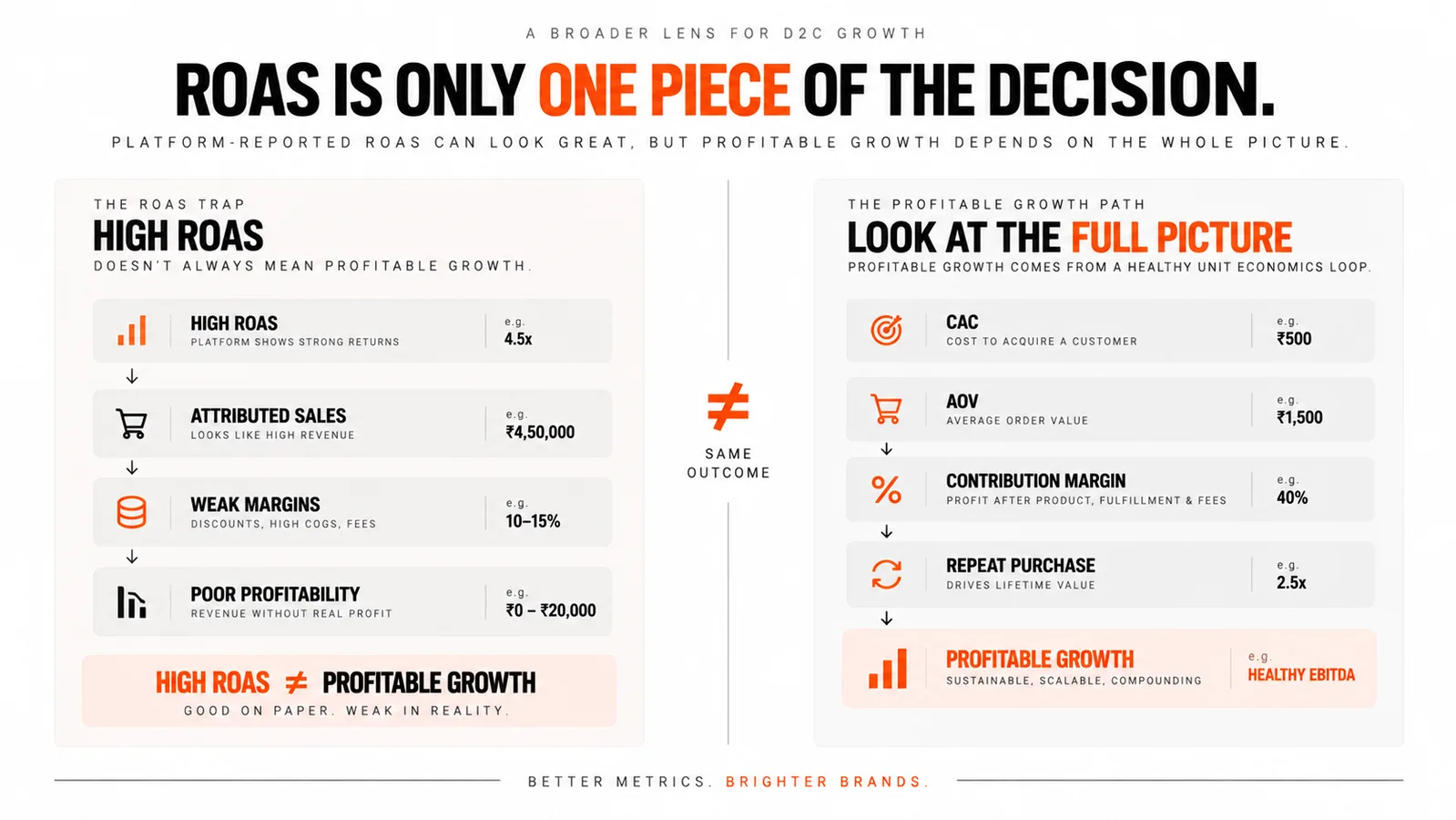
This is also why an ad with weak reported ROAS is not automatically a bad ad. If you have never worked through how to diagnose low-ROAS Meta Ads, that is worth reading before you judge a candidate on their pause and kill instincts.
Profitability discipline before scaling is also what makes a case study readable. In the Bartisans D2C Meta Ads case study, the reported outcome was 5.53x ROAS with 1.28M+ unique accounts reached on a modest spend base. That is a specific result in a specific account with a specific margin structure, not a benchmark you should expect anyone to reproduce for your brand.
The D2C Metrics a Good Meta Ads Expert Should Understand
- CPM: the cost of reaching the audience. Rising CPM can signal competition, creative fatigue or narrow targeting.
- CTR: whether the creative earns attention. High CTR with weak sales points past the click.
- CPC: the price of a visit, driven by CPM and CTR together.
- CVR: how well the site converts the traffic it receives.
- AOV: how much each order is worth, which sets the CAC you can afford.
- ROAS: platform attributed return, useful for comparing campaigns, weak as a profitability verdict.
- MER: total revenue divided by total marketing spend, a blended sanity check across channels.
- CAC and new customer CAC: what acquisition truly costs once existing customer revenue is separated out.
- Contribution margin: what is left after product, fulfilment, fees and discounts. The number that decides scale.
- Repeat purchase rate and LTV: whether a first order is worth buying at a loss.
- Payback period: how long your cash is tied up before the customer becomes profitable.
These metrics trade against each other. Pushing CAC down usually costs volume. Raising AOV through bundling can lower conversion rate. Chasing a low CPM can buy cheap, low-intent attention. A good operator names the trade-off they are accepting instead of implying every number can improve at once.
How a Good Meta Ads Expert Diagnoses a D2C Account
Diagnosis moves down the chain in order, not straight to the ads.
- Creative: CTR, engagement, hook retention, message to product fit
- Traffic: unique outbound clicks against landing page views, which exposes load and quality problems
- Landing page: conversion rate, clarity in the first screen, mobile behaviour
- Product: offer, price, positioning, reviews, delivery promise
- Checkout: checkout conversion, payment success, friction and form length
- Acquisition: CAC and new customer CAC by channel
- Economics: contribution margin and MER
- Retention: repeat purchase rate and LTV
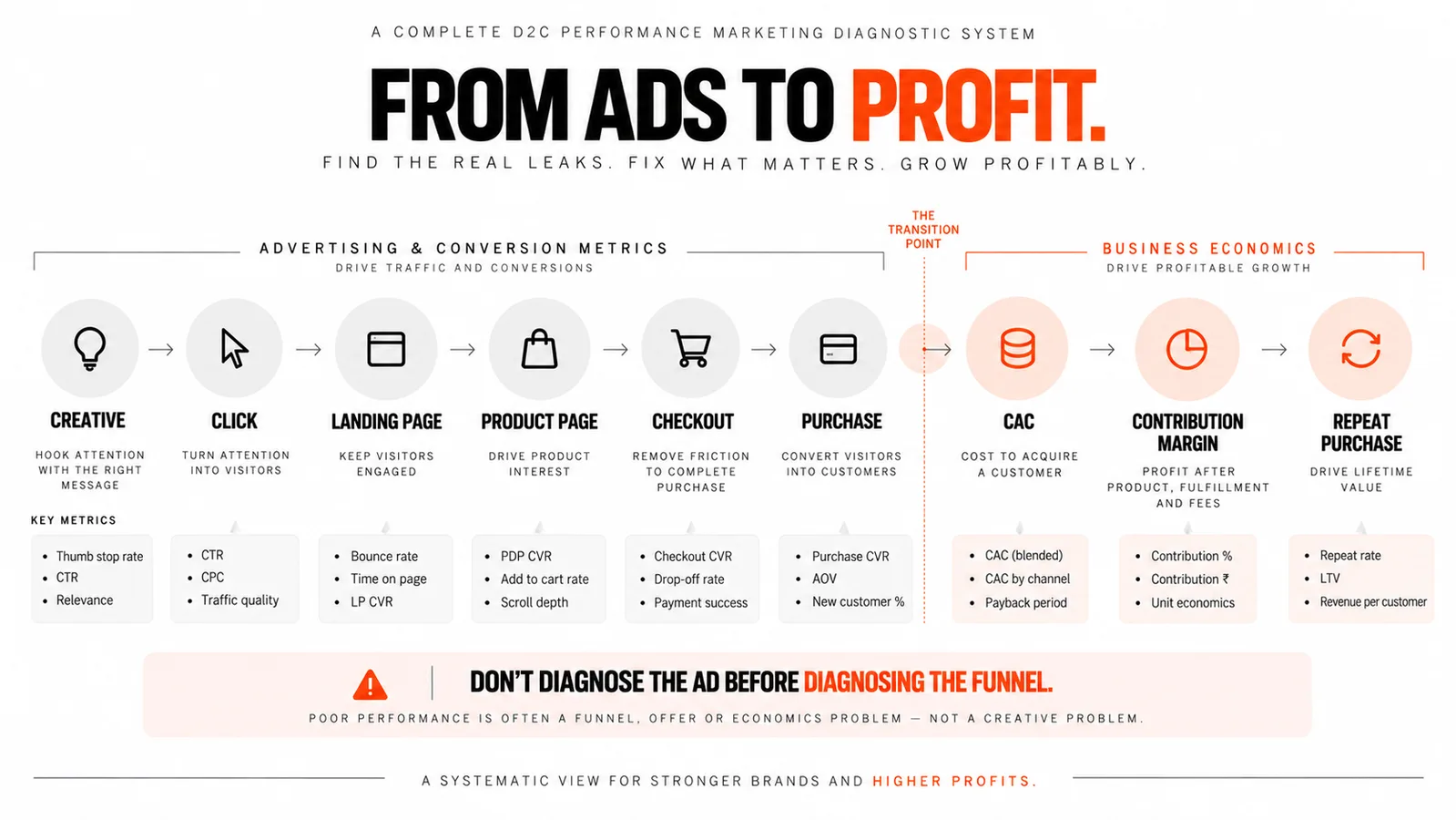
A falling ROAS does not automatically mean change the ads. It can mean the offer aged, a competitor undercut you, a payment method started failing, or the tracking changed. The step most often skipped is the traffic step, which is exactly where Meta Ads traffic quality breaks before revenue confirms it.
Post-click work is not a separate discipline from media buying. The D2C Meta Ads and CRO case study for Ultimate Party Pooper reported 3.26x ROAS alongside a 20x add-to-cart lift, which is a reminder that the ad and the page are one system. Again, that is one account's outcome, not a promise.
How to Evaluate a D2C Meta Ads Expert's Creative Testing Process
Ask what they test, and listen for the level they operate at.
- Concepts: a fundamentally different idea about why someone buys
- Angles: the same product framed around a different problem or customer
- Hooks: the first three seconds or first line that earns attention
- Formats: UGC, studio, static, carousel, motion graphics
- Offers: bundle, guarantee, free shipping threshold, first order incentive
Changing one word in a headline is a variation, not a test. It rarely produces a readable difference at typical D2C conversion volumes, and it does not teach you anything about your buyer. Meaningful testing changes one idea at a level big enough to detect, and repeats it in cycles so learnings compound. A candidate who works from a structured creative testing framework will be able to describe their cadence, their winner criteria and what they do with a losing concept.
What Should a Meta Ads Expert Ask You Before Launching Campaigns?
The questions they ask you are as revealing as the answers they give. Before spending your money, they should want to know:
- AOV, gross margin and contribution margin by product
- Best selling products and hero SKUs, and which ones you actually want to sell
- Repeat purchase behaviour and typical time between orders
- Customer segments and who the product is genuinely for
- Geographic markets, languages and delivery coverage
- Existing customer data available for exclusions and lookalikes
- Current CAC and historical channel performance
- Existing creative library and how quickly new creative can be produced
- Website conversion rate and checkout completion rate
- Current tracking setup, Pixel events, Conversions API status and attribution settings
- Inventory depth and restock timelines
- Seasonality, promotions and discounting policy
- Fulfilment reliability and return rates
If a candidate is ready to launch without asking about margin, inventory or returns, they are optimizing a number rather than a business.
Questions to Ask Before Hiring a Meta Ads Expert
- How would you diagnose my current account before changing anything?
- What would you need from my business before launching?
- How do you decide what creative to test next?
- What is your definition of a winning ad?
- How do you evaluate CAC, and how do you separate it from blended performance?
- How would you handle a high-ROAS campaign with poor margins?
- How do you separate new customer acquisition from existing customer revenue?
- How do you approach tracking, and how would you validate it in my account?
- What happens if performance falls in week three?
- What would make you recommend reducing Meta spend?
- What would make you recommend increasing it, and how fast?
- How do you work with creative teams, and what do you need from us?
- What do you report every week, and what will you not report?
- How long before you make a major strategic change to the account?
- Tell me about something you changed your mind about in an account.
The last question is the most useful. People who genuinely operate accounts have been wrong, learned something and can describe it without defensiveness.
Red Flags When Hiring a Meta Ads Expert
- Guarantees a specific ROAS before seeing your margins or your account
- Promises overnight scaling
- Talks only about CTR, or only about ROAS
- Refuses or is unable to discuss margins
- Cannot explain attribution windows or the Conversions API in plain language
- Cannot describe a creative testing process
- Uses case studies from unrelated categories or business models
- Shows screenshots with no context on spend, margin or timeframe
- Blames the algorithm for every downturn
- Makes constant changes with no stated hypothesis
- Wants to raise budget before diagnosing the funnel
- Claims one strategy works for every D2C brand
How Much Does a Meta Ads Expert Cost?
Any universal price would be misleading. Cost is driven by account complexity, ad spend, number of markets, creative requirements, reporting depth, whether tracking needs to be implemented, whether CRO is in scope, and whether you are buying strategy or execution.
| Model | How it works | Incentive to watch |
|---|---|---|
| Fixed monthly fee | Flat retainer for an agreed scope | Neutral on spend, but scope creep needs managing |
| Percentage of ad spend | Fee scales with budget | Rewards higher spend, which may conflict with cutting back |
| Project fee | Defined deliverable such as an audit or rebuild | Ends at handover, so ownership returns to you |
| Consulting retainer | Strategic direction and review, execution in house | Results depend on your team's ability to execute |
| Hybrid | Base fee plus a performance component | Only works if the performance metric reflects profit, not revenue |
No model is universally best. What matters is whether the incentive stays aligned when the right recommendation is to spend less.
Meta Ads Expert vs Agency: Which Should a D2C Brand Hire?
A freelancer or independent expert gives you direct access to the operator, lower overhead and concentrated expertise, with capacity risk and dependence on one person. An agency gives you a team across media, creative and CRO, plus redundancy and process, at higher cost and often with less direct access to the senior person you met in the pitch. A consultant gives you strategic depth and a clear diagnosis, but implementation typically stays with your internal team.
The right answer depends on your stage. If you have creative supply and an internal marketer, a specialist may be enough. If you have neither, an agency or a full-funnel operator will serve you better than a media buyer who needs assets you cannot produce.
A Simple Scorecard for Choosing a Meta Ads Expert
Score each candidate from 1 to 5, then compare totals and, more importantly, compare the shape of the scores.
- D2C experience relevant to your category and price point
- Meta platform expertise and diagnostic ability
- Creative strategy and testing methodology
- Understanding of economics: CAC, AOV, contribution margin
- Tracking and attribution competence
- CRO and post-click thinking
- Analytical reasoning, including causation versus correlation
- Communication and reporting clarity
- Relevant case studies with context
- Strategic judgment, including willingness to say no
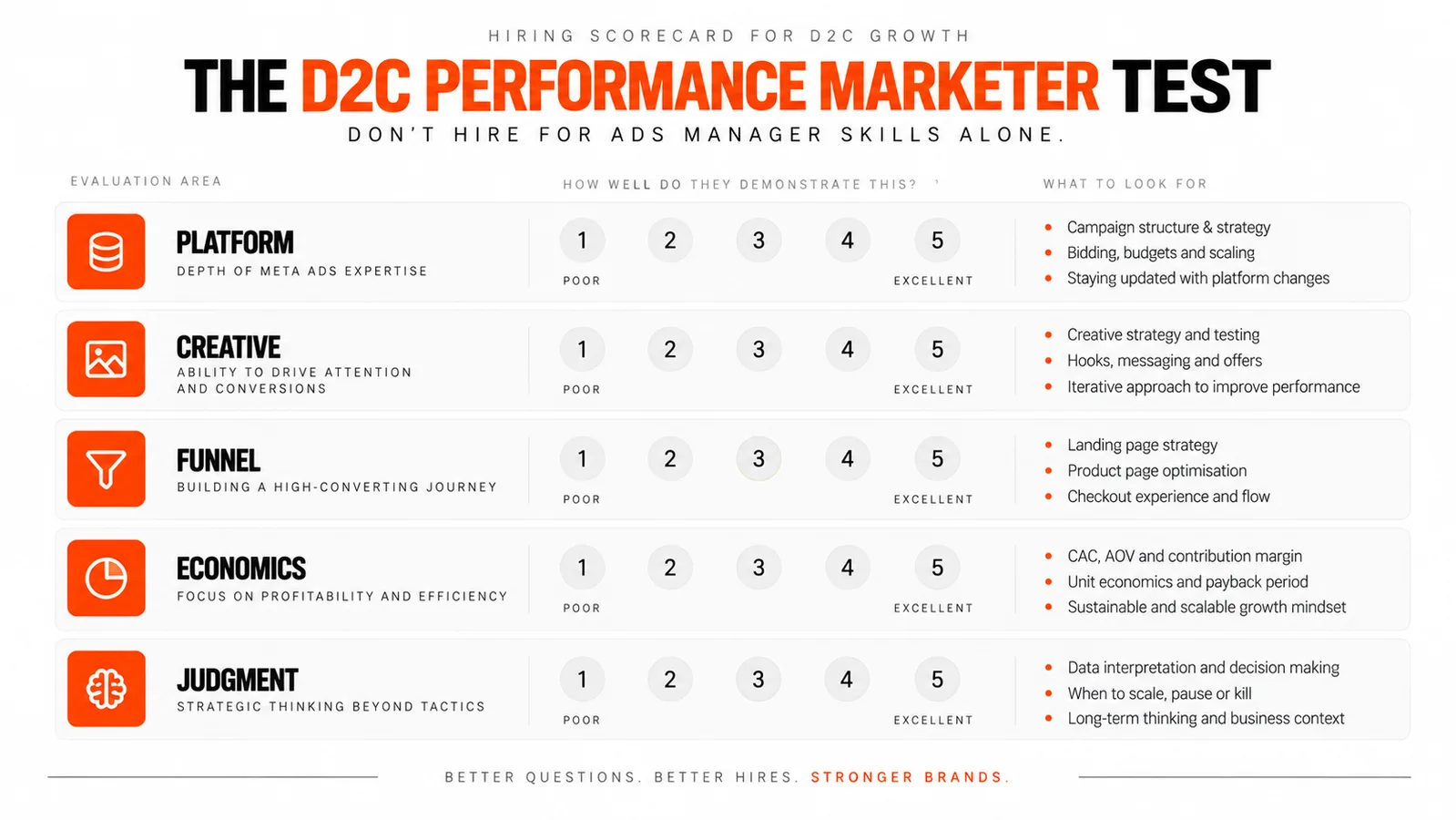
A candidate scoring 5 on platform and 2 on economics is a media buyer. That is a legitimate hire if someone else owns the economics. Problems start when nobody does.
What a Strong First 30 Days Should Look Like
Judge the first month on process, not results. Early performance is noisy and often reflects the account's prior state more than the new operator's work.
- Week 1: audit and baseline. Tracking validation, account structure review, funnel and checkout review, agreed reporting definitions.
- Week 2: strategy and creative hypotheses. A written plan of what will be tested and why, with success criteria stated in advance.
- Week 3: launch and testing. Structured tests running with enough budget and time to become readable.
- Week 4: read the data and decide the next round. What was learned, what is being kept, what is being retired.
The exact timeline depends on spend level, daily conversion volume and how much cleanup the account needed. A low volume account will take longer to produce readable results, and honest candidates will say so up front.
When You Should Not Hire a Meta Ads Expert Yet
Paid acquisition amplifies what already exists. It rarely fixes what is broken. Hold off when:
- Product-market fit is still unproven and organic demand is near zero
- Website conversion is poor and the reasons have not been investigated
- Margins cannot absorb any realistic acquisition cost
- Inventory is unreliable or stock outs are frequent
- The offer is unclear even to people who already know the brand
- Tracking is fundamentally broken and no one can fix it soon
- You cannot fulfil a sudden increase in orders
Spending on Meta in these conditions produces expensive proof of a problem you already had. Fix the constraint first.
How to Know If Your D2C Brand Is Ready for a Meta Ads Expert
- A proven product with real customers and real reviews
- A functioning, fast website with a working checkout
- A clear offer a stranger can understand quickly
- Margins that leave room for acquisition after all costs
- Reliable fulfilment and a manageable return rate
- A defined target customer, not just a broad category
- Baseline conversion data to compare against
- Creative capacity to keep the account supplied with new concepts
- Enough budget to run tests long enough to learn something
- Willingness to change the site and offer, not only the ads
Note that budget adequacy is specific to your economics. A brand with a high AOV and strong margin can learn from far less spend than a low-margin, low-AOV brand, so an arbitrary minimum monthly number is not useful advice.
The Final Decision: What Should You Actually Hire For?
Do not hire someone because they describe themselves as a Meta Ads expert. Hire someone who can follow the chain from ad to click to product page to checkout to purchase to CAC to margin to repeat purchase, and who can tell you what they would test, why they would test it, and how they would know whether it worked.
That is a higher bar than platform fluency, and it is the difference between buying media and buying growth.
Hem Meisheri works directly with D2C brands across Meta, Google, creative strategy, CRO and retention, with performance evaluated against CAC, ROAS and contribution margin. You can see how that D2C performance marketing approach is structured, or read more D2C and performance marketing insights.
Frequently Asked Questions
What does a Meta Ads expert do for a D2C brand?
A Meta Ads expert for a D2C brand usually owns account strategy, campaign structure, creative briefs and testing, audience and delivery analysis, catalogue and product feed setup, Pixel and Conversions API tracking, and reporting. Beyond the platform, a strong one also reads landing page, product page and checkout performance, and evaluates results against CAC, AOV, contribution margin and repeat purchase rather than platform ROAS alone.
How do I choose a Meta Ads expert?
Choose based on reasoning, not screenshots. Ask how they would diagnose your account before changing anything, how they design creative tests, how they judge whether a campaign is profitable, and how they would react if performance fell. Score candidates across platform skill, creative strategy, funnel understanding, economics and judgment. The person who explains trade-offs clearly is usually a safer hire than the person who promises outcomes.
How much does a Meta Ads expert cost?
There is no universal price. Cost depends on ad spend, account complexity, number of markets, creative production needs, tracking work, reporting depth and whether the engagement is strategic consulting or hands-on management. Common models are a fixed monthly fee, a percentage of ad spend, a project fee, an advisory retainer or a hybrid. Each model carries different incentives, so ask what happens commercially when spend should be reduced.
Should I hire a Meta Ads freelancer or agency?
It depends on your stage and internal capability. A freelancer or independent consultant gives direct access to the person doing the work and lower overhead, with concentration and capacity risk. An agency provides a broader team, creative and CRO resources and redundancy, usually at higher cost and with less direct access to the senior operator. Brands with no internal marketing function often need more support than a single specialist can supply.
What metrics should a D2C Meta Ads expert track?
At minimum: CPM, CTR, CPC, conversion rate, AOV, ROAS, MER, CAC, new customer CAC, contribution margin, repeat purchase rate, LTV and payback period. The important part is not the list but the hierarchy. Platform metrics diagnose delivery and creative. Business metrics decide whether spending more is a good idea. A good operator can explain which metric they are willing to sacrifice and why.
Is a high ROAS enough to prove a Meta Ads expert is good?
No. ROAS is a platform-reported ratio of attributed revenue to spend. It says nothing about gross margin, discounts, returns, cash on delivery losses, shipping, payment fees, or whether the revenue came from customers who would have bought anyway. A campaign can report strong ROAS and still lose money after costs. Ask for the economics behind the number and the context of the account.
How long should I give a Meta Ads expert before evaluating performance?
It depends on spend, conversion volume and the state of the account. Accounts with steady daily conversions produce readable data faster than accounts with a handful of orders per week. A reasonable approach is to evaluate process in the first month, early learning signals in the second, and business outcomes over a period long enough to cover your purchase cycle and creative testing cadence rather than a fixed arbitrary deadline.
When should a D2C brand hire a Meta Ads expert?
When the product sells, the site converts at a workable rate, margins can absorb acquisition cost, fulfilment is reliable and there is budget to run tests long enough to learn. If the offer is unclear, tracking is broken, or the site converts poorly, paid traffic will amplify those problems rather than solve them. Fix the foundation first, then hire someone to scale it.
- How to hire a performance marketer for your D2C brand
- Where Meta Ads traffic quality breaks: clicks, landing page views, purchases
- Meta Ads optimization: don't kill a low-ROAS ad too quickly
- Creative testing framework that actually compounds
- Revenue leak finder: increase revenue without increasing ad spend
Evaluating someone to run your D2C Meta Ads and want a second opinion on their approach? Send me the questions you're stuck on.
Message me on WhatsApp