Meta Ads Campaign Objectives: How to Choose the Right Objective
The objective should follow the business goal, then the conversion location, conversion event, performance goal and data sources should be built around it.
By Hem Meisheri · October 2026
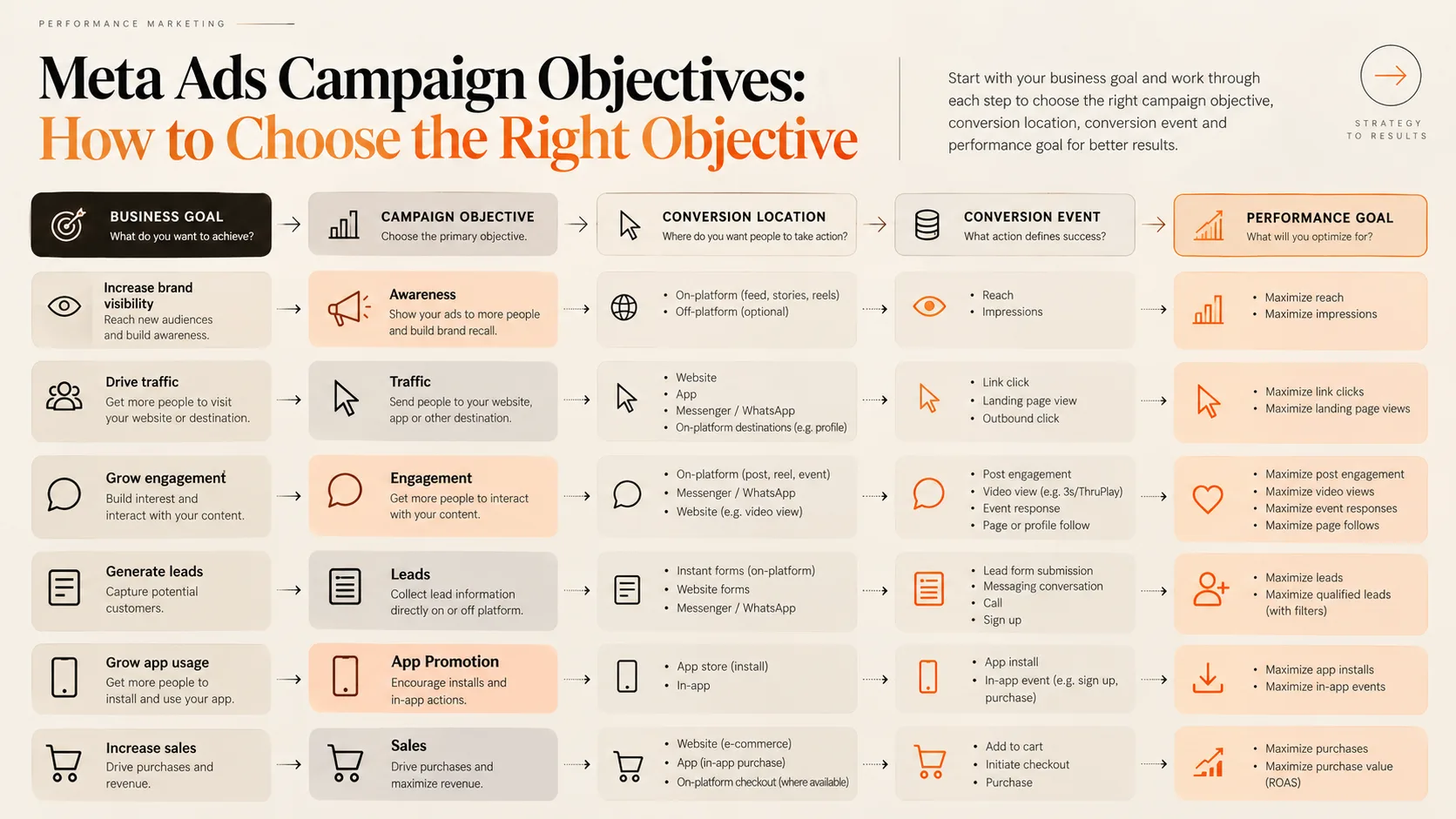
Choosing a Meta Ads campaign objective is one of the first decisions you make when setting up a campaign.
But the objective should not be selected simply because it sounds closest to what you want.
The objective needs to align with the business goal, the action you want people to take, the performance goal you want Meta to optimize toward, and, where applicable, the conversion location, conversion event and data sources required for the campaign.
That makes campaign objective selection a planning decision, not just a campaign-setting decision. It is the same business-first thinking behind my D2C performance marketing work.
In the Meta Blueprint framework, the available campaign objectives are:
- Awareness
- Traffic
- Engagement
- Leads
- App promotion
- Sales
Each objective is designed around different business goals and can provide different options for performance goals, conversion locations and conversion events. This guide explains how those objectives work and how to think about choosing between them.
What Is a Meta Ads Campaign Objective?
A Meta Ads campaign objective is the campaign-level choice that aligns your advertising campaign with the business outcome you want to achieve.
The Meta Blueprint document connects each objective to a business goal and explains when that objective should be used. It also highlights the importance of checking whether the campaign requires specific data sources. For example:
- If the business wants to increase awareness, the Awareness objective is relevant.
- If the business wants to send people to a destination, the Traffic objective is relevant.
- If the goal is interaction, the Engagement objective is relevant.
- If the business wants to collect leads, the Leads objective is relevant.
- If the goal is app installs or app activity, the App promotion objective is relevant.
- If the goal is purchases or other important actions, the Sales objective is relevant.
The important point is that the objective should follow the business goal.
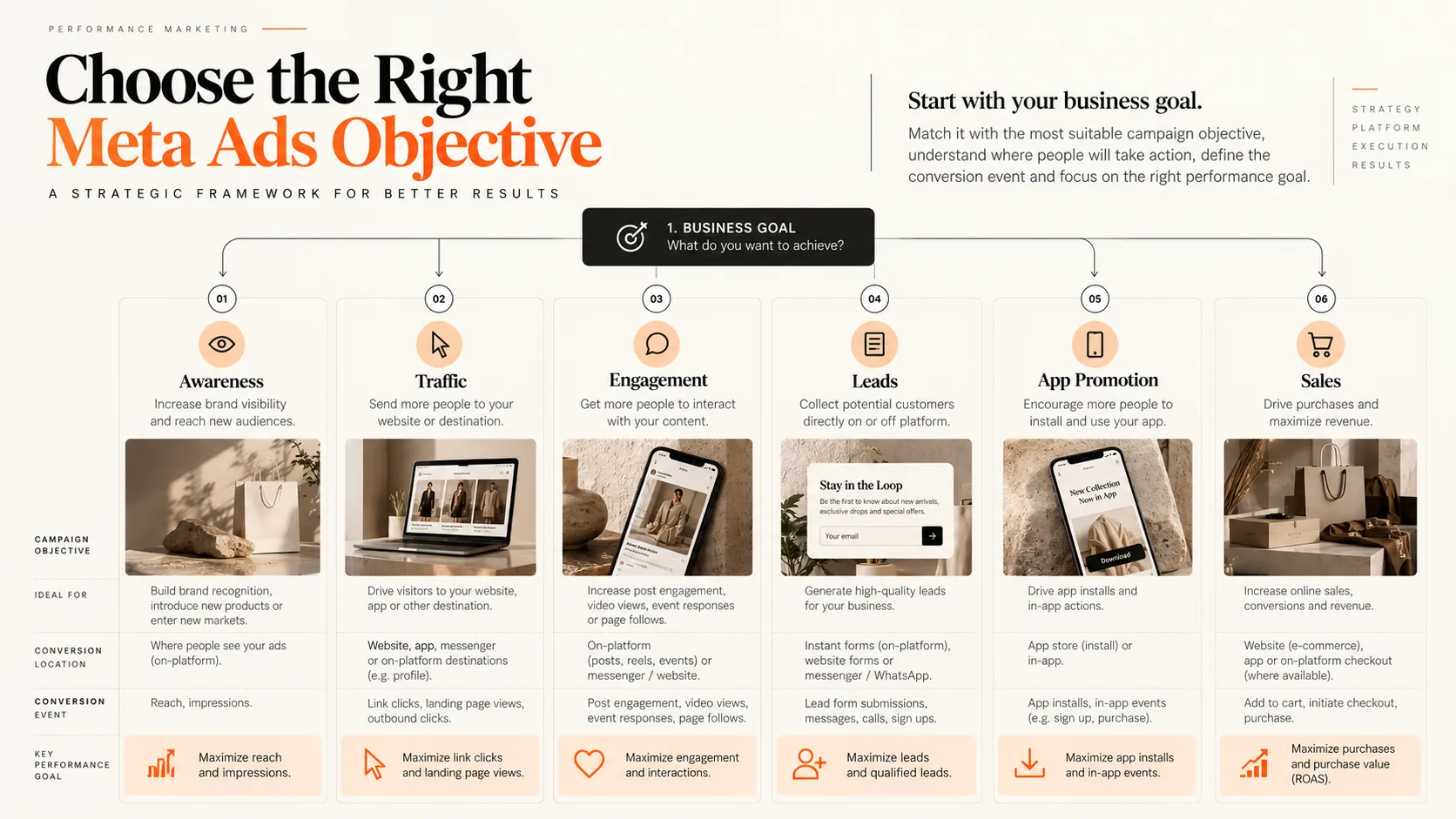
The 6 Meta Ads Campaign Objectives
1. Awareness Objective
The Awareness objective is designed for businesses that want to reach people and increase awareness, introduce a brand or improve recall. The PDF identifies situations such as:
- A new business
- A business that has undergone a name change
- A business that wants more potential customers to know about it
Relevant outcomes include brand awareness, ad recall, video views, reach and impressions. The objective can use performance goals such as:
- Maximize reach of ads
- Maximize ad recall lift
- Maximize ThruPlay views
- Maximize 2-second continuous video plays
When should you use it? Use Awareness when the business goal is primarily about getting the brand or message in front of people and improving awareness or recall. It is not simply a cheaper alternative to other objectives. The campaign should be planned around the awareness outcome you actually want.
2. Traffic Objective
The Traffic objective is designed to send people to a destination such as a website, app or shop on Facebook or Instagram. The Blueprint gives examples such as a business running a flash sale on its website, or a business wanting to send potential customers to a webpage describing its services.
Relevant goals include link clicks, impressions and landing page views. The Traffic objective can use destinations including website, app, Messenger, WhatsApp, calls and Instagram profile. For a website destination, the conversion event is Landing page views. The performance goals include:
- Maximize number of landing page views
- Maximize number of link clicks
- Maximize daily unique reach
- Maximize number of conversions
When should you use it? Use Traffic when the business goal is to send people to a destination. The important distinction is between wanting people to visit a destination and wanting them to complete a more specific business action. The Blueprint provides different objectives and performance goals for those different outcomes. Once traffic is running, it helps to know how to diagnose Meta Ads traffic quality before judging the campaign on later outcomes.
3. Engagement Objective
The Engagement objective is designed to find people likely to interact with a business online and take actions such as starting a conversation or commenting on posts. Relevant outcomes include video views, post engagement, conversions and messages.
Engagement campaigns can use different conversion locations, including website, app, ad, messaging app and Facebook Page. Depending on the setup, performance goals can include:
- Maximize ThruPlay views
- Maximize 2-second continuous video plays
- Maximize engagement with a post
- Maximize event responses
- Maximize group joins
- Maximize link clicks
- Maximize reminders set
- Maximize daily unique reach
- Maximize number of conversions
When should you use it? The answer depends on the actual business outcome. If the business wants people to interact with content, respond to an event, watch video or start a conversation, the Engagement objective provides the relevant campaign structure.
4. Leads Objective
The Leads objective is designed to collect leads for a business. The Blueprint gives the example of a business that wants potential customers to sign up for a monthly newsletter and reach people willing to share their contact information to learn more about the business.
Relevant conversion locations include website, app, Messenger, WhatsApp, calls and Instagram profile. Depending on the conversion location, relevant conversion events can include:
- Complete registration
- Contact
- Find location
- Lead
- Schedule
- Search
- Start trial
- Submit application
- Subscribe
- View content
Leads campaigns can use goals such as maximize number of conversions, maximize value of conversions, maximize number of link clicks, maximize number of landing page views and maximize daily unique reach.
When should you use it? Use the Leads objective when collecting leads is the business goal. The campaign can be structured around different conversion locations and actions depending on how the business wants to collect those leads.
5. App Promotion Objective
The App promotion objective is designed to encourage people to install and use an app. The Blueprint identifies relevant outcomes such as app installs and app events. App promotion performance goals include:
- Maximize number of app events
- Maximize number of app installs
- Maximize value of conversions
- Maximize number of link clicks
According to the Blueprint, the App promotion objective requires a registered app and Facebook SDK. It can also use deep linking or deferred deep linking to direct people to a specified destination within an app.
When should you use it? Use it when the business wants people to install or use its app. The correct performance goal depends on whether the desired outcome is app installs, app events or value of conversions.
6. Sales Objective
The Sales objective is designed to find people likely to make purchases or take other important actions online or in-store. It can support sales on a website, app, Messenger or WhatsApp. Relevant outcomes include conversions, Messenger and WhatsApp messages, and catalog sales.
Possible conversion locations include website, app, website and app, Messenger, WhatsApp, and website and shop. Possible conversion events include:
- Add payment info
- Add to cart
- Add to wishlist
- Complete registration
- Initiate checkout
- Purchase
- Search
- Start trial
- Subscribe
- View content
Sales performance goals include maximize number of conversions, maximize value of conversions, maximize number of landing page views, maximize number of link clicks and maximize daily unique reach. For app conversions, the Blueprint identifies Facebook SDK as a required data source. For other conversion locations, it identifies Meta Pixel and Conversions API.
When should you use it? Use Sales when the business wants to drive purchases or other important sales-related actions. The specific conversion location and conversion event should then match where and how that action occurs.
Meta Ads Objective vs Performance Goal
One of the most important distinctions when planning a Meta Ads campaign is the difference between the campaign objective and the performance goal.
The objective establishes the broader business outcome. The performance goal defines what the campaign should optimize toward within that objective.
For example, within the Awareness objective, the Blueprint lists performance goals including maximizing reach of ads and maximizing ad recall lift. Within the Leads objective, the available goals include maximizing the number of conversions and maximizing the value of conversions.
So campaign planning should not stop at:
"Which objective should I choose?"
You also need to ask:
"What specific performance goal should this campaign optimize toward?"
Getting this right also makes later Meta Ads optimization decisions easier, because each campaign is judged against the outcome it was actually built for. The same applies to Meta Ads creative testing: tests are only comparable when the performance goal behind them is clear.
Conversion Location Matters Too
For several Meta Ads objectives, choosing the objective is only one part of campaign planning. You may also need to select a conversion location.
The Blueprint shows conversion locations such as website, app, Messenger, WhatsApp, calls and Instagram profile. The available options depend on the campaign objective.
This matters because the conversion location affects the available conversion events and performance goals. For example, the Leads objective can use different conversion locations, while the Sales objective can support website, app, messaging and shopping-related destinations.
Conversion Events Need to Match the Business Action
A conversion event represents the action that the campaign is working toward. For example, the Sales objective can use events such as add to cart, initiate checkout, purchase, subscribe and start trial. The Leads objective can use events such as lead, contact, schedule, submit application and subscribe.
The key planning question is therefore: What action actually represents the outcome we want from this campaign? That answer should guide the campaign setup.
Why Data Sources Matter When Choosing a Campaign Objective
The Meta Blueprint specifically states that data sources are an important part of choosing a campaign objective. Data can help a business understand the customer journey from:
Discovery → Engagement → Acquisition → Conversion
Data sources can help businesses understand customer actions and create more personalized ad experiences. The Blueprint also explains that without sufficient data sources, it can become more difficult to:
- Find people who have expressed interest
- Obtain accurate measurement and reporting
- Ensure ads are relevant and useful
That means campaign objective selection should not happen in isolation. The objective, conversion location, conversion event and required data sources need to work together.
A Simple Framework for Choosing Your Meta Ads Campaign Objective
Before creating a campaign, work through these questions.
Step 1: What is the business goal?
Is the business trying to increase awareness, send people somewhere, generate engagement, collect leads, increase app installs or app activity, or generate sales?
Step 2: Choose the corresponding objective
| Business goal | Meta Ads objective |
|---|---|
| Increase awareness | Awareness |
| Send people to a destination | Traffic |
| Generate interactions | Engagement |
| Collect leads | Leads |
| Promote an app | App promotion |
| Generate purchases or important sales actions | Sales |
These mappings follow the business-goal framework in the Meta Blueprint.
Step 3: Determine the conversion location
Where should the desired action happen? For example: website, app, Messenger, WhatsApp, calls or Instagram profile. The available options depend on the objective.
Step 4: Determine the conversion event
What specific action represents success? Examples from the Blueprint include lead, contact, add to cart, initiate checkout, purchase, subscribe and start trial.
Step 5: Select the performance goal
Finally, determine what you want Meta to optimize toward. This could mean maximizing reach, ad recall lift, landing page views, link clicks, conversions, conversion value, app installs, app events, post engagement or video views. The available performance goals depend on the selected objective and campaign setup.
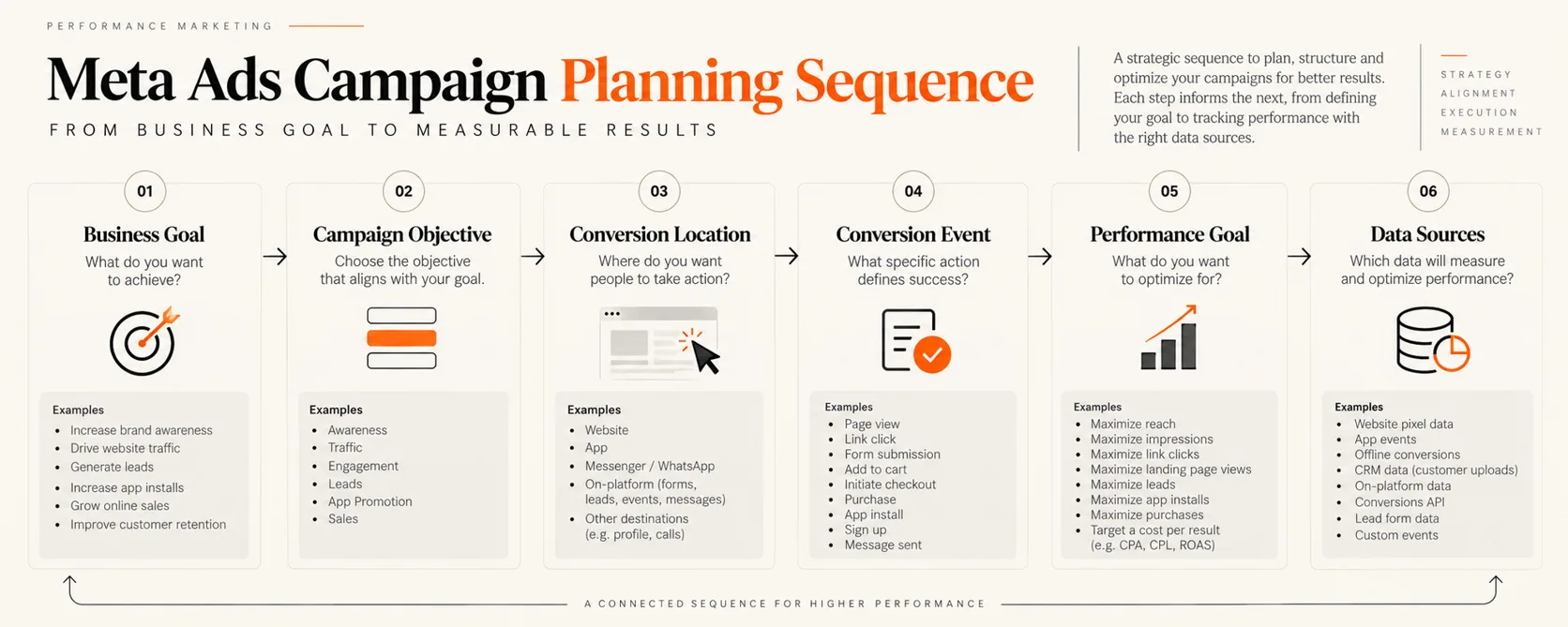
The Biggest Mistake: Starting With the Campaign Setting
A common planning error is to start inside Ads Manager and ask: "Which objective should I select?"
A better process is to start with the business outcome. The Meta Blueprint's framework essentially works backwards from the business goal:
Business goal → Campaign objective → Conversion location → Conversion event → Performance goal → Required data sources
The exact options differ by objective, but this sequence provides a much clearer way to approach campaign planning.
Meta Ads Campaign Objective Examples
Example 1: New brand
- Business goal:
- Increase awareness
- Objective:
- Awareness
- Possible performance goal:
- Maximize reach of ads or maximize ad recall lift
A new business wants more potential customers to know about the brand. This matches the Awareness objective's intended use in the Blueprint.
Example 2: Website promotion
- Business goal:
- Send people to a destination
- Objective:
- Traffic
- Possible performance goal:
- Maximize landing page views
A business wants to send people to a webpage describing its services. This is consistent with the Traffic objective framework.
Example 3: Lead generation
- Business goal:
- Collect leads
- Objective:
- Leads
- Possible performance goal:
- Maximize number of conversions
A business wants people to provide their contact information. The Leads objective is specifically designed for this goal.
Example 4: Ecommerce purchase
- Business goal:
- Generate sales
- Objective:
- Sales
- Conversion event:
- Purchase
- Possible performance goal:
- Maximize number or value of conversions
An ecommerce business wants to drive purchases. The Blueprint lists Purchase as a conversion event under the Sales objective.
Meta Ads Campaign Objectives: Final Checklist
Before launching a campaign, check:
- Have you defined the business goal?
- Does the campaign objective match that goal?
- Have you selected the appropriate conversion location?
- Is the conversion event aligned with the desired action?
- Is the performance goal appropriate?
- Are the required data sources available?
- Does the campaign setup support the way customers actually move from discovery to conversion?
This approach keeps the campaign structure connected to the business outcome rather than treating the campaign objective as an isolated Ads Manager setting. Once campaigns are live, a structured Meta Ads audit for D2C brands is the logical next step to check whether that setup is actually performing.
Conclusion
Choosing the right Meta Ads campaign objective starts with understanding what the business actually wants to achieve.
Awareness is built around reaching people and improving awareness or recall. Traffic is designed to send people to destinations. Engagement focuses on interactions. Leads focuses on collecting leads. App promotion focuses on app installs and activity. Sales focuses on purchases and other important sales actions.
But the objective is only the beginning. A properly planned Meta Ads campaign also needs the right conversion location, conversion event, performance goal and data sources.
Start with the business goal. Then build the Meta Ads campaign around it.
For more on planning and diagnosing paid campaigns, browse more performance marketing insights.
FAQ
What are the campaign objectives in Meta Ads?
The Meta Blueprint covers six campaign objectives: Awareness, Traffic, Engagement, Leads, App promotion and Sales.
How do I choose a Meta Ads campaign objective?
Start with the business goal. Then select the objective that corresponds to that goal and determine the appropriate conversion location, conversion event and performance goal.
What is the difference between a campaign objective and a performance goal?
The campaign objective represents the broader campaign outcome, while the performance goal specifies what the campaign should optimize toward within that objective.
Which Meta Ads objective is used for lead generation?
The Leads objective is designed to collect leads for a business.
Which Meta Ads objective is used for purchases?
The Sales objective is designed to find people likely to make purchases or take other important actions online or in-store.
What is a conversion location in Meta Ads?
A conversion location is where the desired action takes place. Depending on the objective, this can include a website, app, Messenger, WhatsApp, calls or an Instagram profile.
Not sure your campaigns are built around the right objective? Tell me your business goal and I will tell you how I would structure it.
Message me on WhatsApp