Meta Ads Audit for D2C Brands: A Complete Step-by-Step Checklist
Don't start with ROAS. Check whether the account can be trusted, where the funnel is leaking, and whether the economics support scaling.
By Hem Meisheri · October 2026
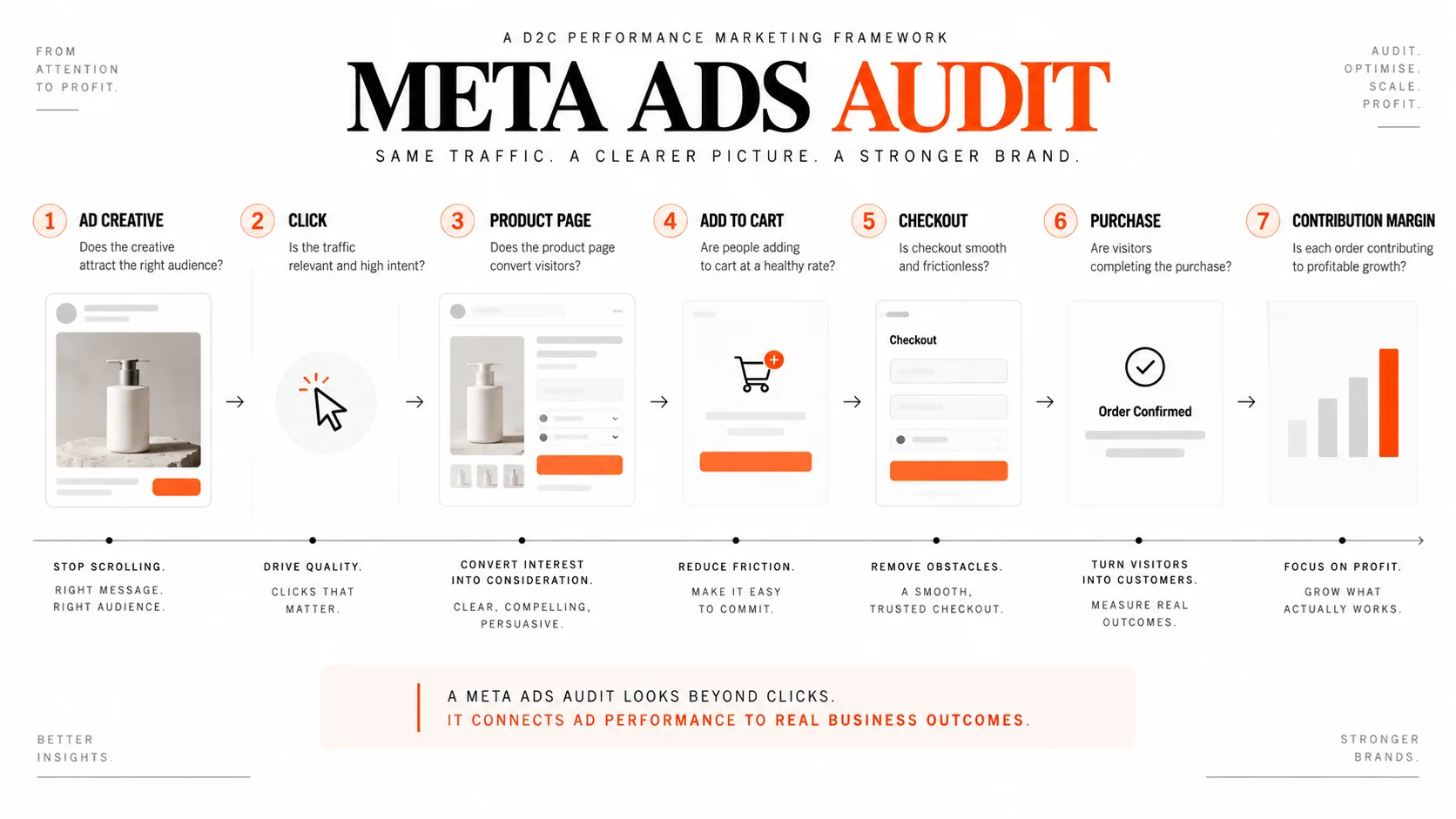
If your D2C brand is spending money on Meta Ads, an audit should answer one simple question: where is the money working, and where is it leaking?
Most audits start with ROAS. That is usually too late. A campaign can have a good ROAS and still have weak margins. A campaign can have a poor ROAS because the landing page is broken. An ad can have a low purchase ROAS while still playing an important role earlier in the customer journey.
A proper Meta Ads audit for D2C brands looks at the entire acquisition system, the same full-funnel approach behind my D2C performance marketing work:
Tracking → Account structure → Campaigns → Creative → Audience → Traffic → Website → Conversion → CAC → Contribution margin
This guide shows you exactly how to do it.
What Is a Meta Ads Audit?
A Meta Ads audit is a structured review of your Meta advertising account to identify:
- Tracking problems
- Wasted ad spend
- Weak campaigns
- Poor creative performance
- Audience problems
- Funnel leaks
- Budget allocation issues
- Scaling problems
- Attribution gaps
- Profitability issues
The important part is the order. Do not optimize the account before checking whether the data is trustworthy.
If your purchase tracking is wrong, your ROAS is wrong. If your website is leaking conversions, changing campaigns may not solve the problem. If your margins cannot support your CAC, increasing spend can simply increase losses. That is why a good ecommerce Meta Ads audit should move from measurement to economics, rather than jumping directly into campaign settings.
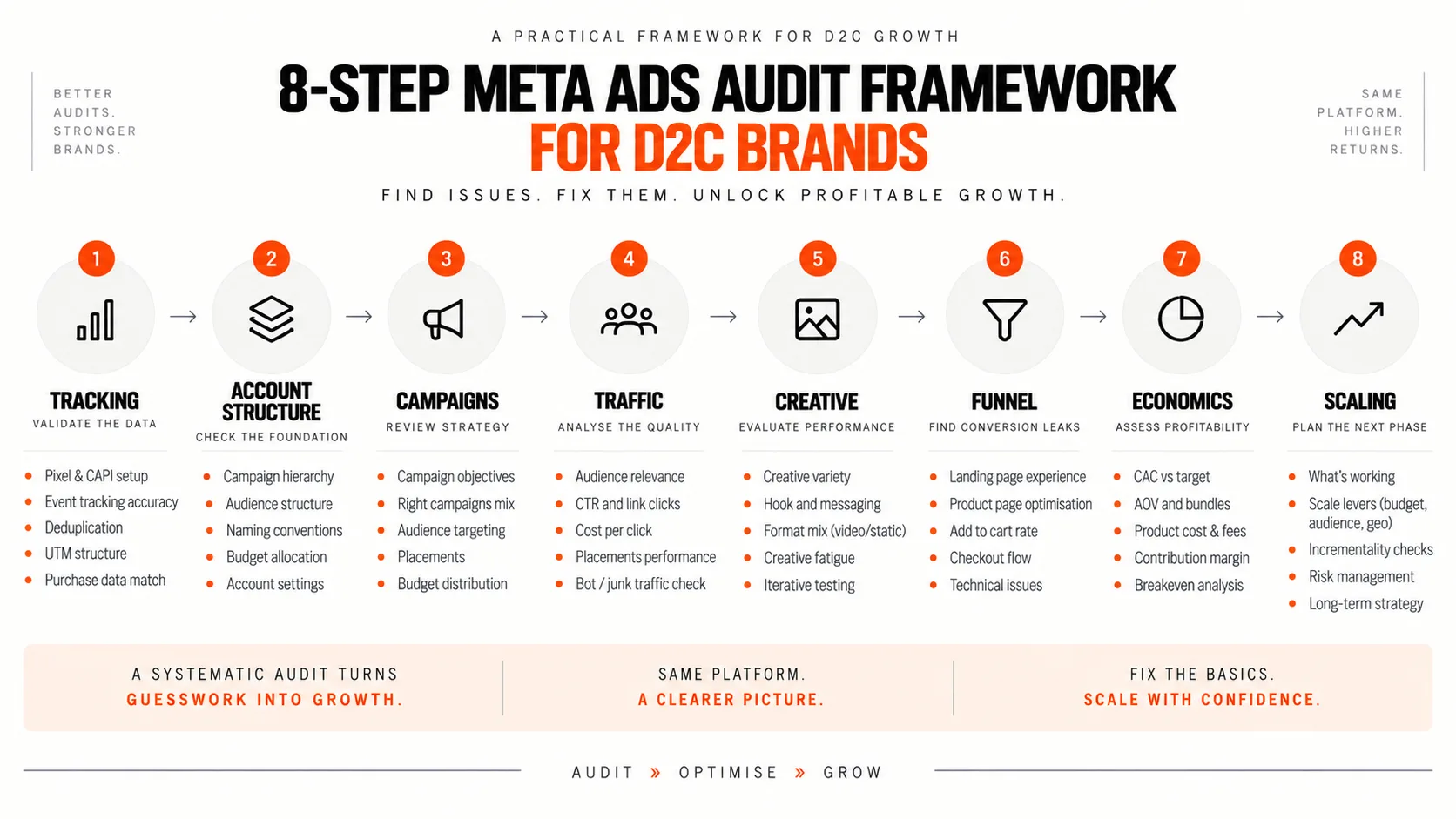
The D2C Meta Ads Audit Framework
I recommend auditing the account across 8 areas:
- Tracking and measurement
- Account structure
- Campaign performance
- Audience and traffic quality
- Creative
- Website and funnel
- Budget and economics
- Scaling readiness
Let's go through each one.
1. Start With Tracking and Measurement
Before looking at performance, make sure the performance data can actually be trusted. This is the most important part of a Meta Ads account audit.
Meta Pixel
Verify that the Pixel is installed correctly and firing the important events. For an ecommerce brand, this normally includes PageView, ViewContent, AddToCart, InitiateCheckout and Purchase. The exact implementation depends on the website and tracking setup.
Purchase tracking
Check whether purchases are being recorded correctly. Compare website orders vs Meta-reported purchases. Do not expect every platform to report exactly the same number because attribution windows, browser restrictions and platform measurement differ. But a large unexplained gap deserves investigation.
Event parameters
Check whether important parameters are being passed correctly. For ecommerce, this can include product ID, product name, value, currency, content type and product information.
Conversions API
If your setup uses Conversions API, check whether server-side events are being received correctly and whether browser and server events are properly deduplicated. Don't assume that simply having CAPI installed means tracking is healthy. Check the actual event flow.
Test the complete purchase journey
Do an actual test: Ad → Landing page → Product page → Add to cart → Checkout → Purchase. Then verify what appears in your analytics and Meta Events Manager.
If tracking is broken, stop the performance analysis here and fix the measurement first.
2. Audit the Account Structure
Next, look at how the account is organized. You want to understand what campaigns exist, what job each campaign is doing, and why the structure exists.
Campaign objective
Does the campaign objective match the actual business goal? For a D2C ecommerce brand, this could mean optimizing toward purchase rather than using an objective simply because it produces a cheaper top-of-funnel metric.
Campaign duplication
Look for unnecessary campaigns competing for similar audiences. More campaigns do not automatically mean more control. Sometimes they simply fragment the available data and make the account harder to understand.
Naming conventions
You should be able to open the account and understand campaign purpose, product or category, audience, creative concept, geography and date or testing cycle without decoding random campaign names.
Too much fragmentation
Is the account structure helping Meta learn, or is it mainly helping the advertiser feel organized?
Those are not always the same thing.
3. Audit Campaign Performance
Now move into the actual numbers. Do not look at ROAS alone. Review at least spend, revenue, purchases, ROAS, CPA/CAC, CPM, CTR, CPC, landing page views, add-to-cart rate, checkout rate, purchase conversion rate, average order value and frequency.
Then compare them across campaign, ad set, ad, placement, geography, age, gender, product, creative concept and time period. The objective is not to find the campaign with the highest ROAS. The objective is to find where performance changes and why.
4. Find Where the Funnel Is Breaking
This is one of the most useful parts of a Meta Ads performance audit. Instead of looking only at Spend → Purchase → ROAS, look at:
Impression → Click → Landing Page View → Product View → Add to Cart → Checkout → Purchase
The Meta Ads traffic quality equation uses the same principle, comparing unique outbound clicks, landing page views and purchases to locate where traffic is breaking.
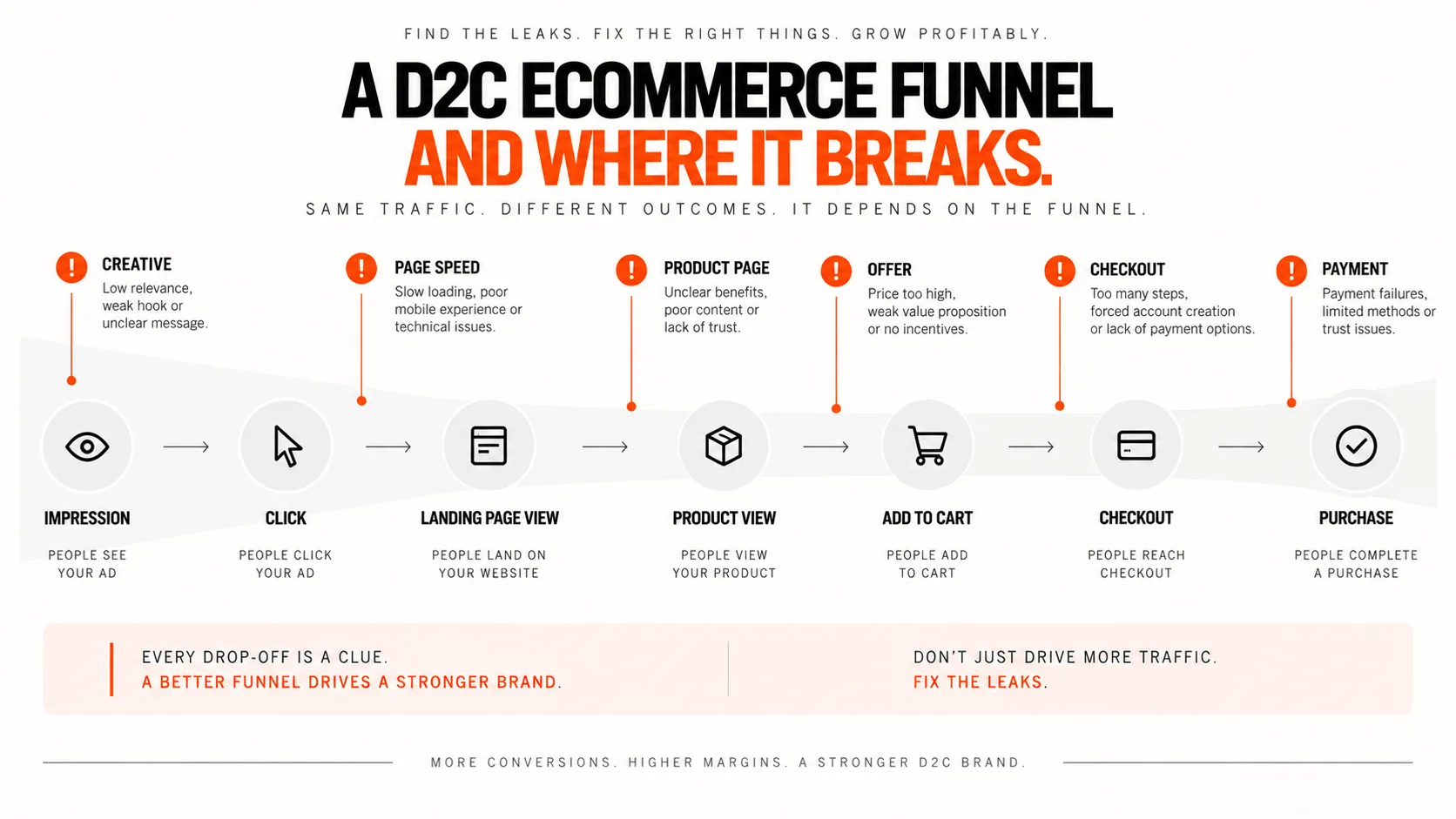
Problem 1: High impressions, low clicks
Investigate creative, hook, offer, message and audience relevance.
Problem 2: Good clicks, poor landing page views
Investigate website speed, page loading, redirects, tracking and mobile experience.
Problem 3: Good landing page views, poor add-to-cart rate
Investigate the product page, pricing, product-market fit, product images, reviews, offer, trust and shipping information.
Problem 4: Good add-to-cart, poor checkout completion
Investigate shipping costs, payment options, checkout friction, unexpected fees, trust and technical problems.
Problem 5: Good checkout activity, poor purchases
Investigate payment failures, COD issues, checkout bugs, payment options, shipping restrictions and tracking.
This is why simply changing the ad is often the wrong response.
5. Audit Your Creative
For D2C brands, creative deserves its own section. Your audit should answer: are we testing different ideas or just making different versions of the same ad?
Hooks
What happens in the first few seconds? Does the creative immediately communicate the problem, the product, the benefit, the curiosity or the offer?
Angles
Are you testing different reasons someone might buy? For example:
- Problem angle: “Your skincare routine is not working because…”
- Product angle: “Three reasons customers switched to…”
- Outcome angle: “What changed after using…”
- Proof angle: “Why thousands of customers…”
- Objection angle: “Is it actually worth ₹1,999?”
These are different concepts. Changing the background, font or CTA while keeping the same idea is usually not meaningful creative diversity. A creative testing framework that compounds focuses on hooks, formats and angles rather than superficial changes.
Creative fatigue
Look for rising frequency, falling CTR, rising CPC, falling conversion rate, increasing CAC and declining revenue per impression. But don't automatically blame fatigue. Performance can also fall because of offer changes, seasonality, competition, landing-page problems, audience changes or tracking problems. The audit should identify the evidence before deciding on the cause.
6. Audit Audience and Traffic Quality
A cheap click is not necessarily a valuable click. Look beyond CPC and investigate what happens after the click. Break performance down by age, gender, geography, placement, device, new vs returning customers, prospecting vs retargeting, product and creative.
The objective isn't to declare an audience bad because it has a higher CPC. For example:
Audience B costs more to acquire traffic but could produce substantially better economics. That's why traffic quality matters more than cheap traffic.
7. Audit Your Website and Funnel
A Meta Ads audit should not stop inside Ads Manager. If you are sending thousands of people to a website, the website is part of the advertising system.
Landing page
- Does it match the ad?
- Is the offer obvious?
- Does it load quickly?
- Is it mobile-friendly?
- Is the CTA clear?
Product page
Check product images, product videos, price, reviews, benefits, specifications, delivery information, returns, FAQs, trust signals and CTA visibility.
Cart
Check unexpected costs, shipping, discounts, product quantity, trust and the checkout CTA.
Checkout
Check the number of steps, payment options, mobile usability, form fields, payment failures, COD process and error messages.
The Ultimate Party Pooper case study is a good example of why this matters. The campaign work included website optimization because fixing the conversion path was part of the growth problem, not something separate from Meta Ads.
8. Audit CAC and Profitability
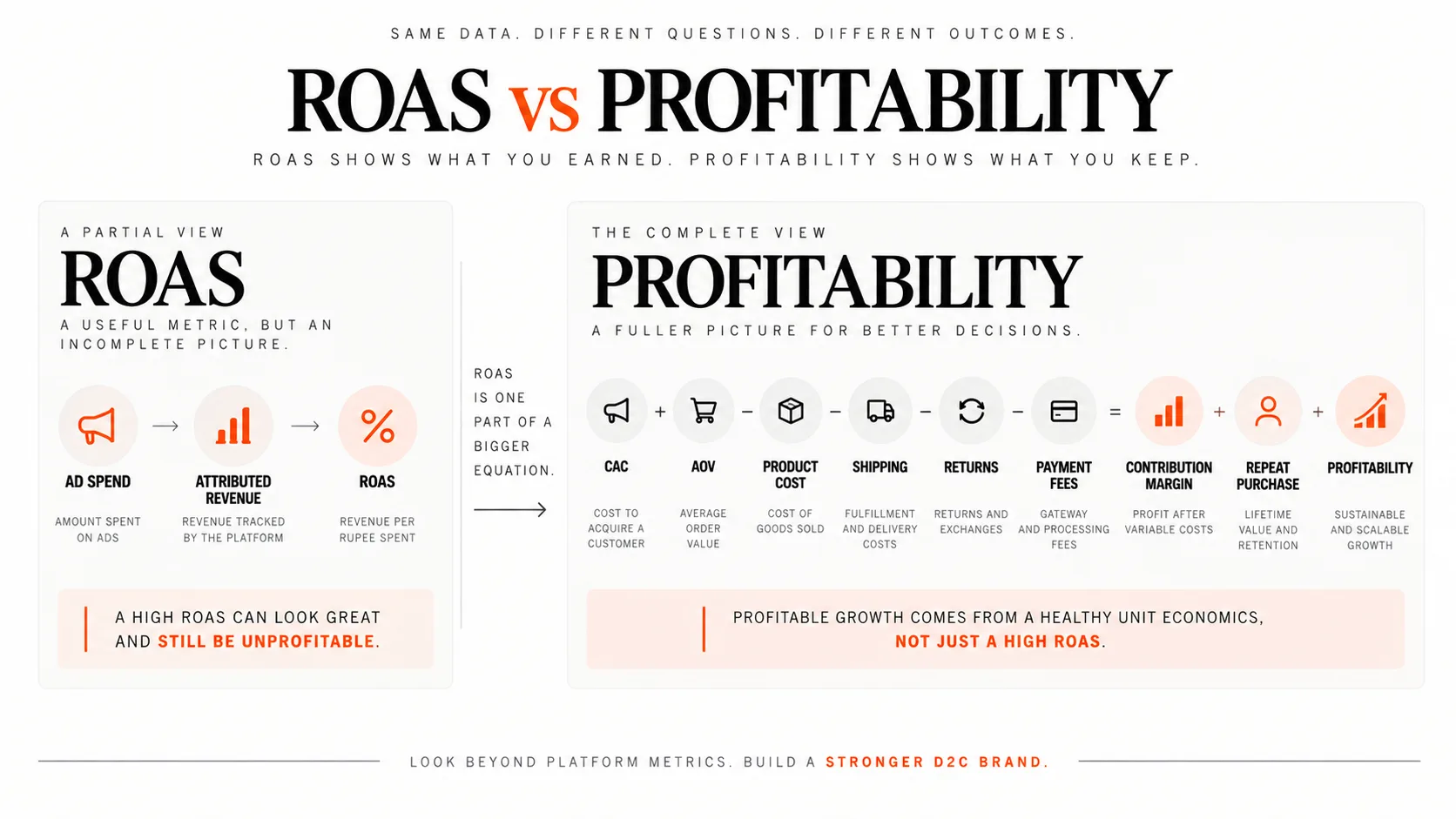
This is where a basic Facebook Ads audit becomes a real D2C performance audit. ROAS tells you revenue generated / advertising spend. But a D2C brand ultimately needs to know whether the economics work.
Look at selling price, product cost, shipping, payment gateway fees, discounts, returns, COD losses, packaging, ad spend, agency or freelancer fees, contribution margin, repeat purchase and customer lifetime value.
For example, imagine AOV = ₹2,000 and your contribution before advertising is ₹800. Your acquisition cost cannot simply be judged against an arbitrary ROAS target. You need to understand how much contribution remains after acquiring the customer. That is the lens behind results like the Bartisans case study: growth judged on economics, not on a platform number alone.
Don't Audit ROAS in Isolation
Suppose you see Campaign A: 4x ROAS and Campaign B: 2x ROAS. It is tempting to immediately move budget from B to A. But ask:
- What is the AOV?
- Are the customers new or returning?
- What are the margins?
- Is Campaign A retargeting?
- Is Campaign B prospecting?
- Is B introducing new customers?
- Is there a difference in product mix?
- What is the actual CAC?
- What happens to blended performance if B is reduced?
A high platform ROAS is not automatically equivalent to profitable growth. As covered in why you shouldn't kill low-ROAS ads too quickly, individual ads should be evaluated in the context of the customer journey rather than judged only by their final attributed ROAS.
9. Audit Budget Allocation
Now ask: where is the money actually going? Create a simple table:
| Area | Spend | Revenue | ROAS | CAC | Observation |
|---|---|---|---|---|---|
| Campaign A | ₹X | ₹X | X | ₹X | |
| Campaign B | ₹X | ₹X | X | ₹X | |
| Campaign C | ₹X | ₹X | X | ₹X |
Overspending
Campaigns consuming significant budget without producing acceptable downstream results.
Underspending
Potentially useful campaigns or creative concepts that haven't received enough spend to draw a meaningful conclusion.
Concentration
If one campaign or creative is responsible for most of the spend, ask what happens if performance deteriorates.
Retargeting dependence
A strong overall ROAS can sometimes hide heavy dependence on existing demand. Look at prospecting and retargeting separately.
10. Audit the Offer
Sometimes the problem isn't the ads. It's the offer. Check price, discount, bundle, free shipping, quantity, gift, guarantee, returns, payment options, urgency and product positioning.
If I showed the same product to the same audience with a materially better offer, would conversion likely change?
If yes, the advertising account may not be the main problem.
11. Audit the Testing System
A healthy D2C account should continuously produce new information. Ask what have you learned in the last 30 days?, not just what performed best. You should be able to identify winning and losing hooks, winning angles, formats and products, audience insights, offer insights, funnel problems and creative fatigue signals.
Test → Measure → Learn → Build next test → Repeat
If every new creative is based on someone's opinion, you don't have a testing system. You have random production.
12. Create an Audit Action Plan
This is the part many audits miss. You don't need a 47-page PDF explaining everything that is wrong. You need to know what should be fixed first. I classify findings into four groups.
P0: Measurement problems
Fix immediately. Purchase event broken, incorrect revenue value, duplicate purchases, missing tracking, major attribution issue.
P1: Major money leaks
Fix next. High-spend low-conversion campaigns, broken checkout, poor landing page, weak offer, severe creative fatigue.
P2: Optimization opportunities
Work through systematically. Creative testing, audience analysis, budget allocation, product-level optimization, retargeting structure.
P3: Nice-to-have improvements
Do later. Naming cleanup, dashboard design, minor structural changes.
This prevents the common mistake of spending three hours fixing campaign names while the checkout is losing customers.
The 30-Minute Meta Ads Audit
If you don't have time for a complete audit, start here.
- Check the last 30 days: spend, revenue, purchases, ROAS, CAC, AOV.
- Compare to the previous period: what changed?
- Find the biggest spenders: which campaigns, ad sets and ads consumed the most money?
- Follow the funnel: Click → Landing Page View → Add to Cart → Checkout → Purchase.
- Check creative: top performers, declining performers, new tests, repeated concepts.
- Check economics: can the business actually afford the current CAC?
- Pick the top three actions. Not ten. Three.
Meta Ads Audit Checklist for D2C Brands
Use this as your final checklist.
- ☐ Meta Pixel working
- ☐ Purchase event working
- ☐ Purchase value correct
- ☐ Currency correct
- ☐ Product parameters correct
- ☐ CAPI reviewed where applicable
- ☐ Browser/server events reviewed
- ☐ Test purchase completed
- ☐ Website orders compared with platform data
- ☐ Campaign objectives make sense
- ☐ Campaign structure is understandable
- ☐ No unnecessary fragmentation
- ☐ No obvious duplicate campaigns
- ☐ Naming is understandable
- ☐ Spend reviewed
- ☐ Revenue reviewed
- ☐ ROAS reviewed
- ☐ CAC reviewed
- ☐ AOV reviewed
- ☐ CPM reviewed
- ☐ CTR reviewed
- ☐ CPC reviewed
- ☐ Conversion rate reviewed
- ☐ Frequency reviewed
- ☐ Placement performance reviewed
- ☐ Geography reviewed
- ☐ Age reviewed
- ☐ Gender reviewed
- ☐ Device reviewed
- ☐ Prospecting vs retargeting reviewed
- ☐ Hooks reviewed
- ☐ Angles reviewed
- ☐ Formats reviewed
- ☐ Offers reviewed
- ☐ Creative fatigue checked
- ☐ Creative diversity checked
- ☐ Testing system reviewed
- ☐ Landing page reviewed
- ☐ Product page reviewed
- ☐ Add-to-cart rate reviewed
- ☐ Checkout reviewed
- ☐ Payment flow tested
- ☐ Mobile experience checked
- ☐ Shipping and returns reviewed
- ☐ Product margin calculated
- ☐ Contribution margin calculated
- ☐ CAC threshold defined
- ☐ Returns considered
- ☐ Shipping considered
- ☐ Payment fees considered
- ☐ Repeat purchase considered
- ☐ Tracking problems prioritized
- ☐ Major spend leaks identified
- ☐ Funnel problems identified
- ☐ Creative tests planned
- ☐ Budget changes justified
- ☐ Next 3 actions documented
What a Good Meta Ads Audit Should Tell You
1. Can I trust the data?
If not, fix tracking first.
2. Where is the funnel breaking?
Identify the exact stage.
3. What is causing the problem?
Separate evidence from assumptions.
4. What should change?
Give specific actions rather than generic recommendations.
5. Can the business afford to scale?
This is the most important question. Scaling a campaign that has bad unit economics doesn't solve the problem. It multiplies it.
Final Takeaway
A Meta Ads audit for a D2C brand should not be a screenshot of Ads Manager with a few comments underneath. It should connect:
Ad → Traffic → Website → Conversion → Customer → Economics
If your tracking is broken, fix measurement. If the traffic is poor, investigate the audience and creative. If people click but don't buy, investigate the funnel. If customers buy but margins are weak, investigate CAC, AOV, contribution margin and retention. And if everything works, you have a much stronger foundation for scaling.
The goal of an audit isn't to find the campaign with the highest ROAS. It's to understand where money is being created, where it is being lost, and what should happen next. For more frameworks, browse all performance marketing insights.
FAQ
How often should you audit Meta Ads?
A detailed audit can be useful monthly, while smaller performance checks should happen more frequently. The depth of the audit should depend on account size, spend and how quickly performance is changing.
How long does a Meta Ads audit take?
A quick diagnostic can take around 30 minutes. A proper ecommerce Meta Ads audit can take considerably longer because it should include tracking, campaigns, creative, website, funnel and business economics.
What should I check first in a Meta Ads audit?
Start with tracking and measurement. If your purchase or revenue data is unreliable, performance decisions based on that data can also be unreliable.
What metrics should I check in a Meta Ads audit?
At minimum, review spend, purchases, revenue, ROAS, CAC, AOV, CPM, CTR, CPC, conversion rate and frequency. Then investigate the funnel from click through purchase.
Is ROAS enough to evaluate Meta Ads?
No. ROAS measures attributed revenue relative to ad spend, but it does not by itself tell you whether the acquisition is profitable after product costs, shipping, discounts, returns and other expenses.
Should I turn off low-ROAS ads?
Not automatically. Look at spend, data volume, customer journey, creative role, funnel performance and the rest of the account before making the decision.
What is the difference between a Meta Ads audit and optimization?
An audit diagnoses the account. Optimization acts on those findings. A useful sequence is: Audit, Diagnose, Prioritize, Test, Measure, Optimize.
- Meta Ads campaign objectives: how to choose the right objective
- The Meta Ads equation that tells you where your traffic quality is breaking
- Creative testing framework that actually compounds
- Meta Ads optimization: don't kill a low-ROAS ad too quickly
- Bartisans case study: 5.53x ROAS
- Ultimate Party Pooper case study: 3.26x ROAS
- All performance marketing insights
Want a second pair of eyes on your Meta Ads account? Tell me what you are spending and where you think it is leaking.
Message me on WhatsApp