How to Hire a Performance Marketer for Your D2C Brand
How to evaluate platform skill, creative thinking, funnel diagnosis, business economics and judgment before handing someone your acquisition budget.
By Hem Meisheri · September 2026
Hiring a performance marketer sounds simple.
Find someone who knows Meta Ads. Look at their ROAS. Check a few case studies. Agree on a monthly fee. Start running campaigns.
That is how many D2C brands approach it. It is also how they end up hiring someone who can operate Ads Manager but cannot diagnose why the business is or is not growing.
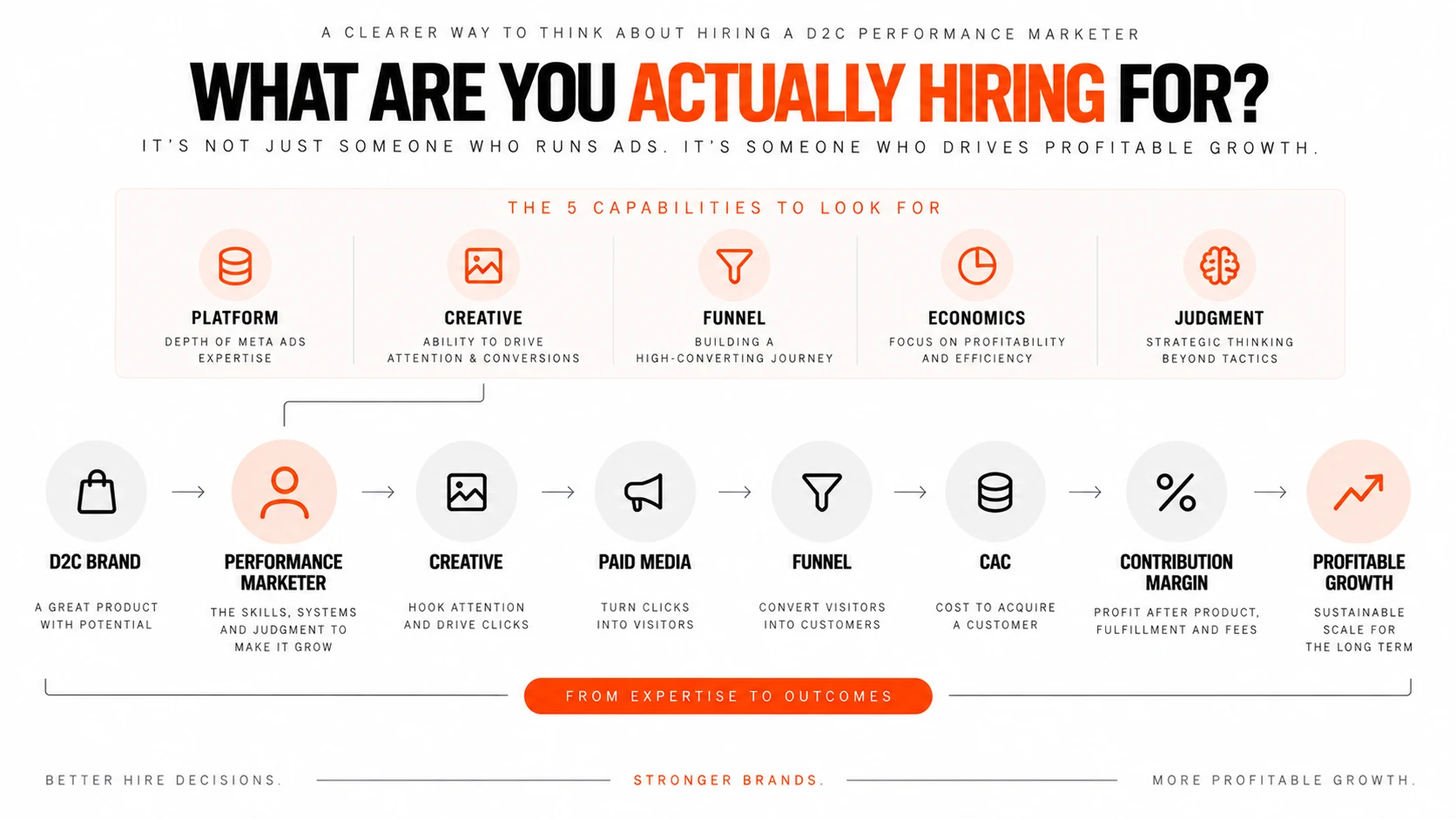
A good D2C performance marketer is not simply someone who can launch campaigns. They need to understand the system around the campaigns:
Creative → Traffic → Product Page → Checkout → Purchase → CAC → Margin → Repeat Purchase
A Meta Ads account can look healthy while the business is losing money. A campaign can report lower ROAS while producing better customers. The real question is not, “Who can run my ads?” It is, “Who can understand my acquisition economics, find where growth is breaking, build the right experiments and make better decisions with my money?”
What Does a D2C Performance Marketer Actually Do?
A performance marketer's job is to improve measurable business outcomes from paid acquisition. For a D2C brand, that can involve Meta Ads, Google Ads, creative strategy, audience and campaign structure, landing pages, product pages, conversion rate optimization, tracking, attribution, CAC, AOV, ROAS, MER, contribution margin, retention and experimentation.
The role is broader than “running Facebook Ads.” A small company may need one person to own most of the paid acquisition system. A larger company may have separate specialists for media buying, creative, CRO, analytics, retention and growth. Define what the person must own before you interview them.
First Decide What You Actually Need
1. Which channels do they own?
Is the person responsible for Meta only, Meta and Google, marketplaces, TikTok, email and WhatsApp, or the entire paid acquisition function? Do not hire a generalist if you need a deep Meta specialist. Do not hire a Meta-only specialist if you expect them to own Google, CRO and retention.
2. What stage is the brand at?
An early-stage brand may need someone who can test positioning, identify winning products, build creative hypotheses, establish tracking and learn customer behaviour. A larger brand may need budget management, CAC control, forecasting, multiple markets, creative-team coordination, incrementality and close work with finance.
3. What problem are you solving?
“We need more sales” is too broad. The actual constraint might be rising CAC, stale creative, weak traffic, a poor product-page conversion rate, low AOV, unreliable tracking, weak repeat purchase or uncertainty about which products deserve scale. Hire for the constraint, not the job title.
Do Not Hire Based on ROAS Screenshots
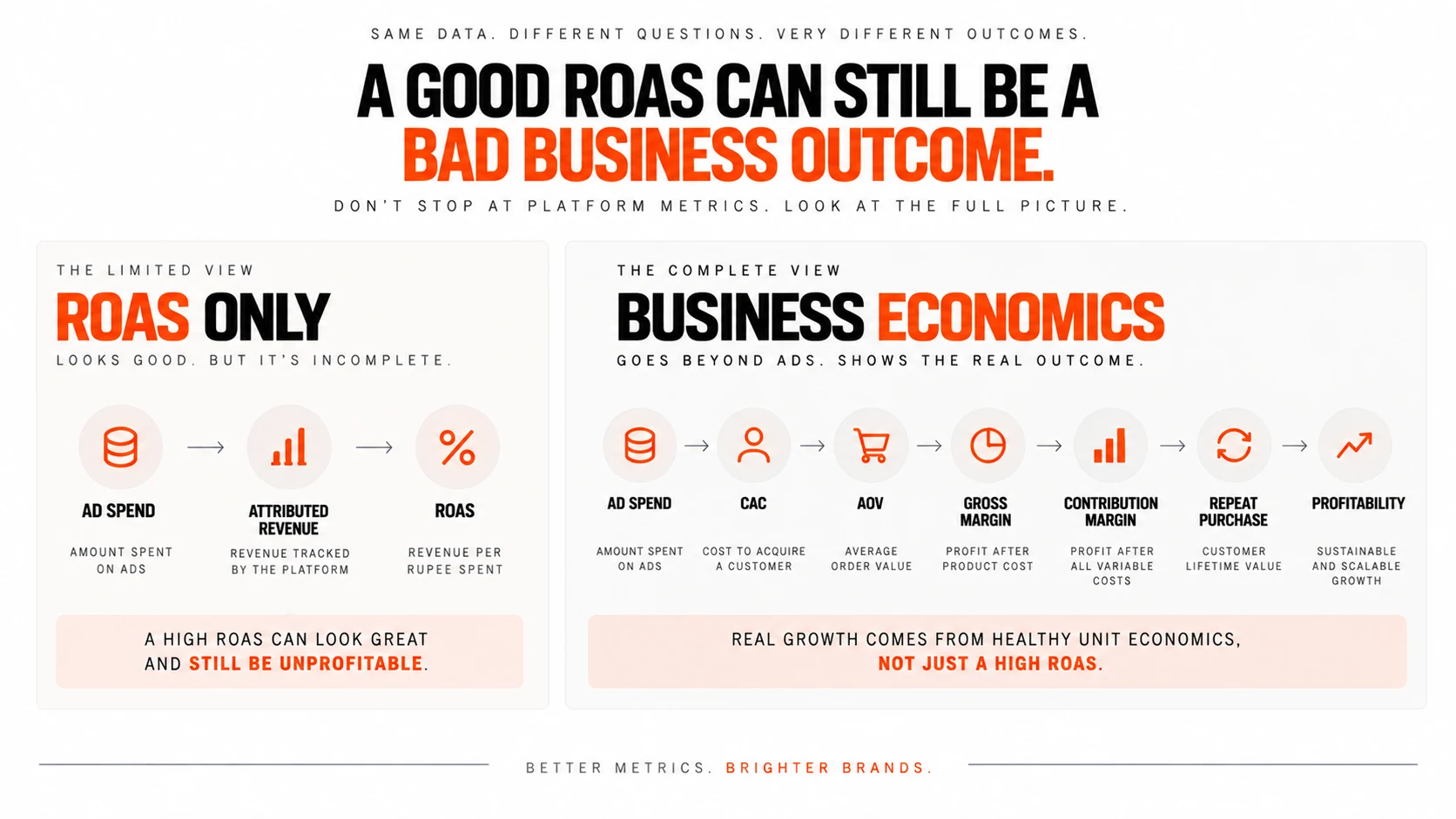
A screenshot showing 12.4x ROAS looks impressive, but it does not reveal gross margin, discounting, returns, shipping costs, payment fees, existing-customer revenue, attribution settings, duration, spend level or product economics.
A small campaign producing a large attributed return is not automatically better than a scaled campaign at a lower return. Neither tells you whether the underlying business is profitable. Ask a better question: “What happened to the business economics while you managed the account?” That is much harder to fake.
What Should You Look For in a D2C Performance Marketer?
I would evaluate candidates across seven areas.
1. Platform expertise
They should understand campaign structure, budgets, placements, creative delivery, attribution, retargeting, catalogue campaigns, tracking, Conversions API and account diagnostics. But platform knowledge is only the first layer. Someone can be excellent at Ads Manager and still be a mediocre performance marketer.
2. Creative understanding
They should understand hooks, angles, offers, formats, UGC, founder-led content, demonstrations, testimonials, objections, creative fatigue and concept testing. More importantly, they should explain why a creative deserves a test. “Our current ads focus on features, so we will test a problem-led angle” is a hypothesis. “Let us make another video” is not.
3. Funnel understanding
A performance marketer should not stop thinking when someone clicks. If CTR is good but purchases are weak, the problem might be landing-page clarity, positioning, price, offer, trust, checkout, payment options, shipping or product-market fit. Ask: “If CTR is good but conversion rate falls, what do you investigate first?”
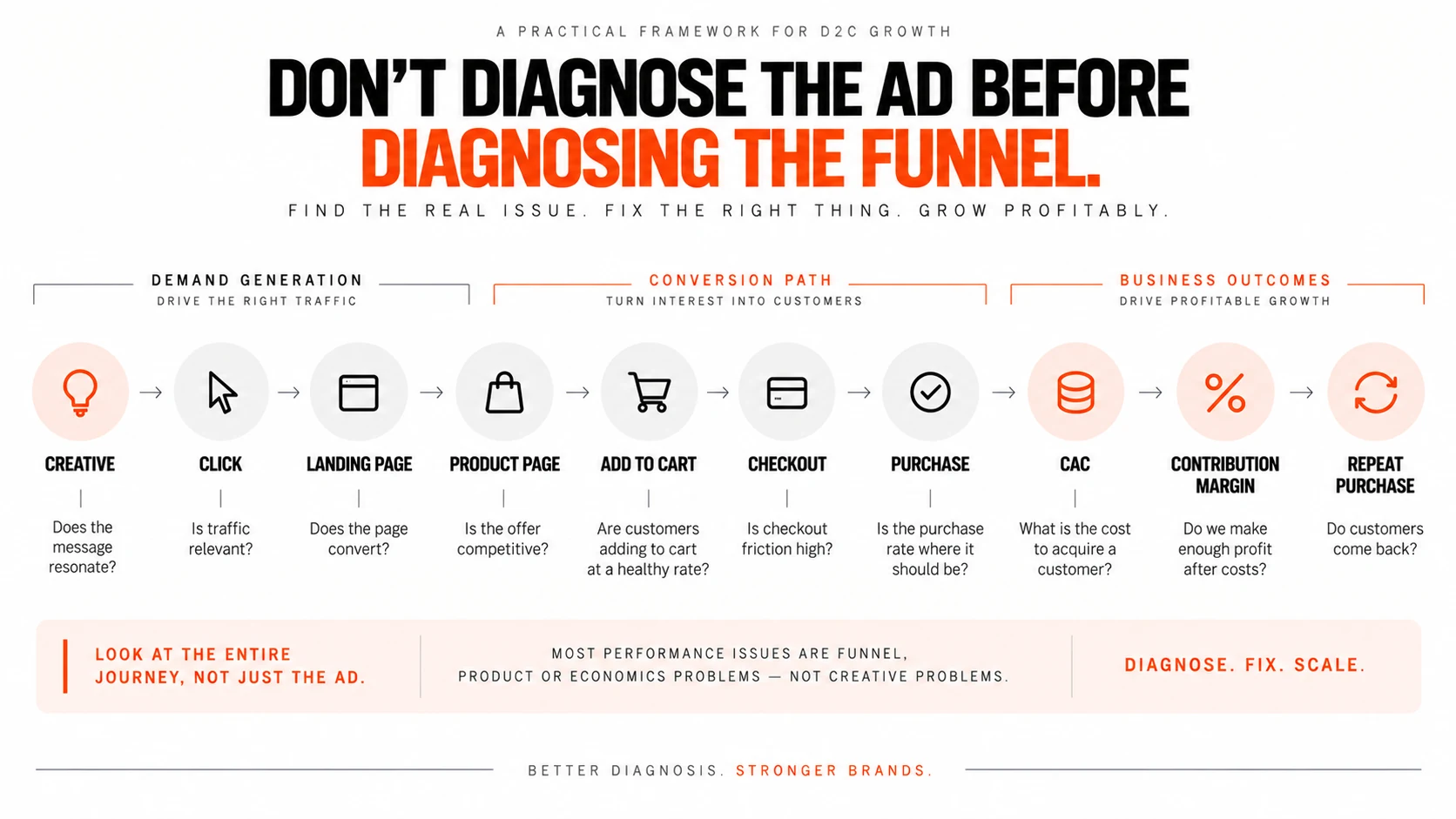
The Meta Ads traffic quality framework is a useful way to identify whether the leak sits between the click, landing-page view and purchase.
4. Business economics
A real performance marketer understands CAC, AOV, gross margin, contribution margin, LTV and MER. They do not need to be your CFO, but they need enough commercial understanding to avoid optimizing a metric that looks good inside Ads Manager while hurting the business.
5. Tracking and attribution
They should understand Meta Pixel, Conversions API, GA4, UTMs, Shopify analytics, attribution windows, server-side events, purchase-event quality and discrepancies between platforms. If Meta reports ₹10 lakh and Shopify reports ₹7 lakh, they should investigate instead of choosing the more flattering number.
6. Experimentation
Ask what they would test first. A strong candidate can build hypotheses across creative, offer, audience, landing page, product, pricing, funnel and budget allocation, then explain what is being tested, why it matters and what result would change the decision.
7. Judgment
The strongest candidate may tell you not to raise the budget, that Meta is not the problem, that the brand needs better creative first, or that the margins cannot support the current CAC. You need someone who can make good decisions with incomplete information, not someone who agrees with every growth idea.
The 10 Questions I Would Ask Before Hiring
- How would you audit my account before changing anything? Look for a structured answer, not “I will check the campaigns.”
- What information do you need before starting? They should ask about margins, AOV, products, customers, history, tracking, creative, website, fulfilment and returns.
- How do you decide what creative to test? Listen for hypotheses and customer psychology, not merely a quantity of videos.
- What metrics do you look at first? There is no universal answer, but the reasoning should connect the funnel to business economics.
- What would make you reduce ad spend? A marketer who only talks about scaling is missing half the job.
- What would make you increase ad spend? Look for conditions, not arbitrary rules.
- How do you know whether an ad is a winner? They should distinguish early signals, confidence, business significance, attribution and sustainable performance.
- What happens when ROAS falls? “Change the campaign” should not be the first answer. Diagnosis comes first.
- Tell me about a campaign that failed. Ask what they believed, what happened, what changed and what they learned.
- When would you tell me not to scale? This tests judgment directly.
Ask for Case Studies, but Ask Better Questions
Do not stop at “Can you show me your results?” Ask about the starting point, budget, timeframe and exactly what the person controlled. Did they manage media only, or did they also influence creative, landing pages, offer and CRO? Ask what failed and what happened after they left.
A seasonal sale, new product, price change, organic growth, influencer activity or viral video can produce growth that an ad account later claims. Context separates a useful case study from a flattering screenshot. The Bartisans D2C case study is one relevant example of reporting the spend, reach and outcome together rather than presenting a number without its operating context.
Do Not Ignore Creative Ownership
One common mistake is hiring a media buyer and expecting them to solve a creative problem. If the account needs better creative, someone must own that responsibility: the performance marketer, a creative strategist, an in-house team, an agency or the founder.
A good performance marketer should at least answer: “What creative should we make next, and why?” The goal is not more ads for the sake of volume. It is meaningful hypotheses. A structured creative testing framework helps you evaluate whether the candidate can turn learning into a repeatable system.
What About Certifications?
Meta and Google certifications can demonstrate familiarity with the platforms. They do not prove that someone can profitably grow your D2C brand. Relevant experience, reasoning, contextual case studies and analytical ability matter more than certifications alone.
Freelancer vs Agency vs In-House vs Consultant
| Model | Advantages | Risks |
|---|---|---|
| Freelancer | Direct access, lower overhead, specialist expertise and fast communication | Limited capacity, one-person dependency and fewer creative or CRO resources |
| Agency | Broader team, multiple specialists, creative resources, reporting and redundancy | More overhead, junior account handling, less senior access and standardized processes |
| In-house | Deep brand knowledge, full-time attention and easier collaboration | Higher fixed cost, recruitment risk, management burden and specialist gaps |
| Consultant | Strategic expertise, audits and internal system building | Execution remains with your team and requires internal capability |
There is no universally correct model. The choice depends on what capabilities your company already has and what the new hire must own.
How Much Does a Performance Marketer Cost?
There is no single correct price. Fees depend on monthly ad spend, channel count, markets, creative and CRO responsibility, reporting, tracking implementation, strategic involvement and business complexity.
You may encounter fixed monthly retainers, percentages of ad spend, project fees, consulting fees, performance-linked models and hybrids. Do not choose only by the cheapest quote, and do not assume the most expensive person is best. Ask what business problem they can solve for the fee and how their incentives behave when the correct decision is to spend less.
How to Structure the First 30 Days
- Week 1, audit: review tracking, account structure, creative, products, funnel, analytics and economics.
- Week 2, strategy: build creative hypotheses, a campaign plan, measurement definitions and a testing roadmap.
- Week 3, launch: run the highest-priority tests with enough time and budget to become readable.
- Week 4, learn: document what happened, what changed, what worked, what failed and what should be tested next.
The exact timeline depends on spend and conversion volume. A low-volume account needs longer to generate useful evidence. The first month should establish baselines and learning, not force an immediate promise to scale.
Red Flags When Hiring a Performance Marketer
- Guarantees a specific ROAS without understanding your product, site and margins
- Only talks about ROAS or CTR
- Cannot explain a testing process
- Wants to scale immediately without diagnosis
- Blames every decline on Meta
- Cannot explain tracking and attribution
- Has only screenshots with no context
- Shows case studies from an unrelated business model
- Says every account needs the same strategy
The D2C Performance Marketer Test
Score each candidate from 1 to 5 across five areas. Platform measures whether they can operate and diagnose Meta or Google. Creative tests whether they form meaningful hypotheses. Funnel tests whether they can diagnose what happens after the click. Economics tests their understanding of CAC, AOV, margin and profitability. Judgment tests whether they can make good decisions when the answer is not obvious.
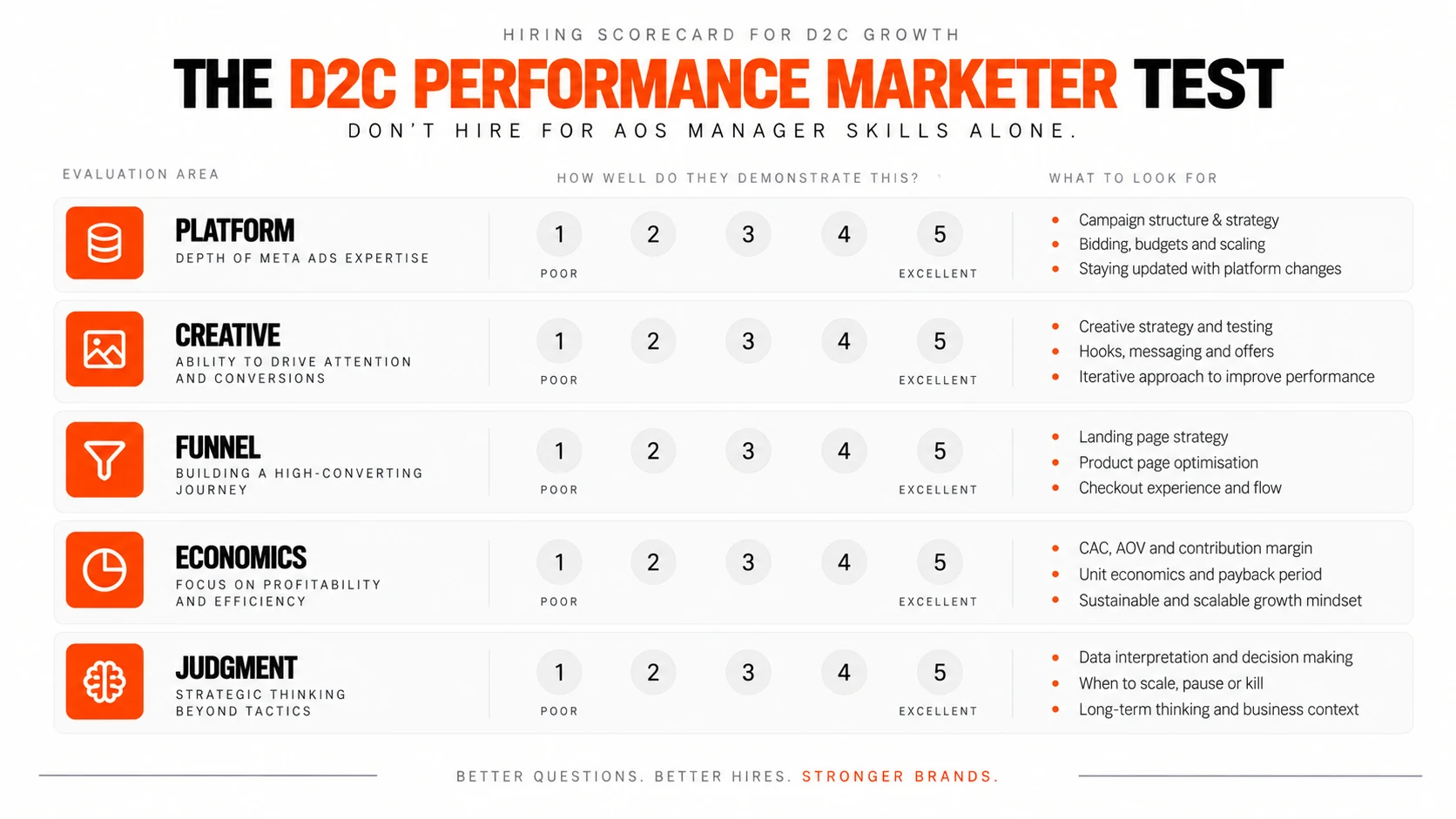
This scorecard is more useful than asking how many years of experience someone has. Experience matters, but five years can still mean repeating the same mistake. A candidate with less tenure and stronger analytical judgment may be more valuable.
When You Should Not Hire a Performance Marketer
Sometimes the answer is not “find a better marketer.” Do not rush into paid acquisition when product demand is unproven, the offer is unclear, margins cannot support acquisition, the website does not convert, fulfilment or inventory is unreliable, tracking is broken, the customer is undefined, creative supply is absent or there is no meaningful testing budget.
A performance marketer can help acquire customers. They cannot manufacture product-market fit or solve every business problem through Ads Manager.
What Should a Good Performance Marketer Ask You?
A serious candidate should want to know your AOV, gross and contribution margins, profitable products, repeat-purchase rate, current and historical CAC, winning and losing creatives, website and checkout conversion rates, returns, shipping costs, markets, inventory risks and tracking setup.
If someone wants to spend your money without understanding those inputs, be cautious.
The Difference Between a Media Buyer and a Performance Marketer
A media buyer may be excellent at campaign setup, budget allocation, audience management and platform optimization. A performance marketer connects those activities to the business: creative, traffic, conversion, customer, CAC, margin, retention and profitability.
One person does not need to execute every part. They do need to understand how the parts interact. That is the standard I would use when hiring for a D2C brand.
The Final Hiring Checklist
- Have they worked with a relevant business model, stage and price point?
- Can they explain past results, context and what they controlled?
- Do they understand CAC, AOV, margins, creative and tracking?
- Can they diagnose the whole funnel and explain their testing process?
- Can they describe what failed and when they would not scale?
- Can they communicate clearly, challenge assumptions and see beyond platform metrics?
The Right Person Is Not the One Who Promises the Biggest Number
You are not merely hiring someone to run Meta Ads. You are hiring someone to make decisions with your acquisition budget. They need to understand the customer, creative, funnel, economics, data and the limitations of that data. Most importantly, they need to know what not to change.
Sometimes the right decision is to increase spend. Sometimes it is to change creative, fix the landing page, revise the offer or improve tracking. Sometimes it is: do not spend more money yet.
The person worth hiring can look at the whole acquisition system and explain what is happening, why it is happening, what to test next, what result would change their mind and whether the growth is actually profitable.
For that full-funnel approach, explore my D2C performance marketing work, or browse the Insights hub for more practical frameworks.
Frequently Asked Questions
How do I hire a performance marketer for my D2C brand?
Start by defining the problem, channels, acquisition economics and level of ownership. Then evaluate candidates on platform expertise, creative strategy, funnel analysis, tracking, economics and judgment rather than ROAS screenshots alone.
What should I look for in a D2C performance marketer?
Look for someone who understands both advertising platforms and the business behind them. They should be comfortable with creative testing, CAC, AOV, conversion rate, tracking, attribution, funnel analysis and profitability.
Should I hire a Meta Ads freelancer or agency?
It depends on your internal capabilities. A freelancer may provide more direct specialist access, while an agency may provide a broader team and additional capabilities. Neither model is inherently better.
How much does a performance marketer cost?
There is no universal rate. Pricing depends on experience, ad spend, channels, scope, creative responsibility, CRO, tracking and strategic involvement. Management fees are also separate from the advertising budget in many engagements.
Is ROAS enough to evaluate a performance marketer?
No. ROAS measures attributed revenue relative to advertising spend, but it does not by itself account for gross margin, returns, shipping, discounts, repeat purchases or other business economics.
How long should you give a performance marketer before evaluating them?
There is no universal number of days. Evaluation depends on spend, conversion volume, account condition and the testing required. The first phase should establish baselines and test clear hypotheses rather than promise a predetermined result.
What questions should I ask a performance marketer?
Ask how they audit an account, what they need before launching, how they develop creative tests, how they diagnose declining performance, how they think about CAC and margins, how they handle tracking and when they would recommend reducing rather than increasing spend.
Looking for someone who can manage the full D2C acquisition system, not just Ads Manager? Tell me what your brand needs to solve.
Message me on WhatsApp